Signs Of A Respiratory Infection In A Bearded Dragon?
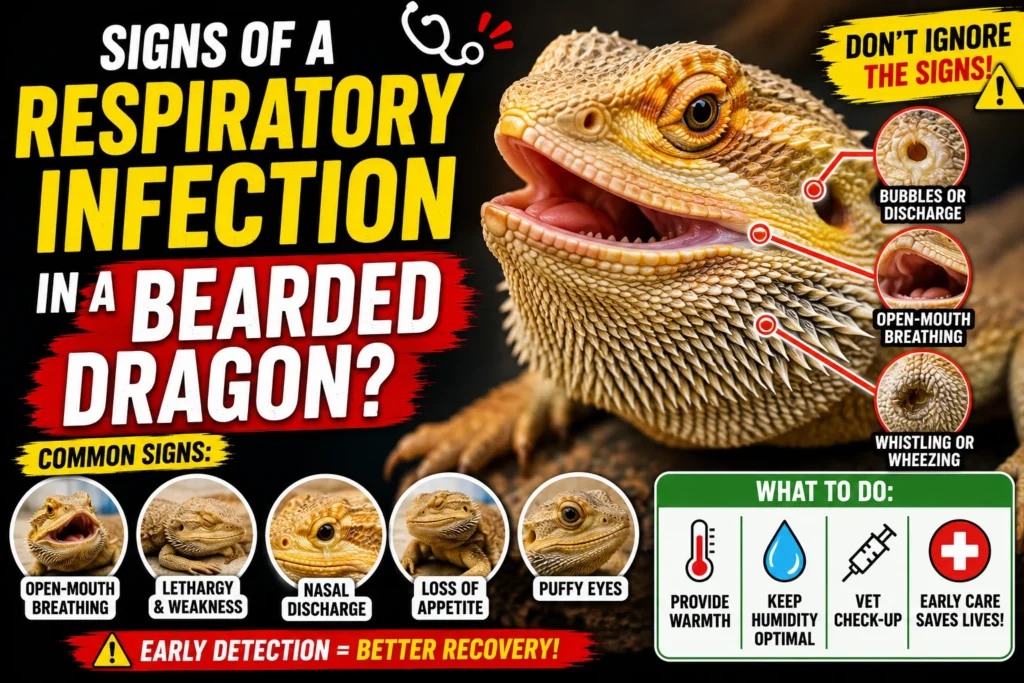
Signs Of A Respiratory Infection In A Bearded Dragon? It’s every bearded dragon owner’s worst nightmare watching their scaly best friend in any form of distress. Respiratory infections are a frequently seen (and potentially very dangerous) problem amongst the scaled friends in our lives, and spotting the signs quickly could mean everything for their well-being.
Signs Of A Respiratory Infection In A Bearded Dragon?
Understanding Respiratory Infections in Bearded Dragons
Respiratory infections (aka ‘pneumonia’ and/or upper respiratory tract disease (URTD) of bearded dragons are caused by bacteria, viruses or fungi that proliferate when an animal’s immune system is suppressed . The culprits are most frequently the recently discovered Mycoplasma pogonae (which has wreaked havoc on dragon colonies) and adenoviruses which have caused serious pneumonia cases . Most of the time poor husbandry is the instigator (e.g., wrong temp gradients, high humidity, inadequate airflow, not enough UVB).
Key Warning Signs to Watch For
1. Respiratory Distress Signs
Open-mouth breathing or gaping: In most instances a gaping mouth can be a means to lose heat, but persistent open-mouth breathing and gasping is a dangerous sign. It can mean that your dragon is struggling to obtain adequate air and you will need to rush your pet to the vet for prompt attention.
Wheezing and crackling in their breathing: The presence of wheezing or crackling in the dragon’s chest when breathing or open-mouth breathing while not under their basking light should indicate the dragon is not receiving enough air and should be checked. When a dragon exhibits this symptoms, it can also look like your pet has a “sore” that they’re trying to cough or sneeze up; be sure you ask your vet to treat your dragon’s issue so that they may resume proper breathing again.
Increased effort during breathing: Watch your dragon’s abdomen or chest to see if it is moving or expanding much more rapidly or aggressively than usual as they inhale or exhale. This often accompanied by open-mouth breathing and may cause the dragon to appear to be reaching up for air. Some cases the patient appears to be staring up at the light to gain better access to air – this has sometimes been referred to as “star-gazing” because the patient does look like they’re “star-gazing” or “ stargazing” for access to their air supply.
Coughing or Sneezing: A dragon can’tvomit, so sneezing or coughing in many cases indicates that it’s dealing with something that’s iritating its airways or that there may be a respiratory infection that the pet’s body is trying to expel or treat; owners often report a wheezing type sound or their dragon appears to be trying to clear it’s throat or airways during these coughing or sneezing fits.
5 Signs Your Dragon Needs A vet immediately What Are They?
Open mouth breathing or gaping: Although sometimes a bearded dragon gaping their mouth can mean they’re attempting to cool their body down when they’re under the heat lamp, if they are gaping when they aren’t under the heat light and/or seem to be having difficulty breathing it can be a warning sign that your pet isn’t getting enough oxygen and you should immediately visit a veterinarian.
Increased effort of respiration: Watch for their chest or abdomen area to move quite rapidly as they breathe in and out.
When the difficulty getting enough: air becomes great enough, some bearded dragons may extend their neck out, what’s known as”star-gazing”.
I’m told that there was a recent case report of a “wheezing” effect that occur when one patient was exhaling, but they had been experiencing increased breathing effort as well. One very observant reptile hobbyist reported hearing “popping” in the lungs when they breathed with an increased rate of respiration; these ”popping” sounds may have resulted from the build-up of fluid or even an actual air sac in the lungs that had burst and/or was leaking fluid.
2. Visible Discharge
Nasal Discharge: A bubble, mucus or clear fluid that is coming out of either or both nostrils and you dragon is not drinking will indicate you are looking at an upper respiratory infection. The discharge may be cloudy or have blood tinged within the mucus.
Oral Discharge: Excessive drooling or thick saliva and mucus coming out of the mouth that can even be ejected with coughs would be indicative of a more serious stage of infection.
Blocked Nostrils: The nose will be covered by a piece of shedding so that will also include inhibited breathing, but in combination with other symptoms it could represent an over production of mucus because of infection.
Behavioral changes: Weak and lethargic infected dragons are usually sluggish and lethargic. Dragons often sleep much longer and seem unresponsive to the activity of their environment. At worse, the disease may prevent the animal from moving from their heat source. Loss of appetite anorexia always comes hand-in-hand with respiratory infection. Your dragon is less likely to want their favorite bugs or greens, resulting in significant loss of body mass.
Signs of Dehydration: In addition to all of the above symptoms, your dragon’s skin may not spring back when given a gentle pinch and their eyes will appear sunken. Dehydrated dragons are more at risk for and recover more slowly from respiratory illnesses. Black Bearding Black or dark coloring on the beard that is not a result of a mating display, or threat can also indicate a dragon that is in pain, uncomfortable, and potentially very ill.
4. Physical Examination Findings
Observable Abnormalities: Swollen or puffy throat to imply swelling/fluid buildup. Pale or bluish mucous membranes, to show poor oxygen levels. Very lean with visible bones. Sometimes kyphosis (bent back) if breathing has been difficult.
Changes to Posture: A dragon might have to hold certain postures to assist with breathing. They can do this by: holding the head up in an outstretched neck position sloping the body downwards reluctant to lie flat on its back or belly.
Also Check: What To Do If Your Dog Eats a Chicken Bone From The Trash?
The Most Common Causes
Mycoplasma pogonae Infection
According to studies done recently the Mycoplasma pogonae seems to be the cause of these mass deaths, of bearded dragons in the collection . In an outbreak involving 33 juvenile dragons, all the animals contracted pneumonia caused by Mycoplasma pogonae, with all sorts of pneumonia represented- histiocytic pneumonia, lymphocytic pneumonia and heterophilic pneumonia all seen to be the result.
Viral Infections
HeAdV2 was associated with interstitial pneumonia in one case and he had more specific respiratory tropism than AgAdV1 (Which more often results in liver and intestinal disease). It’s worth mentioning that some AgAdV was isolated from normal and dyspnic dragons, and is likely only a secondary factor in disease process for most animals.
Environmental Factors
Temperature being too cool: The reptile’s immune system is weakened when their temperatures are lower than recommended ranges. For juvenile’s optimal temperature range on basking area is 100 to 110 degrees F, with cool side approximately 80 degrees F. In adult bearded dragons the recommended basking range is 95 to 100 degrees F, with the cool side again at 80 degrees F.
Forcing too much humidity in the enclosure: Some humidity is required for bearded dragons to shed correctly, however if levels exceed 40-50% it provides the perfect conditions for the spread of bacteria and fungi.
Bad Air Ventilation Poor circulation of air in the enclosure allows bacteria and airborne irritants to concentrate in one area of the enclosure making your bearded dragon more susceptible to infections.
Immediate Steps If You Suspect Infection
1. Check and Adjust Husbandry
Check the temperature gradient of your enclosure NOW. Lower temperatures is by far the leading, treatable cause of all reptile respiratory infection. Do not use analog (old style, round dial) thermometers and a digital thermometer with a probe is preferred to a temperature gun, if you are only going to be doing the check 2 to 3 times per week. Some experts suggest to ramp temps up 5-10 degrees as an immune boosting measure to help animals get through illness.
2. Create a Sloped Basking Area
Create aramp or sloped surface so that the head of the dragon is lower than the rest of the body. In many cases, gravity can facilitate drainage from the respiratory tract and ease breathing.
3. Provide Warm Soaks
Provide shallow warm (85-90 F) baths as this helps to ensure hydration but these should not be unsupervised. For a more aggressive approach, a gentle mist with water can sometimes be enough to break up mucus in the nose, but use this only in moderation as to not distress the already ill dragon.
4. Seek Veterinary Care Immediately
Never try to manage a respiratory infection with a few over-the-counter remedies or the half-empty prescription bottle of last year’s illness. Be it viral, bacterial or fungal, all respiratory infections require a very specific treatment . A 2009 report from Ohio State found that even with empiric antibiotic therapy, a dragon with mixed adenovirus and Mycoplasma co-infection died .
- A certified reptilian veterinarian should:
- Perform a Physical Exam
- Perform Diagnostic Imaging (X-rays)
- Run Blood Tests
- Send Cultures to the Lab to Identify the Pathogen
Prevention Is Better Than Cure
Maintain Optimal Husbandry
Basking spot: 100-110F for juveniles and 95-100F for adults
Cool side: Around 80F
Night temperature: This should be 65 F or warmer. A ceramic heat emitter is a great option.
Humidity: 30% or 40% or a blend of both depending on your climate.
UVB light: Make sure you change bulb every 6 to 12 months.
Air circulation: Make sure your terrarium allows for fresh air circulation with no drafts.
Quarantine New Arrivals
Always put new beardies into quarantine for 30-90 days before you put them with other lizards, as you add them to your community. They have respiratory diseases, and these spread VERY quickly amongst lizards in an enclosure.
Reduce Stress
Handling a dragon reduces their resistance and may predispose them to infection. Ensure they have sufficient hiding areas, avoid handling when sick, and avoid housing in overly large populations.
Regular Health Monitoring
You can track your dragon’s behavior, respiration and diet each day, keeping a journal for yourself to best notice anything out of the ordinary and help the doctor.
Frequently Asked Questions
Could a bearded dragon survive a respiratory infection by itself?
Some of the most mild respiratory infections could potentially resolve with adequate husband ary, but others would have the possibility of escalating into more severe cases such as pneumonia and or death; in this case, I’d consult the reptile veterinarian on the proper course of treatment and that is often a prescription medication.
How is a reptile respiratory infection different from one for a different animal?
Unlike other reptile animals, reptiles do not have a diaphragm and are prone to respiratory infections since they lack any cilia in their lungs, so they don’t help flush mucus out. Therefore, many reptiles’ bodies have difficulties clearing them and a few don’t at all.
How does a reptile with pneumonia sound?
With respiratory issues, the reptilian would usually have a whistling sound coming out when it breathes, but also you could hear bubbling and clicking in the back of its throat, kind of like humans that are having difficulty breathing and have a head congestion.
Do bearded dragons get respiratory infections from being stressed?
Yes, when you stress your bearded dragons it has the opportunity to compromise the Immune system and lower it’s defenses, that is when reptiles get infections like respiratory, and this may happen when the bearded dragon is given poor heating and lighting, bad food source, over handling, lack of shelter and or hide for comfort.
How fast does a reptile respiratory infection get deadly?
It really depends on how quickly and well the doctor diagnoses it and the overall well being of the dragon. However in one report it mentioned an outbreak of Mycoplasma pogonae that killed reptiles, even as fast as within a 2-3 hour window; don’t waste time.
Is it safe to use human antibiotic for reptiles and or bearded dragons?
Never! The dosage is entirely different as well as the medications, the dragon could end up dying from too much of an antibiotic, too little of an antibiotic, or the completely wrong antibiotic. We do not suggest this as it will harm your animal or even get him killed like this example: “Dragon was given too much of this drug by previous veterinarian and as well it did not even have that respiratory infection. “
What is the difference between Mycoplasma pogonae and other species and what are the symptoms and what causes this reptile respiratory disease?
It’s one of the latest known species in this family, Mycoplasma pogonae is also know as a bacteria that causes pneumonia, not a primary disease like most of the time, the research shows that the M. Pogonae will cause a severe and often lethal infection.
How can I tell if a reptilian is shed or has a respiratory infection?
Some signs of a respiratory infection is to have constant clicking or popping sound from their throat and lungs; sometimes even coughing. The reptiles could also experience extreme loss of appetite, weakness and sometimes a bubbly nose if the mucus get stuck.
Is it contagious to other reptiles?
Yes. These infections are highly contagious from reptile to reptile. If one of your reptiles get any kind of illness it’s better to quarantine them. That can stop the possible of getting others infected from them, especially respiratory infections.
What will the veterinarian do if the reptilian have a respiratory infection?
When the veterinarian performs an evaluation, they will look into symptoms and ask questions on where they live, what the temperature ranges are and diet, and so forth, based on signs the veteranarian would determine if it may be pneumonia and perform diagnostics such as an X-ray to check the lungs or blood work.