What To Do If Your Dog Eats a Chicken Bone From The Trash?
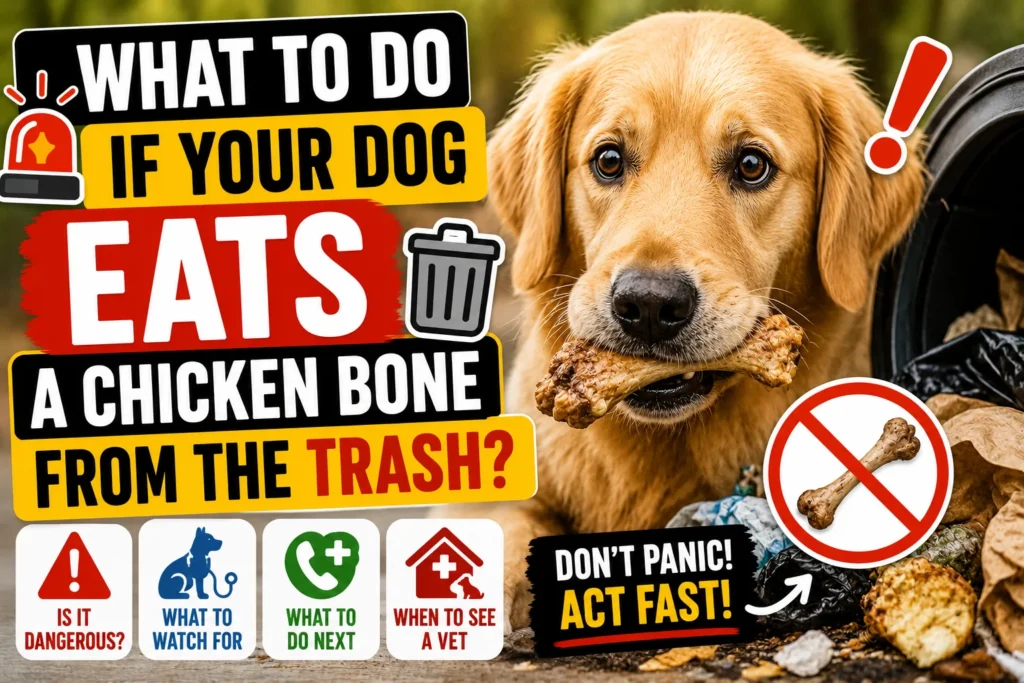
What To Do If Your Dog Eats a Chicken Bone From The Trash? Your back is turned for a split second, reaching to refill a water glass with an automatic dog sitter who somehow just became a miniature vacuum, and the next thing you know, your dog is making great progress on consuming a leftover chicken bone that has “accidentally” ended up in the garbage. Your stomach lurches. Your eyes begin to dart back and forth in a panic.
You are going to get so mad, even though you should have known better, or really he should know better!
And while this is absolutely not ideal… I have a good amount of good news. As a veterinarian, this is a more common emergency that I see in my general practice than you’d probably imagine, and as long as it is managed appropriately and promptly, more often than not, the outcomes are good. So, breathe. This is what we are going to do.
What To Do If Your Dog Eats a Chicken Bone From The Trash?
Why Chicken Bones Are So Dangerous?
But let’s introduce the bad guy of our tale: The main concern should be cooked chicken bones . Since heat causes chicken bones to become brittle and porous, they are prone to breaking into splinter-like pieces when a dog chews on them. The splinters can cause:
- Penetration of the mouth, throat, or intestines. This can lead to severe blood loss and peritonitis (dangerous infection of the abdominal cavity).
- Choking or producing an intestinal obstruction. Dogs may block their food passages or intestinal tracts with bones.
- Spreading infection. Many raw bones may be coated with harmful bacteria such as Salmonella or E coli.
Many people still point out that dogs have been crunching bones for thousands of years, but, modern veterinary practitioners are largely in agreement that the slight possibility of a serious, potentially fatal incident, is not worth taking.
Immediate Action Plan (What to Do Now)
If your dog has just scavenged a bone, here is the protocol I recommend to my clients:
Step 1: Stay Calm and Assess the Situation
Panicking helps no one. If you catch your dog in the act, try to calmly take the remaining bones away. However, do not chase them; this will likely cause them to swallow the prize faster to avoid losing it .
Step 2: Do NOT Induce Vomiting
This is your biggest and riskiest mistake. Don’t feed your dog hydrogen peroxide or salt to induce vomiting. When your dog vomits up bone material, the sharp edges will shred his esophagus and turn a bad situation into an even worse one.
Step 3: Check for Immediate Danger
If it is safe for you to do so, carefully open up your dog’s mouth and look at his throat. If you can plainly see and reach and safely pull out the bone in your dog’s mouth, go ahead and grab it with your hand. But if the bone is stuck in his throat, his eyes look like he’s panicky, you feel him claw at his mouth, hear gagging noises or difficulty breathing-don’t do it; take him to your vet right away.
Step 4: Call Your Vet (Even if They Seem Fine)
Contact your vet, or your closest animal ER immediately. Tell them: What type of bone How much was ingested The size of your dog They’ll tell you what to do from there, according to the best information for YOUR specific dog.
Step 5: Soft Food Protocol (If the Vet Approves)
If the vet has okayed for at-home observation, you may choose to feed your dog just a few bites of soft food to help “ cushion” the bones so they may be more gently eased out. White bread or canned, plain pumpkin (NOT pie filling) may also be used as “ cushions” that will blunt the sharp points of the bones. Discuss this option with your vet.
Also Check: Why is My Cat Yapping or Meowing at the Wall?
What to Watch For (Symptoms Requiring Immediate Vet Care)
Fortunately, even after it’s swallowed, the battle isn’t over for 24-72 hours when it finally emerges the other end, and during that time you must closely monitor your dog. Let your regular vet know (if they are available and it is safe to do so it’s usually better to go directly to your nearest animal hospital if you have to reach one in an emergency situation) if your pet begins choking, gas, coughs, vomits, appears lethargic, lose interest in eating, appears sick or seems to have trouble getting comfortable or complains about pain when you push his or her abdomen, he or she probably isn’t able to pass this through without surgery.
What the Vet Will Do
Once you reach the clinic, you’ll have your dog seen by the veterinarian. She will conduct a physical examination, most likely taking radiographs (X-rays) to pinpoint the location of the ingested material and rule out signs of perforation or blockage . Treatment depends on many factors and includes:
- Mild forms: fluids, diet bland diet, and observation.
- Moderate Cases: Endoscopy (a scope to remove bones from the esophagus or stomach) .
- Severe Cases: Emergency surgery is necessary if the bone is blocking the intestine or has punctured the intestinal wall .
Prevention is the Best Medicine
The best way of not having another attack is not to repeat this sequence.
- Secure the Trash: Use a dog-proof lidded garbage can or keep the bin inside a cupboard .
- Double-Bag Bones: Immediately dispose of chicken carcasses in a sealed plastic bag in an outside trash can .
- Teach “Leave It”: This command is a lifesaver. Practice it consistently so your dog knows to back away from tempting items .
Frequently Asked Questions (FAQs)
Can a dog die from eating chicken bones?
Yes it is rare though if it is caught quickly. The risks that a dog is likely to die from however involve either a hole being created through the gastro-intestinal tract which causes the dog to become septic or an obstruction forming the intestinal canal which necessitates surgical removal.
How long does it take for a dog to pass a chicken bone?
If the chicken bone is to pass it will do so between 24 hours and 72 hours.
My dog seems fine after eating a bone. Is it safe to just “wait and see”?
Yes. If your dog is showing no signs then your vet will usually advise a “wait and see” policy. This must be coupled however with you being hyper-vigilant of the symptoms listed at the beginning of the page for a period of at least three days.
Is it better if the chicken bone was raw?
Raw chicken bones are considered more to the safe side than cooked ones as the bones are less brittle, and don’t splinter to easily. Nevertheless this higher likelihood still carries with it the increased possibility of your dog developing salmonella and other forms of food poisoning; still too a greater risk than the alternatives for potential choking and obstruction are still there too.
Can I feed my dog bread to help with the chicken bone?
There are varying opinions on the use of bread; however, some people will give a couple of slices of plain white bread to the dog to cushion the stomach and help cover any sharp edges. Consult your vet for the correct amount.
Can small breed dogs eat chicken bones?
Yes it does, although these breed dogs are also at more risk due to their smaller throats and intestines so for this reason alone the question of whether your dog should consume chicken bones should not even be put to thought.
What do veterinarians do if the chicken bone gets stuck in the intestines?
Should an obstruction form due to this kind of circumstance your veterinary surgeon would then resort to an enterotomy, that is surgery to make an opening to the intestinal tract so that a blockage can be surgically removed.
Are bones from pet stores better for dogs?
Pet stores offer various types of bones. However, veterinarians advise against hard bones like those from beef or pork because they may fracture the dog’s teeth. While the debate continues on the benefits of raw, meaty bones, cooked bones should be avoided altogether by dogs.
What indicates that my dog’s intestine has perforated?
Vomiting and diarrhea (often with bloody discharge, vomiting of blood), fever, exhaustion and collapse, fever, significant abdominal pain, and guarding (protecting his tummy) indicate your dog has an acute emergency on his hands (well, paws).
Why should dogs avoid trying to regurgitate after ingesting bones?
Because once they’re broken into shards, those pieces become jagged, sharp shards which can result in tears and perforations. The esophagus will essentially be sliced up if he tries to regurgitate.