How to Clean a Fish Tank Without Killing Beneficial Bacteria?
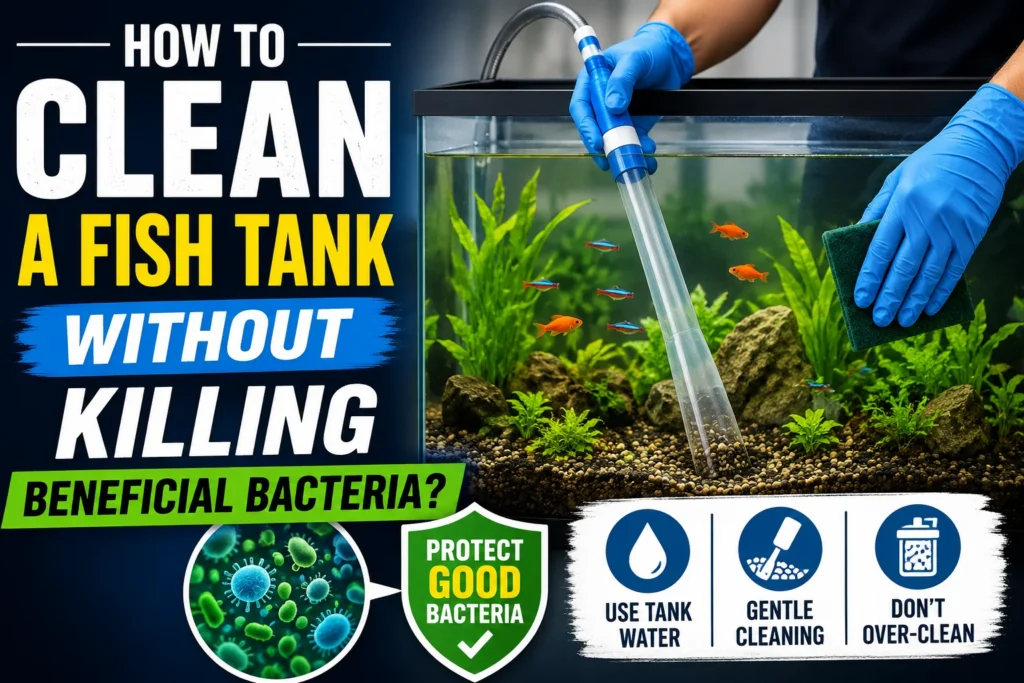
How to Clean a Fish Tank Without Killing Beneficial Bacteria? Tank cleaning: It sounds like a pretty essential task and, while true that it needs doing regularly, it can wreak absolute havoc on the very environment your fish live in if it isn’t done correctly. Here is your comprehensive, fool-proof, fish-saving guide on cleaning your fish tank.
How to Clean a Fish Tank Without Killing Beneficial Bacteria?
Understanding your target 2Before jumping to any cleaning methods, it is important that you know exactly what it is that you are protecting. Aquarium tanks act as small ecosystems that work to utilize the harmful bacteria the predominant forms being Nitro somonas and Nitro bacteria that are naturally living in the tank, to convert the hazardous waste into more safe products.
The Nitrogen Cycle Explained
Here’s what happens in your tank:
Fish produce ammonia and this can also come from rotting food and plant matter ammonia to nitrite Ammonia to Nitrite 1st Conversion by Nitro somonas bacteria nitrite to nitrate Nitrate to Nitrate 2nd conversion by Nitro bacteria Nitrate Removal Ammonia can convert into nitrates but nitrates are removed via water changes
If these good bacteria are absent, your fish will quickly be poisoned by excessive amounts of ammonia and nitrite in your water. This condition is sometimes called “new tank syndrome”.
Where Beneficial Bacteria Live?
However, these friendly bacteria are not exclusively found suspended in the water column, but colonize on any surfaces within your tank, including:
- Filter media (sponges, bio-balls, ceramic rings)- these are home to the largest populations of bacteria
- Substrate (gravel, sand)
- Decorations (rocks, driftwood)
- Aquarium glass
Plants (surface of the leaves)
That’s why flushing out the tank just removes so few good bacteria, but thoroughly scrubbing the walls of the tank can wipe them all out .
Step-by-Step Guide to Safe Tank Cleaning
Preparation: Gathering Supplies
Before starting, ensure you have :
A clean bucket dedicated only for aquarium use A gravel vacuum or siphon An algae scraper (plastic type needed for acrylic tanks) Water dechlorinator/conditioner Pre-mixed water of tank temperature (within 2-3 degrees Fahrenheit)
Never use soap, detergents, or household cleaners they leave residues that are toxic to fish .
Step 1: Turn Off Equipment
Unplug the heater, filter, and any other electrical equipment for safety .
Step 2: Perform a Partial Water Change
Be sure to never empty all the water in the tank; doing so will eliminate too much bacteria and can effectively kill your entire nitrogen cycle .
The ideal approach is :
- Change only 20-30% of the water for routine cleaning
- Never exceed 40% unless it’s an emergency
- Change water weekly for typically stocked tanks
- Every 10-14 days for lightly stocked or planted tanks
- Every 5-7 days for heavily stocked tanks
The water you remove is precious for cleaning! Save it for rinsing your filter media.
Step 3: Clean the Substrate
For Gravel Substrates :
- Use a gravel vacuum siphon
- Push it straight into the gravel, then slowly lift to allow waste to rise while gravel falls back
- Only clean one-third to half of the gravel per cleaning session
- Clean different sections in rotation to preserve bacterial colonies
For Sand Substrates :
- Hold the siphon just above the sand surface
- Swirl gently to lift debris without pulling up sand
- Avoid plunging deeply into sand, as this can cloud water and disturb settled sediment
For Planted/Aquasoil Substrates :
- Spot-clean visible waste only
- Let plant roots and beneficial micro fauna do the rest
Step 4: Clean the Filter This Is the Critical Step
The filter houses most of your beneficial bacteria and is the place where mistakes are most commonly made .
DO:
- Rinse filter media only in the removed tank water you saved
- Gently squeeze sponge media to remove debris
- Swish biological media (ceramic rings, bio-balls) gently
- Clean only part of your filter media at a time (e.g., if you have multiple sponges, clean one now, wait 2-4 weeks, clean the next)
- Immediately reinstall media after cleaning
DON’T:
- Rinse filter media under tap water chlorine and chloramine kill bacteria instantly
- Replace all filter media at once
- Over-clean to the point of sterility
- Deep-clean every tank compartment simultaneously
The goal is to remove debris, not to sterilize .
Step 5: Clean Decorations and Glass
- Algae removal: Use a dedicated algae scraper or magnetic cleaner
- Decoration cleaning: If visibly dirty, remove and gently scrub in old tank water
- Never use household cleaners or vinegar inside a tank with inhabitants
Step 6: Refill the Tank
- Always dechlorinate new water before adding it to the tank
- Match temperature within 2-3°F of tank water
- Slowly add treated water to avoid disturbing substrate
- Plug in equipment once water level is restored
Step 7: Monitor Water Parameters
After cleaning, test water for ammonia, nitrite, and nitrate for a few days . This helps ensure your bacterial colonies are intact and functioning properly.
Also Check: Signs of Hyperesthesia Syndrome In Domestic Cats
Frequency Guide: How Often Should You Clean?
| Tank Type | Water Change Frequency | Filter Cleaning |
|---|---|---|
| Heavily stocked | Every 5-7 days | Every 2-4 weeks |
| Typically stocked | Weekly | Every 2-4 weeks |
| Lightly stocked | Every 10-14 days | Every 3-4 weeks |
| Heavily planted | Every 10-14 days | Every 3-4 weeks |
Important: When cleaning multiple biological surfaces (substrate, filter, decorations), stagger them rather than doing everything at once .
Common Mistakes That Kill Beneficial Bacteria
Using Tap Water on Filter Media
Tap water contains chlorine and chloramine, which are lethal to beneficial bacteria . Always use old tank water for rinsing.
Over-cleaning
A “sterile” tank is actually unhealthy for fish. Beneficial bacteria need to be preserved, not eliminated .
Complete Water Changes
Removing all tank water removes the bacteria living on surfaces and stresses fish unnecessarily .
Replacing Filter Media Too Often
Most filter cartridges and media don’t need frequent replacement. When manufacturers recommend monthly cartridge changes, it’s often marketing—the bacteria on that cartridge are valuable .
Cleaning Everything at Once
If you clean substrate, filter, and decorations in one session, you’re removing bacteria from multiple colonies simultaneously this can cause a bacterial population crash .
Supporting Your Bacterial Colonies
Add Bacteria Supplements
Products containing beneficial bacteria can help replenish colonies after cleaning . Look for:
- FritzZyme MONSTER 360
- Tetra Cleaning Bacteria
- Aqueon PURE
- API Quick Start
Avoid Overfeeding
Excess food produces more waste and can overwhelm your bacterial colonies .
Maintain Proper Temperature
Beneficial bacteria thrive between 70-85°F (21-29°C) .
Ensure Adequate Oxygen
Aerobic bacteria need oxygen maintain good water circulation and surface agitation .
Signs Your Bacterial Colony Is Healthy
- Water is clear
- Ammonia and nitrite consistently test at 0 ppm
- Nitrate levels are measurable but manageable
- Fish show normal behavior
- No unusual algae blooms
What to Do If You Kill Your Bacteria
If you accidentally kill beneficial bacteria (signs include ammonia spikes, cloudy water, stressed fish) :
- Perform small water changes (10-15%) every day to reduce toxins
- Add a bacteria supplement to help recolonize
- Reduce feeding to lower waste production
- Test water daily until ammonia and nitrite return to 0 ppm
Frequently Asked Questions
How often should I clean my fish tank without harming bacteria?
Typically, perform a 20-30% water change weekly for most tanks. Clean filter media every 2-4 weeks using old tank water. Clean substrate in sections rather than all at once .
Does removing water remove beneficial bacteria?
No. Beneficial bacteria primarily live on surfaces like filter media, gravel, and decorations, not in the water itself. That’s why partial water changes are safe .
Can I clean filter media with tap water?
Absolutely not. Tap water contains chlorine and chloramine that kill beneficial bacteria instantly. Always rinse filter media in old aquarium water .
How much water should I change during cleaning?
The ideal amount is 20-30% for routine cleaning. Never change more than 40% unless it’s an emergency, as this can destabilize the tank environment .
Should I remove fish when cleaning?
No, it’s less stressful to leave fish in the tank during partial water changes. Removing them causes unnecessary stress and injury risk .
Will cleaning gravel remove beneficial bacteria?
Gentle vacuuming removes debris without significantly harming bacteria. Avoid digging too deeply and clean only a portion of the gravel each session .
How do I know if my beneficial bacteria are dead?
Signs include ammonia or nitrite spikes in water tests, cloudy water, fish gasping at the surface, lethargy, or clamped fins .
Can I overdose on beneficial bacteria supplements?
No. Adding extra beneficial bacteria is generally safe and won’t harm fish or plants. The bacteria population will naturally stabilize based on available nutrients .
How long does it take for beneficial bacteria to establish in a new tank?
Full cycling typically takes 4-8 weeks. You can speed this up by using established filter media from a cycled tank or commercial bacteria starters .
Do I ever need to replace filter media?
Biological media should be replaced only when it’s physically falling apart. Simply rinsing debris off in old tank water is sufficient for years. Replacing media removes valuable bacterial colonies .
Conclusion
Cleaning your fish tank and not kill beneficial bacteria is all about the 1 principle of “clean slow, clean smart”. NEVER disinfect. NEVER use tap water in filter media. Never clean the entire tank at once. Follow these few tips and you will be rewarded with a fully functioning nitrogen cycle, happy fish and sparkling clean water. Basically, you’re just cleaning up your tank-not killing everything in it. A clean tank supports a more diverse population of micro-organisms that will help maintain the quality of your water and keep your fish happy and healthy.