Why Is My Pet Bird Plucking Its Own Feathers?
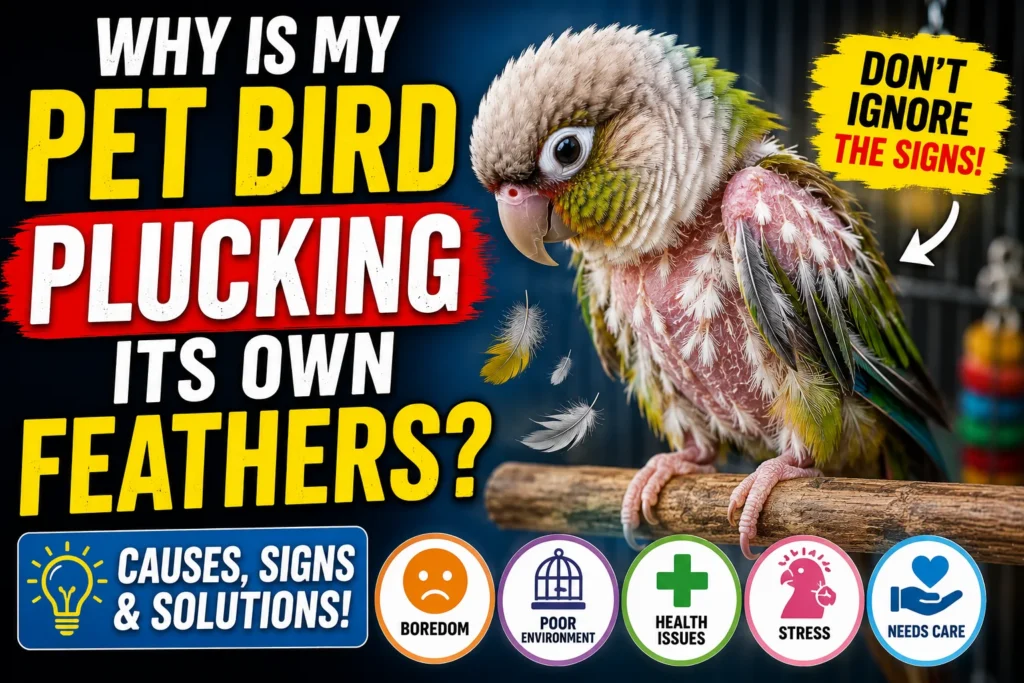
Why Is My Pet Bird Plucking Its Own Feathers? It’s scary when you watch your treasured bird tear his or her own feathers out. Feather plucking in pets is sadly one of the more common concerns that a vians express to their owners but also a very significant concern that a problem exists. Here is how, in simple terms as discussed from a veterinarian’s perspective, we consider and resolve the plucking of feathers from pet birds.
What is Feather Plucking in birds? Feathers plucking (also known as feather-destructive behavior, FDB or feather picking) in birds is the process by which birds may chew, pull or otherwise destroys their own feathers. It is important to remember that feather plucking is not a disease itself, but a symptom which signals that there is an underlying medical or behavioral problem. Feather plucking is most common in parrots, cockatoos, macaws and other psittacines.
Why Is My Pet Bird Plucking Its Own Feathers?
Understanding the Causes: It’s Not Just “Boredom”
Often times when we notice our birds plucking themselves to the extreme it is assumed our bird is simply just trying to express an unhappy bird or an overall boredom, while the majority of the time this can be the cause of plucking, it’s often not the full explanation! Let’s investigate both medical as well as environmental influences that can cause plucking in birds:
1. Medical Causes: Ruling Out Physical Illness
Let’s not overlook this first and foremost: your bird must be thoroughly examined by an avian vet to eliminate all possible medical issues. Unfortunately, many physical conditions can induce discomfort or itchiness in a bird’s body, driving him to pluck at that location .
Common medical causes include:
Diet: One major offender is a diet made primarily of seeds. Seeds are fat-rich and deficient in vitamins, minerals, and amino acids important for keeping your bird’s skin and feathers healthy. A deficiency in Vitamin A, for instance, will cause dry, itchy skin and affect feather growth; the bird then plucks at the feathers.
Skin Infections: A bird may be prone to skin infections (dermatitis), whether caused by bacteria, fungi or yeasts, and feather follicle infections (folliculitis). Both cause considerable itchiness.
External Parasites: Though many do not realize it, birds can have external parasites, mites and lice, that infest feathers and skin.
Internal Diseases: Chronic internal conditions, such as kidney and liver problems that result in itchy skin; tumors; certain infections like Giardia(especially prevalent in cockatiels); Psittacine Beak and Feather Disease (PBFD).
Pain: Your bird may pluck out feathers in an area of skin where there is chronic pain, as with arthritisis or from an injury.
Toxins: exposure to any of various toxins, as zinc or lead.
2. Behavioral and Environmental Causes
When medical causes have been eliminated by a comprehensive examination by a veterinarian, it can often be narrowed down to a behavioral or environmental cause. As an advanced and sentient animal, a bird needs more than just food and shelter; its physical and mental well-being depends on a stimulating, comfortable, and stimulating environment.
Key behavioral and environmental factors include:
- Environmental Factors: Anytime there is a change to their surroundings or environment, they get anxious or stressed. This is as simple as a new dog, a new baby or friend in your home, changes to their scheduled, very loud noises, or being confronted with a predator (e.g. A bird hawk) just beyond their line of sight to the outside environment. Lack of Sleep! Birds actually require a minimum of 10-12 uninterrupted hours of pure darkness.
- Boredom and Lack of Stimulation: This is a very common cause. Birds need plenty of mental and physical stimulation. A lack of interactive toys, foraging opportunities, and social interaction can lead to boredom, frustration, and feather plucking as a coping mechanism .
- Sexual Frustration: A bird that has bonded with its owner as a “mate” can become frustrated if their sexual advances are not reciprocated, or if their perceived mate spends time with others. This frustration can manifest as feather plucking .
Also Check: Can Dogs Eat Raw Shrimp with the Shell On?
What To Do: A Step-by-Step Action Plan
Breaking the feather plucking habit can seem hopeless and, in some cases, modification may be more realistic than an entire ‘cure.’ That said, a deliberate approach is usually necessary for best results.
Step 1: Schedule an Immediate Appointment with an Avian Veterinarian
This step is paramount. The first rule in Feather pluckplacing a birds feathers is: dont try and fix it at home yourself, go and see a vet first. Without getting a correct diagnose, you are essentially guessing.
- What to Expect: The vet will take a detailed history, asking about your bird’s diet, environment, and daily routine . They will perform a full physical examination.
- Diagnostic Tests: Based on the specific exam your veterinarian may suggest various tests including blood work, skin scrapings or biopsies, cultures, X-rays, etc. In an attempt to determine any medical underlying causes.
Step 2: Optimize the Environment and Diet at Home
If the veterinarian rules out a primary medical cause, the focus shifts to improving your bird’s life. Many of these changes are proactive ways to prevent the problem in the first place .
- Improve the Diet: Transition your bird from a seed-based diet to a high-quality, nutritionally complete pelleted diet designed for its species . Supplement the pellets with a variety of fresh, bird-safe vegetables and fruits. This change alone can have a significant impact .
- Enrich the Environment:
- Interactive Toys: Provide a wide variety of toys that can be chewed, shredded, and foraged from. Rotate the toys weekly to prevent boredom .
- Foraging: Make your bird work for its food! Hide treats in foraging toys or around the cage to encourage natural foraging behavior .
- Social Interaction: Spend quality, interactive time with your bird daily. A television or radio left on can provide some comfort and mental stimulation when you are not home Handle Stress and Support sleep: Always aim to maintain a proper sleep routine so the bird always gets 10 to 12 hours of quiet uninterrupted dark hours every night. Provide an extra quiet room that is not in a highly traffic or loud room.
- Figure out what you might be doing that you can stop that might be adding stress to your pet.
- Use misting sprays to give a bird baths or provide as hallow dish of water for your bird to bathe and that will add to the interest in your bird along with providing normal preen skin health, and it can also help in reducing feather plucking . Never wash your pet with any kind of soap.
- Stop rewarding the behaviour: Although tempting, try not to vocalize loudly or rush to your bird when they are plucking their own feathers. As attention as it receives (even a scolding), this simply encourages the behaviour, so ensure your bird gets all the attention for appropriate behaviors.
Step 3: Partner with Your Veterinarian for Long-Term Management
- Follow-Up: In many cases of feather picking, success takes time, and this condition requires consistent management. See your veterinarian on a regular basis throughout the treatment process so they can assess your parrot and tweak the treatment plan.
- Medical Procedures: The Treatment of Last Resort- In certain situations Elizabethan collars (E collars) may be utilized on a temporary basis to keep a bird from access to its own feathers to allow the medication time to work or to break the cycle of repeated self-mutilation. In chronic and severe situations the veterinarian may prescribe behavioral modifying drugs, but these will only be used in conjunction with a change in the animal’s environment and its behavior.
Frequently Asked Questions (FAQs)
Is feather plucking and molting the same thing?
Nope. Molting involves a normal loss and regrowing of feathers, spread symmetrically over the bird’s body. Plucking causes uneven patches of feather loss and isn’t pretty, generally on a body part the bird can access with its beak, such as the chest.
What’s the main culprit for plucking?
Contrary to what many people might guess (i.e. Boredom) most cases of plucking occur for multiple reasons. First off, veterinary diagnosis to rule out underlying disease such as nutritional deficiencies, skin infections or other health problems needs to be completed.
Will the feathers grow back?
If underlying disease and psychological conditions are addressed, most cases recover, and the feathers will regrow. In some cases where there’s been long-term, repeated plucking, the feather follicles may become permanently damaged, and may not grow feathers back in that area.
Can I try using human anti-itch cream or other home remedies?
Absolutely not! Do not apply human creams, lotions, ointments, etc to your bird without the expressed directive from your avian vet. Your avian veterinarian may prescribe a topical treatment but please do not try it on your bird on your own! Only plain water baths for itchy skin.
Is the plucking caused by disease or stress?
It’s difficult to tell, and your vet will have to conduct blood tests, skin scrapings and X-rays to identify any diseases (viral, fungal, bacterial, parasite, tumours, hormonal, metabolic etc). Once disease is eliminated then the cause is likely psychological or behavioural.
My bird is perfectly fine when I’m around, but starts plucking when I leave the room, why?
This typically indicates that there may be an anxiety problem. Most birds with plucking behaviors have overly close relationships with their owners and suffer from separation anxiety. When you leave them it is quite common they will begin plucking.
Could getting a second bird solve the plucking?
Maybe. But it can be a gamble. While another bird may alleviate boredom and lonely ness, but it is possible the new bird will either be an aggressive presence, or may be plucked by the first, even barbered by the first bird ie, have its feathers plucked by the first one!
How long does treatment take?
The duration varies greatly depending on whether disease is the primary cause and once resolved, behaviour needs to change. This can range from a few weeks to several months. Even after some treatment progress is made, sometimes the tendency to pluck is so ingrained, that some reduction of the severity is what’s achievable.
My bird’s chest is bare, but the rest of its head is full of feathers. Why?
Birds cannot reach their heads and top of head (and their eye patches) with their beaks to pluck themselves. It also typically does not look like a disease such as PBFD (Psittacine Beak and Feather Disease) since PBFD may result in the baldness all over the body, including the head. A bald chest or wings often points toward self-induced feather destruction.