Why is My Cat Shaking Her Head Repeatedly?
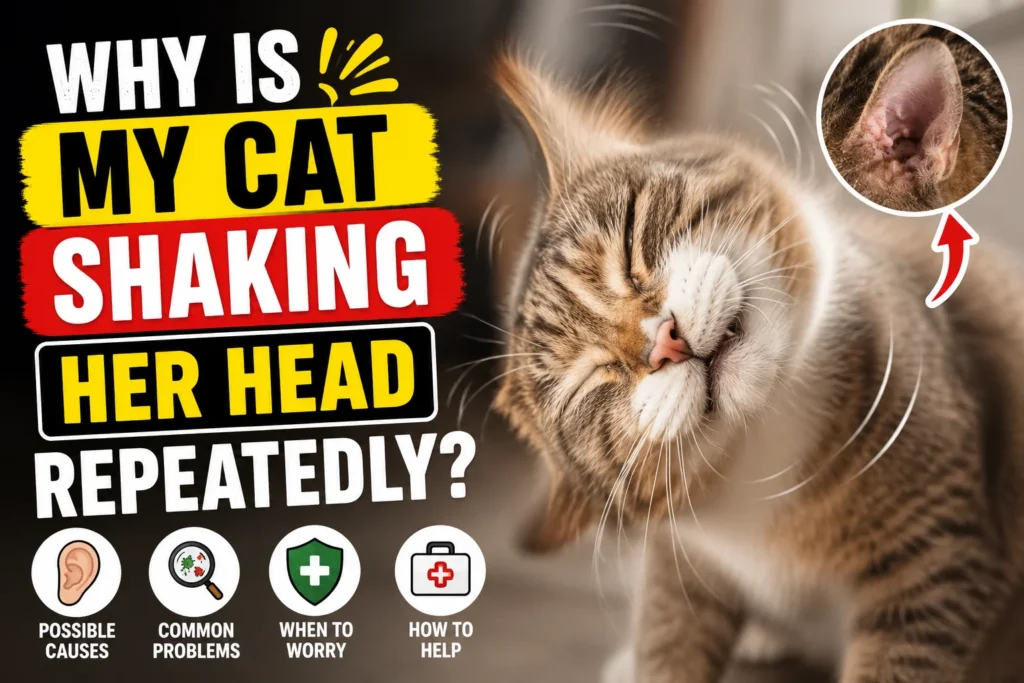
My Cat Shaking Her Head Repeatedly, It starts subtly. A little flick of the ear while she’s napping. Then, a few hours later, you notice it: shake, shake, shake. Your cat is sitting in the middle of the living room, violently rattling her skull like she’s trying to dislodge a thought.
As a veterinarian, I see this in my clinic almost daily. Here is the hard truth: While an occasional head shake is normal (cats do this to realign their ears or remove dust), repeated, violent, or persistent head shaking is never normal. It is a clear, visual scream that something is wrong inside your cat’s ear canal.
Ignoring it can lead to ruptured eardrums, hearing loss, or a painful condition called an aural hematoma (a blood-filled swelling of the ear flap). Let’s diagnose the problem.
5 Medical Reasons My Cat Shaking Her Head Repeatedly
When a cat shakes her head, she is trying to physically eject an irritant. Here are the most common culprits, ranked from most to least frequent.
1. Ear Mites (Otodectes cynotis) – The 1 Offender
If your cat spends any time outdoors or with other cats, ear mites are the statistical favorite. These tiny, white crab like parasites live inside the ear canal, feeding on wax and oils.
- The Clue: The shaking is intense. Look inside the ear. Do you see something that looks like coffee grounds (dark brown/black crumbly debris)?
- The Vet’s Note: Mites are highly contagious to other pets (dogs and ferrets), but they rarely live long on humans.
- Why shaking? The mites bite the skin, causing intense itching. Your cat shakes to try to scrape them off the walls of the canal.
2. Ear Wax Buildup & Foreign Bodies (Grass Seeds)
Cats produce less wax than dogs, but some individuals are “over-producers.” Worse, if your cat goes outside, a foxtail or grass awn can lodge itself deep in the ear.
- The Clue: Sudden onset (one minute fine, next minute frantic). Your cat may hold the affected ear down or tilt her head toward the floor.
- The Vet’s Note: Do NOT stick a Q-tip in there. You will likely pack the debris against the eardrum or push a grass seed deeper, requiring sedation to remove.
3. Ear Infections (Otitis Externa)
Cats get ear infections, but they are usually a secondary problem. This means something else (allergies, polyps, mites) broke the skin, and bacteria or yeast moved in.
- The Clue: The ear smells bad (yeasty or foul). The skin inside looks red, swollen, or hot. You might see yellow or green pus.
- The Vet’s Note: Unlike dogs, cats rarely get yeast infections alone. If your vet prescribes antibiotics without looking for the root cause, the infection will keep coming back.
4. Aural Hematoma (The Emergency Complication)
This is not a cause of the shaking; it is the result of violent shaking. When your cat shakes hard, a blood vessel in the ear flap (pinna) ruptures.
- The Clue: The ear flap looks like a soft, warm, squishy balloon or a pillow. It may feel like a water balloon.
- The Vet’s Note: This requires medical attention. If left untreated, the blood clots, the ear shrivels up into a “cauliflower ear,” which is painful and permanently disfiguring.
5. Ear Polyps or Tumors (Older Cats)
Less common but serious. A non-cancerous inflammatory polyp (or rare cancerous growth) grows from the lining of the ear.
- The Clue: The shaking is persistent but not violent. You may notice a head tilt (ear down), difficulty swallowing, or a hoarse meow.
- The Vet’s Note: Polyps often require surgical removal via a technique called traction avulsion.
Also Check: Can Cats Drink Almond Milk Safely?
When is Head Shaking an Emergency?
You do not need to rush to the ER for a single shake. However, you need to see a vet within 24 hours if you notice:
- The “Coffee Grounds” sign: (Probable mites needs prescription meds).
- Head Tilt: (Inner ear involvement can lead to permanent imbalance).
- Squishy Ear Flap: (Hematoma needs draining).
- Loss of balance or circling: (Neurological involvement).
- Scratches on the face/neck: (Your cat is in pain and trying to dig the ear out).
How to Help Your Cat RIGHT NOW (Home Care)
Until you see the vet, do this safely:
- Do not pour anything (vinegar, hydrogen peroxide, oil) into the ear. If the eardrum is ruptured, this causes deafness and extreme pain.
- Wipe the outer ear only. Use a dry cotton ball. Never go into the vertical ear canal.
- Apply an Elizabethan collar (Cone). If she is scratching her ear with a back paw, put a cone on her. A single scratch can cause the hematoma we discussed.
Vet Treatments (What to Expect)
Your vet will use an otoscope (a cone with a light) to look deep inside the ear. This is the only way to see the eardrum.
- For Mites: A prescription parasiticide (Revolution, Bravecto) – one drop on the skin kills them. Over-the-counter drops rarely work anymore due to resistance.
- For Infection: Medicated ear drops (anti-bacterial/anti-fungal) for 7-14 days.
- For Foreign Body: Sedation and removal with alligator forceps.
- For Hematoma: Surgical drainage or a series of sutures to flatten the ear flap.
Frequently Asked Questions (FAQs)
Is it normal for a cat to shake its head after eating?
Yes, sometimes. Cats may shake their heads if they have dental pain or a tooth root abscess that refers pain to the ear/jaw area. If it is only after eating, check her teeth for redness.
Can allergies cause head shaking in cats?
Absolutely. Atopy (environmental allergies to pollen, dust mites) and food allergies cause itchy skin. The ear canal is lined with skin. If she is also over-grooming her belly or has chin acne, suspect allergies.
My cat’s ears look clean inside, but she shakes her head. Why?
This is a red flag for deep ear infection (Otitis media) or polyps. The problem is hidden behind the eardrum. Your vet needs an X-ray or CT scan to see it.
Can I use olive oil or coconut oil for cat head shaking?
No. Do not do this. Oil traps moisture and bacteria against the skin, turning a mild problem into a roaring infection. It also provides food for yeast.
How do I tell the difference between mites and infection?
Mites: Dry, crumbly, dark brown debris (looks like dirt). No smell.
Infection: Wet, yellow/green/black discharge. Strong, foul smell (sweet or musty).
Will ear mites go away on their own?
Never. They have a 21-day life cycle. They will multiply and spread to your other pets. They require veterinary prescription medication.
My cat is shaking her head and walking in circles. Is this a stroke?
Possibly, but more likely a vestibular syndrome (inner ear infection affecting the balance nerve). This is serious. Get to a vet today to rule out a stroke or a brain tumor.
Why does my cat shake her head after I pet her?
She likely has a hypersensitive ear (maybe an old mite scar or a chronic infection). Petting might tickle the nerve endings or push wax deeper. Have the vet check for a “twitch response” on the ear flap.
How much does vet treatment for head shaking cost?
Ear exam & otoscope: $50–$80
Ear mite meds (Revolution): $20–$40 per dose
Ear infection cytology & drops: $100–$200
Hematoma surgery: $400–$1,000 (requires anesthesia)
Can stress cause head shaking?
Stress causes psychogenic alopecia (over-grooming) and facial rubbing, but rarely violent head shaking. If the shaking is rhythmic and looks like a tremor (not a shake), it could be a neurological issue. Otherwise, assume physical pain first.
The Bottom Line
Do not wait for the “coffee grounds.” By the time your cat is shaking her head repeatedly, she has been uncomfortable for days. The cheapest, kindest solution is a $60 vet exam.
If you treat mites at home with cheap pet store drops, you waste money and time while your cat suffers. If you ignore the shaking, you risk a $1,000 hematoma surgery.
Summary Action Plan:
- Put a cone on your cat to stop scratching.
- Book a vet appointment for tomorrow.
- Do not put anything in the ears.