Symptoms Of Cushing’s Disease In Senior Dogs
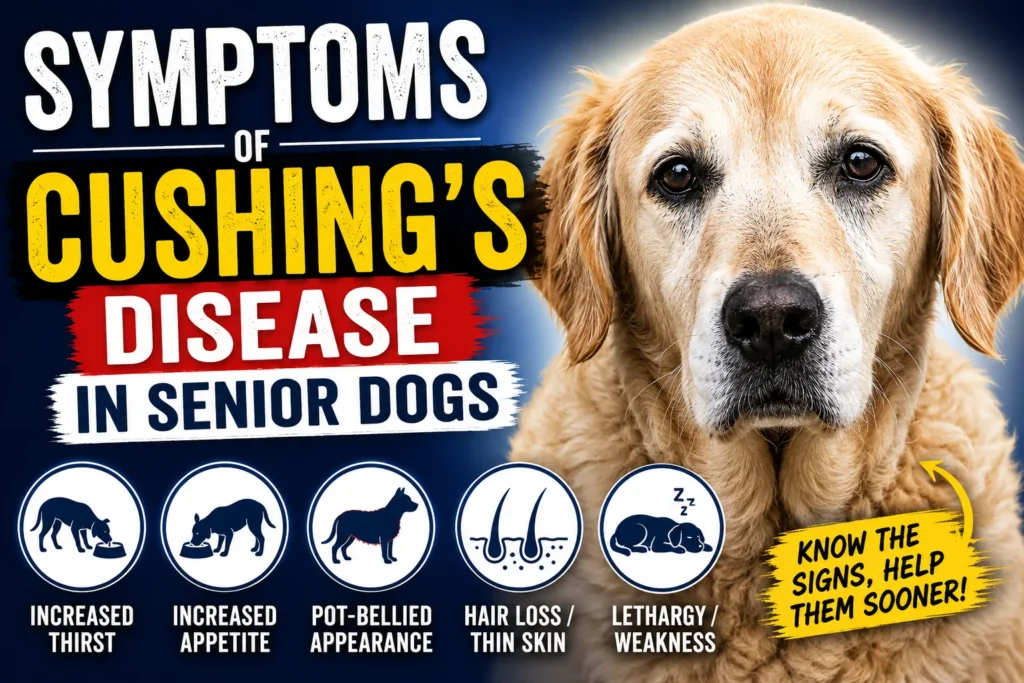
Symptoms Of Cushing’s Disease In Senior Dogs, As our beloved canine companions enter their golden years, we expect grey muzzles, slower walks, and longer naps. But what happens when your senior dog starts drinking water as if they can never be quenched, or loses hair in patches that don’t grow back?
You might be witnessing the subtle, creeping onset of Cushing’s disease (Hyperadrenocorticism) . This common endocrine disorder affects roughly 1 in 1,000 dogs, but among senior populations (dogs over 8–10 years old), the numbers spike dramatically.
Because the symptoms mimic normal aging, Cushing’s is notoriously misdiagnosed or missed entirely. As a veterinarian, I am here to help you decode the physical changes in your old friend. As an SEO writer, I have structured this guide to give you the actionable, high ranking answers you need to help your dog now.
What Exactly is Cushing’s Disease?
Before listing the symptoms, you must understand the “why.” Cushing’s disease occurs when a dog’s body produces excessive cortisol (the stress hormone) over long periods.
There are three types:
- Pituitary-dependent (85-90%): A benign tumor in the pituitary gland signals the adrenal glands to overproduce cortisol.
- Adrenal-dependent (~15%): A tumor on the adrenal gland itself produces the cortisol.
- Iatrogenic (Medication-induced): Caused by long term overuse of steroid medications (prednisone).
While often slow moving, untreated Cushing’s leads to high blood pressure, kidney damage, diabetes, and chronic skin infections.
Symptoms Of Cushing’s Disease In Senior Dogs (The “Classic Triad” of Symptoms)
In veterinary school, we learn to look for three classic signs. If your senior dog has all three, the probability of Cushing’s is very high.
1. Polyuria (Excessive Urination)
Your house trained dog suddenly starts having “accidents” indoors, or wakes you up three times a night to go out. Because cortisol acts like a diuretic, the kidneys cannot concentrate urine. You will notice puddles that look like clear water, not yellow urine.
2. Polydipsia (Excessive Thirst)
Directly linked to the urination. Your dog will drain a water bowl and immediately return for more. A general rule of thumb: If your dog drinks more than 1.5 cups of water per 10 pounds of body weight per day, consult your vet.
3. Polyphagia (Excessive Appetite)
This is the “tricky” symptom. Senior dogs usually eat less. A Cushing’s dog acts starving. They will raid the trash, beg relentlessly, and steal food off the counter. This insatiable hunger is a direct neurological trigger from excess cortisol.
Also Check: How to Cut Overgrown Dog Nails at Home Safely?
7 More Specific Symptoms in Senior Dogs
While the “Three P’s” (Pee, Puke wait, no Pee, Drink, Eat) are primary, senior dogs show specific physical deterioration signs.
4. The “Pot-Bellied” Appearance
Your dog’s ribs and spine feel bony, yet their belly is swollen and sagging. This is not “old man fat.” Cortisol breaks down muscle protein and redistributes fat to the abdomen. The liver also enlarges, pushing the belly outward. Press on it it often feels like a tight drum rather than soft flab.
5. Symmetrical Hair Loss (Alopecia)
Unlike mange or fleas which cause random bald spots, Cushing’s causes symmetrical balding. You will see thinning along the flanks (sides), tail, and back of the neck. The hair that remains is often dry, brittle, and does not regrow. Look for a “rat tail” (bald tail) or thin head hair.
6. Calcinosis Cutis (Hard, Chalky Skin)
This is the only pathognomonic symptom (meaning if you see it, it is definitely Cushing’s). You may notice white, chalky, or hard stone like plaques on the skin, usually along the back, armpits, or groin. These are calcium deposits. They can become ulcerated and infected, requiring aggressive antibiotic therapy.
7. Thin, Bruised Skin (Skin Fragility)
Gently scruff your dog’s neck. Does the skin feel like thin paper or tissue? Do small bumps or scratches cause deep, slow bleeding tears? Excess cortisol destroys collagen, the protein that holds skin together. Senior dogs with Cushing’s often look like they have been in a fight simply from lying on a hard floor.
8. Muscle Wasting & Weakness
Watch your dog climb stairs. Do their hind legs tremble? Do they slip on tile floors? Cortisol eats muscle mass. Senior dogs with Cushing’s develop a condition called “weak hind limb syndrome,” making it hard to rise from a lying position without assistance.
9. Recurring, Hard-to-Treat Infections
If your senior dog is having a bladder infection (UTI) every two months, or a skin infection that clears with antibiotics only to return in two weeks, suspect Cushing’s. The high cortisol shuts down the immune system, allowing bacteria to thrive. These are often chronic ear infections, skin abscesses, or urinary tract infections.
10. Panting & Lethargy (Not Heat Related)
Dogs pant when hot or after exercise. A Cushing’s dog pants heavily while lying on a cool tile floor in an air conditioned house. This is caused by the hormonal pressure on the respiratory system and liver enlargement pushing on the diaphragm. They are tired because their body is working too hard, not because they exercised.
How to Confuse Cushing’s with Normal Aging
Owners often say, “He’s just old.” Here is the clinical difference:
- Normal old dog: Drinks more only on hot days; sleeps after a walk; has occasional gray hair.
- Cushing’s old dog: Drinks relentlessly in winter; cannot stop eating; loses hair in patches; gets a hard, round belly.
What To Do Next (The Diagnostic Path)
Do not buy “Cushing’s supplements” online until you have a diagnosis. If you see 3+ of these symptoms, visit your vet. They will likely run:
- Urinalysis: To check for dilute urine (low specific gravity) and concurrent UTIs.
- Blood Chemistry: To look for elevated liver enzymes (ALP), which are almost always sky high in Cushing’s.
- ACTH Stimulation Test or Low-Dose Dexamethasone Suppression Test (LDDST): The gold standard tests to confirm the diagnosis.
Treatment & Prognosis
Cushing’s is treatable. The standard medication (Vetoryl/Trilostane) controls cortisol production. Most senior dogs live out their natural lifespan (2+ years) with good quality of life once medicated.
Without treatment? The disease progresses to hypertension, retinal detachment (blindness), diabetes mellitus, and kidney failure.
Frequently Asked Questions (FAQs)
At what age is Cushing’s disease most common in dogs?
Most dogs are diagnosed between 8 and 12 years of age. It is rare in dogs under 6 years old unless caused by steroid medications (Iatrogenic).
What dog breeds are most prone to Cushing’s disease?
Poodles, Dachshunds, Boxers, Boston Terriers, Beagles, and Yorkshire Terriers are overrepresented. However, any senior mixed breed can develop it.
Is Cushing’s disease painful for senior dogs?
The disease itself is not acutely painful, but the side effects are. Muscle wasting makes walking painful calcinosis cutis is itchy and painful; and high blood pressure causes headaches and vision loss.
How long can a senior dog live with untreated Cushing’s?
Usually 12 to 24 months from symptom onset, but the quality of life declines severely. Most die from complications like sepsis (ruptured skin infection) or kidney failure rather than the Cushing’s itself.
Can diet alone cure Cushing’s disease in dogs?
No. Diet cannot remove a pituitary or adrenal tumor. However, a low-fat, highly digestible protein diet with limited purines helps manage liver enlargement and muscle wasting.
Why is my senior dog’s belly hard and round?
That is a “pot belly” caused by:
Hepatomegaly (enlarged liver pushing forward)
Muscle atrophy (loss of abdominal wall strength)
Fat redistribution (moving fat to the abdomen)
Do all dogs with Cushing’s lose their hair?
Approximately 80% of dogs develop endocrine alopecia (hair loss). The pattern is always symmetrical. If the hair loss is patchy or itchy, suspect allergies or mange instead.
Can a dog have both Cushing’s and Diabetes?
Yes. This is called a “concurrent endocrinopathy.” Cushing’s causes insulin resistance. If you treat the Cushing’s, the diabetes often becomes much easier to manage.
My dog is on steroids for allergies. Does he have Cushing’s?
Yes this is Iatrogenic Cushing’s. It is reversible. Do not stop steroids abruptly (can cause Addisonian crisis). Ask your vet to slowly wean the steroid dose down. Once off steroids, the symptoms resolve in weeks.
How much does it cost to test for Cushing’s disease?
An ACTH stimulation test typically costs $150–$300. The LDDST test is similar. Monthly medication (Trilostane) ranges from $30–$100 depending on dog size.
Final Takeaway for Senior Dog Owners
If your senior dog is drinking a lake, eating like a horse, and losing hair like a balding tire, do not blame “old age.” Cushing’s disease is a clinical diagnosis with a medical solution.
Take a video of your dog drinking water for 60 seconds straight. Show your vet the bald spots on the tail. Ask for the LDDST test. Treating Cushing’s won’t make your dog young again, but it will stop the relentless thirst, give them back their muscle strength, and let you enjoy your final years together with dignity.