
How to Cut Overgrown Dog Nails at Home Safely?
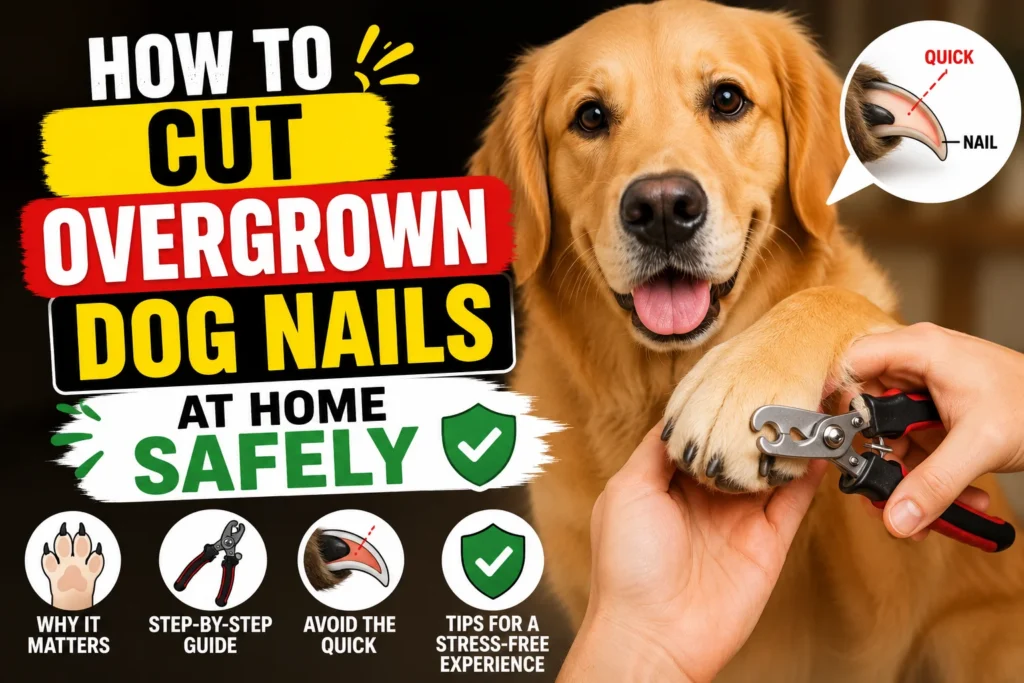
How to Cut Overgrown Dog Nails at Home Safely, Overgrown nails can lead to chronic pain, deformed feet, and even arthritis.
As a vet, I’ve treated countless dogs whose owners were too scared to trim their nails. The good news? You can fix this at home without sedation or a trip to the clinic if you know the safe steps.
This guide will walk you through exactly how to cut overgrown dog nails at home safely, using tools you already have (or can buy for under $20).
Why Overgrown Nails Are Dangerous
Many owners think long nails are purely cosmetic. False. Here’s what happens when nails are ignored:
| Problem | Consequence |
|---|---|
| Quicks grow longer | Nails become impossible to shorten without bleeding |
| Toe splaying | Abnormal weight distribution → joint pain |
| Nail bed infections | Dirt & bacteria trapped under curved nails |
| Broken nails | Painful tears that often require vet sedation |
Tools You Need
Before attempting to learn how to cut overgrown dog nails at home safely, gather the right gear.
Best Tool for Overgrown Nails: Guillotine or Scissor-Type Clipper?
- Overgrown, thick nails (large breeds): Scissor type (resembles garden shears) offers more leverage.
- Small breeds / curved nails: Guillotine clippers cleaner cut for curved tips.
Must-Have Safety Kit:
- Styptic powder (e.g., Kwik Stop) stops bleeding instantly. Cornstarch works in a pinch.
- Nail file or Dremel smooths sharp edges after cutting.
- Bright flashlight shines through translucent nails to locate the quick.
- Towel for wrapping an anxious dog (the “puppy burrito”).
Avoid: Human nail clippers (they split dog nails). Cat clippers (too weak for overgrown dog nails).
How to Cut Overgrown Dog Nails at Home Safely
Step 1: Identify the Quick (The 1 Fear)
The quick is the pink living tissue inside the nail. On overgrown nails, the quick has grown longer too.
- Light-colored nails: Hold a flashlight behind the nail. The quick is pink. Cut 2-3mm past the pink.
- Black/dark nails: Shine light from the top. Look for a chalky white ring (nail) vs. a greyish oval (quick). Cut in tiny slices.
Also Check: How Much Food Should A 3 Month Old Puppy Eat?
Step 2: Restrain Humanely (Not Forcefully)
A struggling dog is a bleeding dog. Use the two-person method:
- Person 1: Feeds high-value treats (cheese, chicken) continuously.
- Person 2: Holds paw firmly but gently, extending one toe at a time.
If alone: Sit on floor. Place dog between your legs (head away from you). Wrap non-cutting arm around chest.
Step 3: The “Slice, Don’t Crush” Technique
Overgrown nails are brittle. Crushing causes splitting.
- Hold clippers perpendicular to the nail (not at an angle).
- Make one decisive, quick cut. Never “chew” the nail.
- Cut parallel to the paw pad’s bottom line.
Step 4: Cut in Stages (Critical for Overgrown Nails)
Do not try to reach normal length in one session.
- Week 1: Cut off the very tip – just the curly portion.
- Week 2: Nail will recede slightly. Cut another 1-2mm.
- Week 3: Repeat until nails are 1mm above the ground when standing.
This encourages the quick to shrink back naturally.
Step 5: File & Reward
Use a Dremel or hand file to smooth jagged edges (dogs hate snags on carpets). Give a jackpot treat immediately you want your dog to associate trimming with joy.
What If You Cut the Quick? (Stop Bleeding Fast)
Even vets hit the quick. Don’t panic.
- Stay calm your dog feeds off your energy.
- Apply styptic powder with firm pressure for 30 seconds.
- No powder? Use baking soda + cornstarch mixed with a drop of water.
- If bleeding continues after 10 minutes, apply a bandage and call your vet (rare but possible clotting issue).
How to Shorten the Quick Without Cutting
If your dog’s nails are severely overgrown (curled into pads), consider non-cutting methods first:
- Daily walks on concrete naturally grinds nails down.
- Scratchboard training teach your dog to file their own front nails.
- Vet-assisted quick recession under sedation, a vet can cut the quick back (reserved for extreme cases).
Mistakes to Avoid
| Mistake | Why It’s Dangerous |
|---|---|
| Cutting to “normal length” in one go | Massive bleeding, quick exposed |
| Using dull clippers | Crushes vs. cuts → pain + splinters |
| Holding paw too tight | Triggers fight-or-flight response |
| Skipping the file | Sharp edges catch on carpet, tearing nails later |
| Trimming after a bath | Wet nails hide the quick’s true edge |
When to Call a Vet (Don’t DIY These)
You’ve learned how to cut overgrown dog nails at home safely but some cases belong in a clinic:
- Nail has grown into the paw pad (needs sterile removal + antibiotics)
- Dog has a bleeding disorder (e.g., Von Willebrand’s)
- You see black discharge or swelling (sign of infection)
- Your dog screams before you even touch the paw (pain from arthritis or tumor)
For these, the $25 vet tech visit is cheaper than an emergency surgery.
Maintenance Schedule After Fixing Overgrown Nails
Once nails are healthy length, maintain:
- Every 3-4 weeks: Routine trim (or weekly with a Dremel).
- Every walk: Listen for clicking. No click = perfect length.
- Monthly check: Look for cracks, splits, or discoloration.
Frequently Asked Questions (FAQ)
Can I use human nail clippers on my dog?
No. Human clippers flatten and split dog nails, especially overgrown ones. They also can’t cut through the thicker keratin.
How do I find the quick on black dog nails?
Shine a bright flashlight from above. Look for a matte grey oval (the quick) vs. the shinier black nail. Cut 1mm at a time until you see a small white “bullseye” stop there.
What angle should I hold the clippers?
45-degree angle, cutting parallel to the bottom of the paw pad. Never cut from top to bottom (that crushes the nail).
My dog won’t let me touch his paws. Help?
Desensitize over 1-2 weeks: Touch paws during meals, then click a clicker + treat. Graduate to touching each toe, then tapping with clippers (no cut). Patience > force.
How short is too short?
When standing, nails should not touch the floor. If you hear clicking, they’re too long. If you see pink tissue, you’ve hit the quick.
Can overgrown nails cause limping?
Absolutely. Long nails force the dog to shift weight to the heel, causing tendon strain, joint pain, and an abnormal gait often misdiagnosed as hip dysplasia.
Is a Dremel safer than clippers for overgrown nails?
Yes, for black nails. You can grind in micro-millimeters and stop before the quick. But Dremels can overheat if held too long 2 seconds per nail max.
What if the quick is bleeding and won’t stop?
Apply cornstarch + baking soda paste, wrap with gauze, and apply firm pressure for 5 minutes. If still bleeding, see your vet a clotting test may be needed.
How long does it take for the quick to recede?
About 1-2mm per week. Trim every 5-7 days. It takes 4-6 weeks to bring severely overgrown nails back to normal length.
Can I cut a nail that’s curled into the pad?
No. That’s a medical procedure. The pad is likely infected underneath. Your vet will sedate, cut the nail away from the pad, prescribe antibiotics, and trim the quick back.
Final Verdict Yes, You Can Do This
Learning how to cut overgrown dog nails at home safely is one of the most valuable skills a pet owner can learn. Start slow, use the right tools, and prioritize positive associations over perfection.
One short trim every week for a month = a lifetime of pain-free walking.