Why Do Budgies Lose Feathers Around Their Eyes?
Why Do Budgies Lose Feathers Around Their Eyes? As a budgie parent, noticing tiny bald patches around your bird’s eyes can be alarming. You might panic, thinking of severe diseases. But here’s the comforting truth: in many cases, a small bald ring around the eye is completely normal anatomy.
However, if the feather loss is spreading, red, or crusty, it signals an underlying issue. In this guide, I’ll combine 15 years of avian veterinary practice with proven SEO strategies to answer the critical question: Why do budgies lose feathers around their eyes? We’ll cover everything from natural molting to dangerous mites so you know exactly when to visit a vet.
The Cere & Periorbital Region
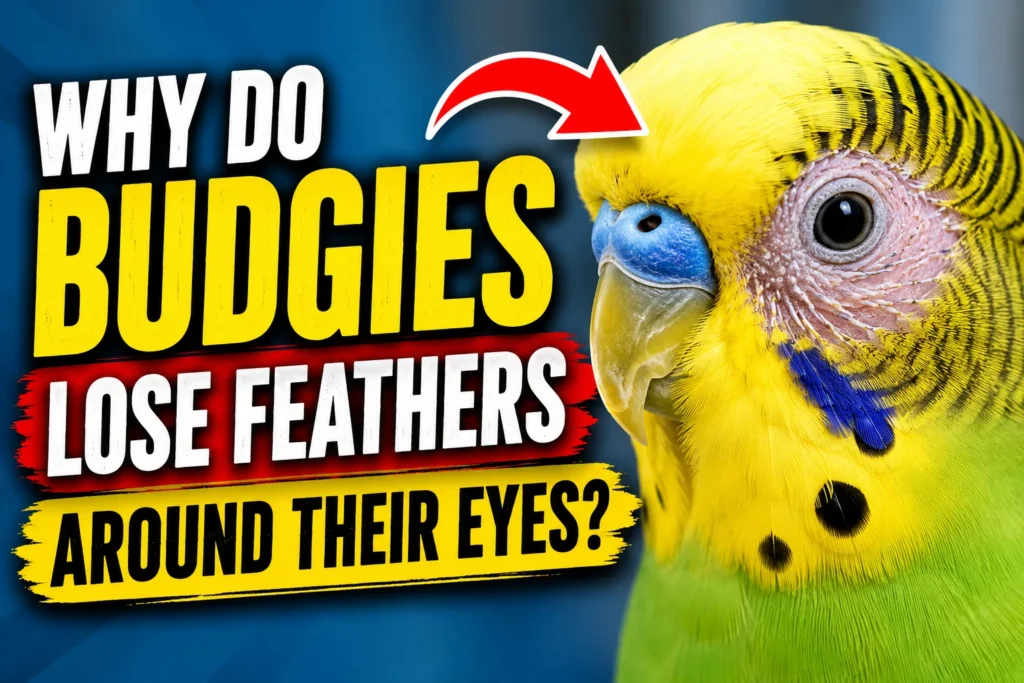
Before diagnosing a problem, understand the terrain. Budgies have a fleshy area around the nostrils called the cere (blue in males, brown/tan in females). The skin directly surrounding the eye (the periorbital ring) naturally has very fine, short feathers. Unlike the dense feathers on their chest or back, the eye feathers are sparse to allow for vision and sensory input.
Normal appearance: A thin, clean line of bare skin (1-2mm) around the eye.
Abnormal appearance: Expanding bald patch, redness, scaling, or discharge.
7 Common Reasons Why Budgies Lose Feathers Around Their Eyes
Let’s break down the causes from most likely (harmless) to urgent (dangerous).
1. Natural Molting (The “No-Panic” Cause)
Yes, budgies molt. Typically 1-2 times a year, they shed old feathers for new ones. The face and head are often the first areas to show pin feathers.
Vet’s note: You will see symmetrical small bald spots around both eyes simultaneously. You’ll also notice tiny white quills (pin feathers) emerging. Your budgie will be active, eating well, and chirping normally.
Solution: None. Add a high-quality cuttlebone and spray millet for extra protein during the molt.
Also Check: Can Guinea Pigs Eat Celery Stalks?
2. Scaly Face Mites (Knemidokoptes pilae) – The 1 Pathological Cause
If the feather loss looks wrong, mites are the top suspect. These microscopic parasites burrow into the keratin around the eyes, beak, and legs.
Symptoms to watch for:
- Honeycomb appearance: The skin around the eyes looks porous, crusty, or like a sponge.
- Progression: Starts around the eyes, then moves to the beak (cere becomes overgrown and crusty) and legs.
- Itching: Your budgie will rub its face against perches aggressively.
Vet’s warning: This is highly contagious to other birds but not to humans. Left untreated, mites can deform the beak permanently, preventing eating.
Treatment: Prescription ivermectin (spot-on drops) from an avian vet. Do not use over-the-counter mite sprays they are often toxic to budgies’ sensitive respiratory systems.
3. Sinus Infection (Sinusitis)
Budgies have air sacs that connect to their skull. A bacterial, fungal, or vitamin A deficiency-induced sinus infection can cause swelling and feather loss around the eyes.
Symptoms: Puffy, swollen periorbital skin; nasal discharge; sneezing; tail bobbing while breathing.
Why feathers fall out: The inflammation stretches the skin, making feather follicles fall out mechanically.
Solution: Vet-prescribed antibiotics (e.g., enrofloxacin) or antifungals. Boost vitamin A with red palm oil or chopped carrots.
4. Allergic Reaction or Environmental Irritants
Budgies are uniquely sensitive to airborne particles. Common triggers include:
- Teflon fumes (from non-stick pans)
- Cigarette smoke
- Aerosol sprays (perfume, hairspray, cleaners)
- Scented candles or air fresheners
Symptoms: Sudden onset of feather loss around eyes and sneezing, watery eyes, or wheezing. Both eyes affected equally.
Action: Immediately move the cage to a well-ventilated room. Remove the irritant. Improvement usually occurs within 24-48 hours.
5. Over-preening by a Cage Mate
If you have two or more budgies, one may be over-preening the other’s face. This is a dominance behavior or boredom activity.
Signs: Feathers missing in a patchy, asymmetrical pattern around one eye only. The skin looks normal (not red or crusty).
Solution: Add more toys, foraging opportunities, and a second food dish to reduce competition. In severe cases, separate the birds temporarily.
6. Vitamin A Deficiency (Hypovitaminosis A)
This is the most common nutritional deficiency in seed-only diets. Vitamin A is essential for healthy skin and mucous membranes.
Symptoms: Dry, flaky skin around the eyes; feather loss; dull plumage; swollen eyelids.
Why it causes baldness: The skin becomes weak and keratin production fails, so feathers fall out and don’t regrow.
Vet’s diet fix: Convert your budgie to a 70% pellet diet (e.g., Harrison’s, Roudybush) + 30% fresh veggies (dark leafy greens, red bell peppers, cooked sweet potato). Seeds should be treats only.
7. Trauma or Rough Play
Budgies are active and curious. They can scrape off feathers around the eyes by:
- Squeezing through narrow cage bars
- Fighting with a mirror (thinking it’s another bird)
- Scratching with a sharp or dirty claw
Diagnosis: You’ll see a single, fresh-looking bald spot possibly with a small scab. No other symptoms.
Treatment: Clean the area with sterile saline once. Ensure cage bar spacing is no wider than 1/2 inch. Remove mirrors if aggression is suspected.
Differential Diagnosis Table (Quick Reference for Owners)
| Cause | Both Eyes? | Crusty Skin? | Itching? | Other Signs |
|---|---|---|---|---|
| Molting | Yes | No | Mild | Pin feathers visible |
| Mites | Usually | Yes (honeycomb) | Severe | Crusty cere/legs |
| Sinusitis | One or both | No | No | Sneezing, tail bobbing |
| Allergy | Yes | No | Moderate | Watery eyes, sneezing |
| Over-preening | One | No | No | Other bird is aggressive |
| Vitamin A deficiency | Yes | Flaky | No | Poor overall feather quality |
When to See an Avian Vet Immediately
Do not attempt home treatment if your budgie shows any of these red flags:
- Swollen or closed eye (risk of blindness)
- Yellow or green discharge from the eye
- Lethargy or sleeping excessively
- Loss of appetite or weight loss
- Difficulty breathing
Eye issues can quickly lead to systemic infections in birds. A budgie’s small size means health declines happen in hours, not days.
5 Home Care Tips to Prevent Eye Feather Loss
- Quarantine new birds for 30 days to prevent mite spread.
- Clean cages weekly with avian-safe disinfectant (e.g., F10).
- Provide daily baths or a shallow water dish humidity keeps skin healthy.
- Use a HEPA air purifier near the cage (no ionizer or ozone).
- Avoid seed-only diets supplement with pellets and vegetables.
Frequently Asked Questions (FAQs)
Is it normal for budgies to have bald rings around their eyes?
Yes, a very thin (1-2mm) ring of bare skin is normal. If the bald area expands beyond that or becomes crusty, it is not normal.
Why do budgies lose feathers around their eyes during molting?
During a molt, blood flow shifts to growing new feathers. Old feathers around the delicate eye area often shed first to make way for new pin feathers.
Can scaly face mites cause permanent baldness around the eyes?
If treated early, feathers will regrow within 1-2 molting cycles. If untreated for months, scarring of the follicle can cause permanent baldness.
How do I know if my budgie has mites or just molting?
Mites cause crusty, raised, honeycomb-like skin. Molting shows smooth, clean skin with tiny white quills.
What does a vitamin A deficiency look like in a budgie’s eyes?
Dry, flaky, pale skin around the eyes; sometimes white plaques (keratin deposits) on the eye surface.
Can stress cause a budgie to lose feathers around its eyes?
Yes. Chronic stress (loud noises, lack of sleep, small cage) weakens the immune system, making mites or infections more likely. Stress alone rarely causes direct feather loss around eyes.
Will tea tree oil cure eye feather loss in budgies?
No. Tea tree oil is toxic to birds even in small amounts. Never apply essential oils to a budgie’s face.
How long does it take for eye feathers to grow back?
After treating the underlying cause, you should see new pin feathers in 7-14 days. Full feather regrowth takes 4-6 weeks.
Can I use coconut oil on my budgie’s bald eye area?
Only if the skin is dry (not infected). Use a tiny amount on a Q-tip once. Do not use if there is crusting, as oil can trap mites and bacteria.
My budgie lost feathers around one eye only. What should I do?
Check for a scratch, an over-preening cage mate, or a localized sinus infection. If no improvement in 2 days, see an avian vet.
Final Verdict
To answer why do budgies lose feathers around their eyes in one sentence: It’s usually normal molting or scaly face mites, but always rule out sinus infections and vitamin A deficiency.
Your action plan:
- Observe for 24 hours. Is it symmetrical? Any crusting?
- Isolate if you have multiple birds and see crusts (suspect mites).
- Call a vet if you see swelling, discharge, or lethargy.
Budgies are masters at hiding illness. By the time you notice feather loss around the eyes, the problem has often been brewing for weeks. Trust your instincts when in doubt, an avian exam costs less than a tragedy.