How to Tell If Your Cat Has a Fever Without a Thermometer?
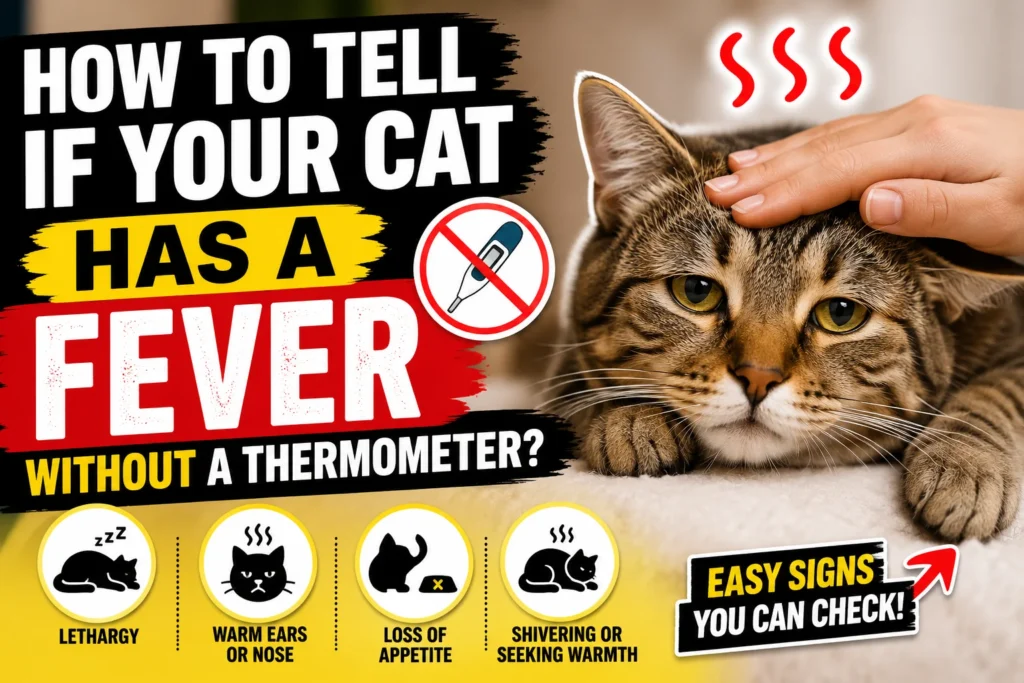
Cat Has a Fever Without a Thermometer. As a cat owner, you know the feeling. Your feline friend is acting strangely hiding more than usual, refusing their favorite treat, or feeling a little too warm to the touch. Your first instinct might be to reach for a thermometer. But what if you don’t have one handy? Or what if your cat transforms into a furry tornado of claws the second you try to take their temperature?
You are not alone. This is one of the most common dilemmas in pet parenting.
While a digital rectal thermometer is the gold standard for accuracy (a normal cat temperature ranges from 100.5°F to 102.5°F), there are reliable, clinical signs you can observe at home to determine if a fever is likely.
The “Touch Test” – Why It’s Tricky
Many owners touch their cat’s nose. Let’s bust that myth immediately, A warm, dry nose does NOT equal a fever. A cat’s nose can be dry and warm because they just woke up, are dehydrated, or are in a warm room.
Instead of the nose, focus on the hidden hotspots. Feel your cat’s ears (the inner pinna), paw pads, and groin area (armpits). Use the back of your hand or your wrist these areas are more sensitive to temperature than your fingertips.
- What to look for: If the ears feel significantly hotter than usual against your wrist, and the paw pads feel unusually warm, a fever is plausible.
- The “Other Cat” comparison: If you have a second healthy cat, compare their ear temps. A feverish cat will feel distinctly warmer than a healthy housemate.
Also Check: How to Care For a Pregnant Cat at Home?
10 Clinical Signs Cat Has a Fever Without a Thermometer
A fever is the body’s natural defense mechanism against infection. It is a systemic response. Look for these behavioral and physical changes:
1. Lethargy and Low Energy
The most consistent sign. Your cat may sleep in the same spot for hours without moving. They might not greet you at the door or play with their favorite toy. Think of it as your cat pressing the “pause” button on life to fight off illness.
2. Loss of Appetite (Anorexia)
A feverish cat will almost always refuse food. If your cat walks to their bowl, sniffs the food, and walks away, that is a red flag. Water intake may also drop, leading to dangerous dehydration.
3. Rapid Breathing or Panting
Cats do not pant like dogs. If your cat is panting with their mouth open, tongue out, or breathing very shallowly and quickly (more than 40 breaths per minute while resting), this is a serious sign that their body is overheated or in distress.
4. Glassy or Watery Eyes
Look closely at their eyes. A fever often causes the eyes to lose their bright, glossy sheen. They may appear dull, watery, or half-closed (often called “squinching” due to discomfort).
5. Shivering or Trembling
Even in a warm room, a cat with a high fever may shiver. This is the body’s attempt to generate heat, even though it is already too hot. If your cat is shaking but not cold, suspect a fever.
6. Decreased Grooming (The “Greasy” Coat)
Healthy cats are fastidious groomers. A feverish cat feels too sick to groom. You will notice the fur becoming messy, spiky, or greasy looking, especially on the head and back.
7. Hiding and Antisocial Behavior
Cats instinctively hide when sick. If your normally social lap cat suddenly vanishes under the bed or inside a closet, they are likely febrile.
8. Purring (But Not Happy)
Surprisingly, cats often purr when in pain or very ill not just when content. If your cat is hiding and purring loudly, do not assume happiness. This is a self soothing mechanism during fever or pain.
9. Stiff Gait or Reluctance to Jump
Fever causes body aches and joint pain. Watch your cat approach the sofa. Do they hesitate? Do they walk with a stiff, careful gait? They are likely feeling systemic inflammation.
10. Hot Ears, Paws, and Groin
Revisit the “touch test.” If all three areas (ears, paw pads, and the hairless part of the groin) feel hot to the back of your hand, combined with the symptoms above, the probability of a fever is very high.
When to Go to the Vet Immediately
A fever is a symptom, not a disease. If you suspect a fever based on the above signs, you need a veterinarian to find the cause (infection, inflammation, toxin, or injury).
You must go to an emergency vet if your cat shows any of these red flags:
- Difficulty breathing (open mouth breathing for more than 30 seconds).
- Vomiting or diarrhea (especially with blood).
- Refusal to drink water for more than 12 hours.
- Collapse or seizures.
- Yellowing of the gums or eyes (jaundice).
Do Not Give Human Medicine
This is critical: Never give your cat Tylenol (acetaminophen), Advil (ibuprofen), or Aspirin. These are toxic to cats and will cause liver failure or death. Even a quarter of a pill can be fatal.
How to Help at Home (Before the Vet)
If your cat has a fever but is alert and drinking small amounts, you can help lower their temperature slightly on the way to the clinic:
- Cool, not cold: Wet a towel with cool (not ice-cold) water and gently stroke it over their paw pads and ear tips.
- Hydration: Offer ice cubes or low-sodium chicken broth (no garlic/onion) to encourage drinking.
- Isolation: Keep them in a cool, quiet, dark room to reduce stress.
Final Verdict
While you cannot get a precise temperature without a thermometer, you can absolutely determine if your cat is sick enough to warrant a vet visit. If your cat has stopped eating, is hiding, and feels hot to the touch trust your gut and go to the vet.
Frequently Asked Questions (FAQs)
Can I use a human forehead thermometer on my cat?
No. Human forehead (temporal) thermometers are calibrated for skin heat loss, not fur. They are inaccurate for cats. Ear thermometers for humans also do not fit the L-shaped cat ear canal.
What is a normal cat temperature vs. a fever?
Normal: 100.5°F to 102.5°F (38°C to 39.2°C). A fever is clinically defined as anything over 103°F (39.4°C). Over 106°F (41.1°C) causes organ damage.
Why does my cat feel hot but acts normal?
If a cat feels warm but is eating, playing, and grooming normally, they likely do not have a fever. They may be in a warm environment or have just exercised.
Will a fever go away on its own in cats?
Sometimes mild viral fevers resolve in 24-48 hours. However, bacterial infections, abscesses, or serious diseases will not. If a fever lasts more than 24 hours or worsens, see a vet.
How do vets take a cat’s temperature?
Vets use a pediatric digital rectal thermometer with lubrication. It takes 10 seconds. Some clinics use an injectable microchip or an auricular (ear) thermometer designed for cats.
Can stress cause a fever in cats?
Yes. “Stress hyperthermia” is real. A nervous cat at the vet may have a temp of 103.5°F due to fear. Vets usually recheck after 10 minutes of calming.
My cat’s ears are hot, but paws are cold. Fever?
Possibly not. Cold paws indicate poor circulation or shock. If ears are hot but paws are cold and gums are pale, this is an emergency (possible heart failure or shock), not just a fever.
How can I keep my cat calm to check for fever signs?
Wrap them in a towel (kitty burrito) to check paw pads and ears. Talk softly. If they resist violently, stop. Forcing restraint increases stress and fake fever signs.
What is “Rabbit Fever” (Tularemia) in cats?
Tularemia is a bacterial infection causing very high fever (106°F), lethargy, and abscesses. It is rare but serious. You cannot diagnose this without a blood test.
Is it safe to use a baby thermometer under the cat’s armpit?
Axillary (armpit) readings are 1-2 degrees lower than rectal. It is safer than nothing, but inaccurate. Add 1.5°F to your reading for an estimate, but still consult a vet.