Why Does My Cat Suddenly Hate My Other Cat?
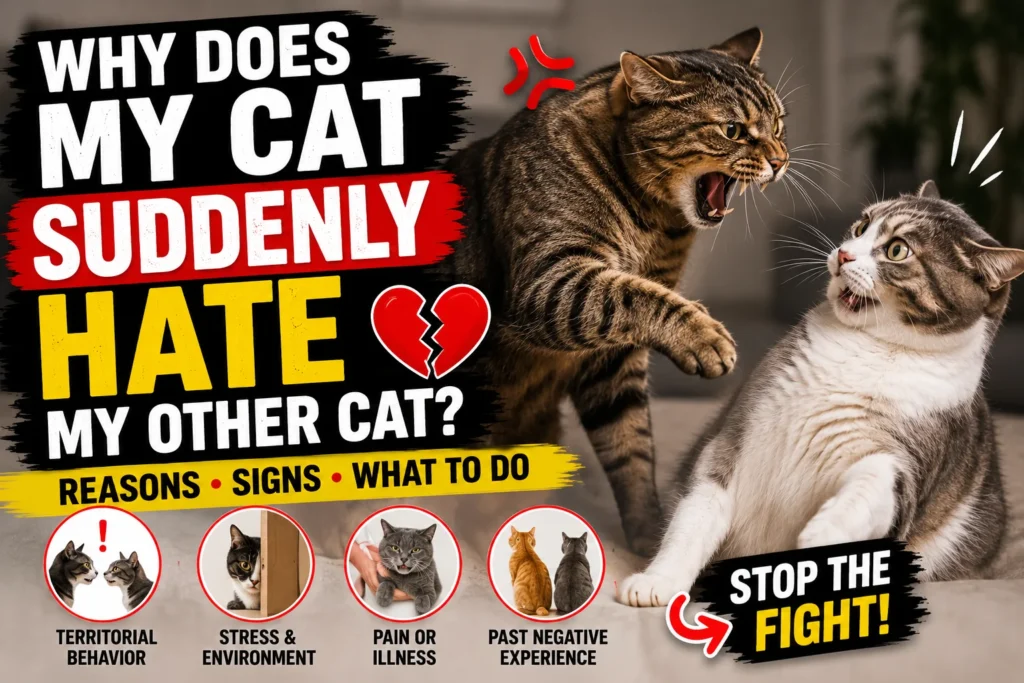
If you are asking, Why Does My Cat Suddenly Hate My Other Cat? you are not alone. This is one of the most distressing and common issues faced by cat owners.
Here is the hard truth: Cats do not feel “hate” the way humans do. What looks like sudden hatred is almost always a medical issue, a stress trigger, or a breakdown in social communication. As a veterinarian, I will walk you through the real reasons behind inter cat aggression and exactly how to fix it.
1. The First Suspect Medical Issues (Never Skip This)
Before assuming a behavioral problem, assume a biological one. Cats are masters of hiding pain. When a cat feels unwell, their survival instinct is to hide weakness, but chronic pain makes them irritable and defensive.
Common medical triggers:
- Dental pain (tooth resorption, gingivitis): A cat in mouth pain may swat at another cat who gets too close to their face.
- Arthritis (especially in seniors): Jumping off the sofa to avoid the other cat hurts. So, the arthritic cat hisses first to prevent contact.
- Hyperthyroidism or kidney disease: These cause high blood pressure, nausea, and increased irritability.
- Invisible injuries: A bite wound abscess from weeks ago can suddenly burst and cause a fever.
What to do: Schedule a vet visit for both cats immediately. Request blood work, a dental exam, and a pain assessment. Treating the underlying illness resolves the “hate” in over 40% of cases.
Also Check: How to Treat Hot Spots on Dogs at Home Fast?
2. Non-Recognition Aggression (The “Wrong Scent” Phenomenon)
This is the 1 reason cats suddenly attack a housemate they have lived with for years.
Your cat identifies family by scent. If one cat returns from a vet visit, a grooming appointment, or even a walk outside on a harness, they smell like antiseptic, other animals, or strange environments. To the resident cat, this is not their sibling it is a stranger intruder.
Real-life example: Cat A goes to the vet for a vaccine. Cat B smells the clinic on Cat A. Cat B hisses and swats. Cat A, confused, defends themselves. A fight erupts.
Fix: Isolate the returning cat in a separate room for 2–4 hours. Rub a towel on the resident cat, then rub it on the returning cat to transfer familiar scents. Reintroduce slowly over 24 hours.
3. Redirected Aggression (The Stranger at the Window)
This is the feline equivalent of “kicking the dog.” Your cat sees a trigger outside (a stray cat, a raccoon, a loud noise) but cannot reach it. The frustration and adrenaline have nowhere to go, so they turn and attack the nearest available target usually their housemate.
Signs: The attack occurs right after staring out a window, ears flattened, tail lashing. The target cat may have been sleeping peacefully nearby.
Fix: Block visual access to windows where intruders appear (use frosted film or blinds). Use Feliway Optimum diffusers to calm both cats. Separate them for 24–48 hours until cortisol levels drop.
4. Resource Guarding (Competition for Essentials)
Cats are solitary hunters by nature. In a home, if resources are scarce or poorly placed, one cat will bully the other to “own” the good stuff.
What triggers resource guarding:
- One shared food bowl (the dominant cat blocks access).
- A single litter box in a corner (an ambush point).
- The prime sunny spot on the cat tree.
Fix: Apply the N+1 rule number of resources = number of cats + 1.
- 2 cats = 3 litter boxes (in different rooms).
- 2 cats = 3 food/water stations (not side-by-side).
- 2 cats = 3 elevated resting spots (cat trees, shelves, window perches).
Do not place resources in dead end hallways where a cat can be trapped.
5. Social Maturity Shift (The 18–24 Month Turn)
Kittens and young adolescents (under 18 months) are socially tolerant. But as cats reach full social maturity (2–4 years), their adult personality emerges. A formerly playful pair may suddenly decide they no longer like sharing territory.
This is not hate it is a normal renegotiation of hierarchy. In healthy cases, it looks like one cat avoiding the other, not full blown fighting.
When to worry: Blood, urine spraying inside, one cat hiding 24/7, or refusing to eat.
When to accept: Occasional hissing and swatting without injury is normal cat communication. Do not punish allow them space.
6. Changes in Household Routine or Environment
Cats are neophobic (fearful of change). Even positive changes can trigger inter-cat aggression. Common culprits:
- Moving to a new home.
- New furniture or removed furniture.
- A new baby, roommate, or another pet (dog).
- A change in your work schedule (you are gone more).
Why this causes “hate”: The stressed cat feels insecure. They take it out on the other cat because that is the only variable they can control.
Fix: Re-establish a predictable routine. Use synthetic pheromones (Feliway Friends specifically for multi-cat households). Provide cardboard boxes and hiding spots to reduce stress.
Step-by-Step Reintroduction Protocol (The Only Method That Works)
If fighting has started, do not just “let them work it out.” That will make it worse. Follow this 3-step vet protocol:
Phase 1: Complete Separation (7–10 days)
Keep cats in separate rooms with their own food, water, litter, and toys. No visual contact. Swap bedding daily to mix scents.
Phase 2: Scent & Sight Trading
Feed them on opposite sides of a closed door. Slide a towel under the door. Once they eat calmly (no hissing), crack the door 1 inch with a baby gate so they can see but not touch.
Phase 3: Controlled Reintroduction
Use leashes or have two adults present. Allow 5-minute supervised sessions. End before any aggression. Gradually increase time. Do not rush this takes 2–6 weeks.
When to Seek Professional Help for Why Does My Cat Suddenly Hate My Other Cat?
Contact a veterinary behaviorist or a feline only behavior consultant if:
- Fights cause puncture wounds or abscesses.
- One cat stops eating or using the litter box.
- You have tried separation and reintroduction twice with no improvement.
- There is hissing, swatting, or stalking every single day for over 2 weeks.
Never punish cats for fighting punishment increases anxiety and worsens aggression. Never use physical force or water sprays.
Final Verdict
Your cats do not suddenly “hate” each other. There is a medical, environmental, or social trigger you have not yet identified. With patience, a vet checkup, and proper reintroduction, the vast majority of inter cat aggression resolves within 8–12 weeks. Your peaceful home can return.
Frequently Asked Questions (FAQs)
Can two cats who used to get along ever be friends again?
Yes, absolutely. In over 80% of cases, proper separation and gradual reintroduction restore a peaceful relationship. However, they may never be “cuddly” again tolerance without fighting is a success.
How long does it take for cats to accept each other after a fight?
At least 2 weeks for stress hormones to subside. Full reintroduction typically takes 3 to 8 weeks. Expect setbacks; that is normal.
Should I let them “fight it out” to establish dominance?
Never. That is dangerous advice. Cat fights can cause severe abscesses, feline leukemia transmission (via bites), and permanent fear based aggression. Always separate.
Why does my cat only hiss at my other cat after coming inside from the yard?
That is classic non recognition aggression. The outdoor cat smells different (grass, soil, other animals). Use the towel scent transfer method described above.
Can a new litter box location cause sudden aggression?
Yes. If you moved a litter box into a narrow hallway or next to a loud appliance, the more timid cat may feel trapped. The aggressor then ambushes them. Move boxes to open, quiet areas.
My cats were fine for 5 years and now hate each other. What changed most often?
In senior cats: arthritis or hyperthyroidism. In young adults: social maturity (age 2–4). Also check for a new stray cat outside your windows.
Will neutering/spaying stop inter-cat aggression?
If done before 6 months, it prevents most hormone-driven aggression. If done later, it reduces but does not eliminate already-learned aggressive behaviors. Still worth doing for health reasons.
What medication can help cats who hate each other?
Vets may prescribe gabapentin (for anxiety/pain), fluoxetine (Prozac for cats), or buspirone (to reduce fear based aggression). Never give human medication. Only under vet supervision.
Does Feliway actually work for multi-cat fighting?
Yes, but only Feliway Friends (blue label) which contains feline appeasing pheromone. The original Feliway (classic, red label) is for urine marking. Place one diffuser per room, and replace every 30 days.
When is rehoming one cat the right choice?
As a last resort if: one cat is chronically injured, the victim cat develops stress cystitis or refuses to eat, or after 6 months of professional behavior intervention with zero improvement. Rehome the aggressor to a single-cat home, not the victim.