
Why Is My Senior Dog Pacing Back and Forth in Circles at Night 2026?
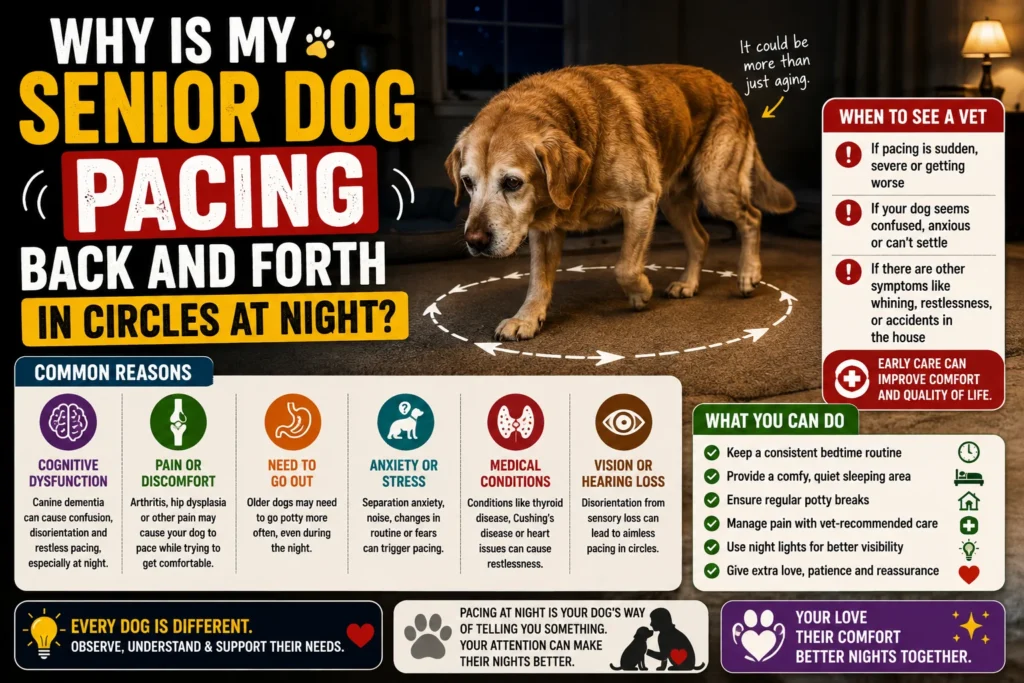
If you’re reading this, it’s likely that you’ve been roused from sleep by the usual and ever so familiar sound of your senior dog’s nails clacking on the floor. It’s 2:00 AM, your dog is walking in circles, and probably in very tight little, rather senseless circles at that. It has probably occurred to you that your senior dog is experiencing night time pacing. “My senior dog is pacing at night why?”
This is perhaps the most frequent and worrying concern that we find in senior veterinary care. First, take a deep breath. As a veterinary professional, the most important thing for you to know is that this is NOT your fault as a pet owner.
Night-time pacing is almost always a medical issue, not a behavioral fault in your dog.
When it comes to night time pacing, the cause can be almost anything while the symptom remains identical, i.e. Walking in circles!
The great thing about night time pacing is that by playing a ‘detective’ and observing patterns, you often can identify the underlying problem, especially as we break down the causes of pacing into the ‘big three’. They are Cognitive Dysfunction (Dog Dementia), Pain, and Neurological/Vestibular problems.
The 3 Main Causes of Nighttime Pacing in Senior Dogs
1. Canine Cognitive Dysfunction “Dog Dementia”
So What’s Happening? At home, the #1 reason I’ve found of late for senior dogs to be walking in circles at night, especially if they are over 10 years of age, is Canine Cognitive Dysfunction (CCD), more commonly referred to as “dog Alzheimer’s.” Alzheimer’s disease like degenerative process going on in the brain, CCD affects almost half of all dogs greater than 10 years of age!
How to spot it:
“Sun downing“: Just like humans experiencing dementia, signs in dogs often seem to develop and worsen around evening. Your dog may appear restless, pace, and become anxious around dusk also called “sun downing”. They may seem restless, pace back and forth repeatedly, get stuck on the exact same circle, or turn around.
Stare blankly at walls, struggle to navigate around furniture, and forget how to get back to the door of the house and not even remember to let me outside and house train house accident after accident Dog not sleeping during the daytime, sleeping during day at night The “DISH” Test This veterinary term refers to CCD signs and a way vet behaviorist remember it Disorientation , Interactions, Sleep Wake and House soiling .
If it does, it’s a near certain CCD diagnosis.
2. Physical Pain
A common assumption is that the dog is “nervous” or “just old”, but in many cases the pacing is actually an expression of unbearable physical pain . Dogs are a resilient bunch and seldom whimper or cry but they do pace.
How to spot it:
- The Pain Pacer: They may pace around trying to find a position in which they don’t hurt. The dog may lie down, only to immediately stand up again, circle, and try yet another.
- Difficulty in movement: May be hard to get up, have stiff legs, will not jump on and off the couch, may not go up stairs. Arthritis or hip dysplasia may be indicated.
- Posture: Lower head carriage, humped back, panting even though the temperature is cool.
- Restlessness: Unlike a dementia patient who loses the ability to find bed it all (they just may roam around without stopping), they ‘find’ their bed and can then not settle down.
3. Vestibular Disease & Neurological Issues
Sometimes, however, the pacing of that dizziness is less the mind reeling and more the body spinning around you. Balance, for the most part, is handled by a tiny inner ear network called the vestibular system. In its absence, everything just spins like crazy.
How to spot it:
- Circle All The Way To The “One Way”: Your dog always circling to one direction (clockwise or counterclockwise) is a red flag that the dog may have an neurological problem or problems with middle/internal ear.
- Head Tilt: Your dog often looks with one tilt of its head to the side. Nystagmus: The dog’s eyes move back and forth erratically (quick darts).
- Stumbling: Falling, acting dizzi, unable to walk without staggering, weaving etc (ataxia).
Cautionary Note: It is crucial for these signs and symptoms (severe circling, head tilt, vomiting) and the dog exhibiting them not to delay seeking the care of a veterinarians. Although most Old Dog vestibular disease clears up on its own there may be other serious conditions, (stroke, brain tumor) which may need treatment.
Differential Diagnosis The “Pain Trial” Method
What’s the difference?
It can sometimes be hard to distinguish between pacing from dog dementia and pacing from pain (and it is possible for both to be happening). If your veterinarian can’t tell the difference on examination, she may ask you to do a ‘Pain Trial’.
What is a Pain Trial?
Your vet will provide a few days’ supply of anti-inflammatory dog pain relief (an example of a common one your vet might prescribe is carprofen, often referred to as Remedy, Navex, or generic carprofen), suitable and safe for your dog to take.
If your dog’s “anxiety and pacing” stopped or became significantly less prominent during the treatment, then physical pain was the underlying cause, and physical pain is being treated. If behavior issues don’t change or are no different, even with adequate dog pain meds, your vet begins leaning towards dementia/cognitive decline.
How to Help Your Senior Dog Rest Tonight
During the time you’re waiting to get into the veterinarian there are several things that you can do for yourself and your dog, to put both you and he to sleep.
For Pain Relief
- Upgrade the Bed. Go the extra mile and supply an orthopedic memory foam bed. A firm dog bed can cushion sore joints and relive pressure .
- Avoid Slip Factor .
- Lay rugs or yoga mats on any smooth or slippery flooring areas. If your dog is suffering, they may “pace” out of fear that they could slip . Relax with a Walk. Take a short (less than 5 minutes) slow walk together prior to bed to ease stiff joints ..
For Cognitive Dysfunction (Dementia)
- Nightlights: Use a dim light in their hallway and beside their bed. This may minimize disorientation should they wake and stumble their way out of their slumber. Do not reorganize the furniture: The routine the demented dog is used to should remain the same, providing them with familiarity.
- White Noise: A fan or a white noise machine should mute jarring noises.
- The sounds of constant white noise may have a calming effect as well.
When to See the Vet
If your senior dog is exhibiting any new signs of pacing, circling, or nighttime restlessness, they need to see a veterinarian. These symptoms are rarely “just because” and often indicate a treatable medical condition or a manageable disease.
Do not wait if you see:
- Sudden collapsing , vomit or labored breathing .
- Signs and symptom include the following
- Head press , and difficulty walking Difficulty getting to sit up * Seizures.
For More Info: How to Use an Orthopedic Dog Bed to Reduce Hip Dysplasia Pain 2026
Frequently Asked Questions (FAQs)
What is “sundowning” in elderly dogs?
Sundowning refers to a set of symptoms that occur specifically in the late afternoon and evening in dogs with Canine Cognitive Dysfunction (CCD). It involves increased agitation, restlessness, pacing, and vocalization as the sun goes down, similar to what Alzheimer’s patients experience .
Can anxiety cause a senior dog to pace in circles at night?
Yes. Anxiety can definitely cause pacing. However, in senior dogs, anxiety is often a secondary symptom caused by the confusion of dementia or the vulnerability of physical pain . If the anxiety is situational (like a storm), it is often anxiety alone .
Why is my dog walking in circles but doesn’t seem to be in pain?
If the circling is in one direction and involves a head tilt, it is likely a vestibular issue. If it is aimless wandering that looks confused, it is likely cognitive dysfunction . Pain doesn’t always look like limping; it often looks like panting and restlessness.
Why does my dog pace at night but sleep fine during the day?
This is a classic sign of Canine Cognitive Dysfunction. The dog’s internal clock (circadian rhythm) is broken, so they sleep deeply during the day and become confused and restless at night .
Is it normal for old dogs to pace in circles before lying down?
Spinning a few times before lying down is a normal nesting instinct from their wild ancestors to flatten grass and check for dangers . However, if the circling is excessive, frantic, or happens for extended periods without lying down (especially at night), it is a sign of a medical problem .
Can a brain tumor cause a senior dog to pace in circles?
Yes. A brain tumor can cause neurological issues that lead to pacing, disorientation, and circling. This is usually accompanied by other signs like seizures, behavioral changes, or vision loss .
How can I calm my elderly dog down at night to sleep?
Try a combination of a soft orthopedic bed, a nightlight, a “last call” slow walk, and a white noise machine. Sticking to a strict bedtime routine helps signal to the brain that it is time to rest .
What is the “DISHA” acronym?
DISHA is a tool used by vets to diagnose Canine Cognitive Dysfunction . It stands for:
Disorientation (getting stuck)
Interactions (social changes)Sleep wake cycles (night pacing)
House-soiling (accidents)
Activity changes (anxiety/pacing).
Does my dog need medication for this?
Possibly. If diagnosed with CCD, there are specific medications and therapeutic diets (like Hill’s b/d) that can slow cognitive decline and help them sleep better at night . If pain is the issue, anti-inflammatories are available. Treatment can significantly improve quality of life, but it requires a prescription.
How do vets test for dog dementia?
There is no single blood test for dog dementia. Your vet will diagnose it by ruling out other medical conditions (via bloodwork, urine tests, and physical exams) and evaluating the behavioral symptoms you are seeing at home .