Signs Your Cat Is Stressed Out After Moving to a New House
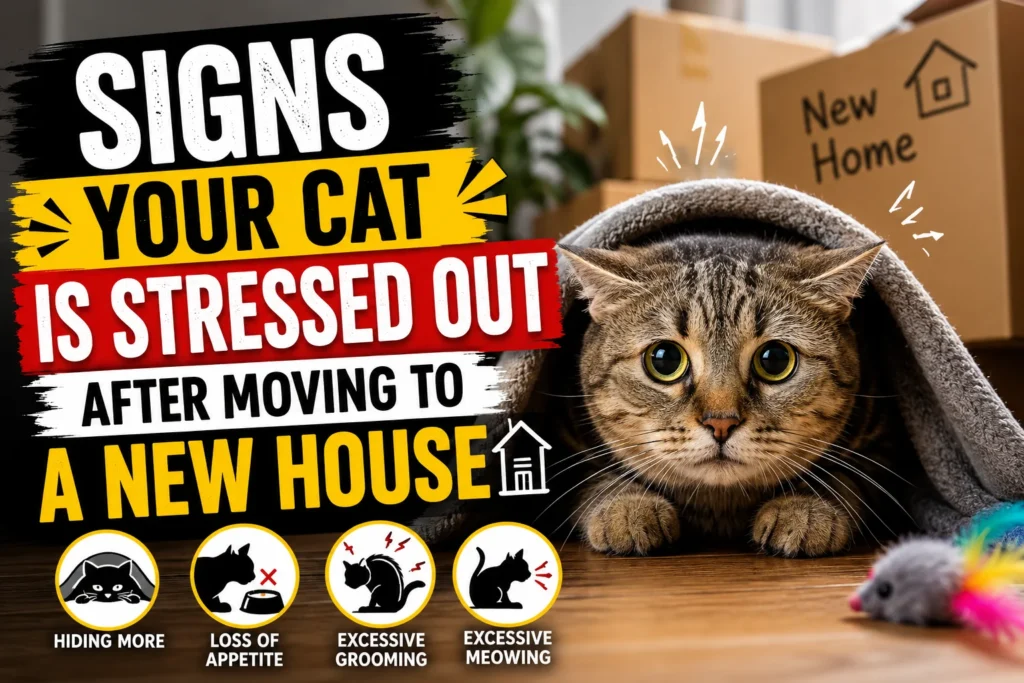
Signs Your Cat Is Stressed Out After Moving to a New House, Moving is often listed as one of life’s most stressful events not just for humans, but for our feline companions as well. Unlike dogs, who may adapt quickly to a new pack dynamic, cats are territorial creatures. They thrive on predictability and the familiar scent of their home.
When you move to a new house, your cat doesn’t see an “upgrade” or a “better kitchen.” They see a foreign, scentless void filled with strange noises. If left unchecked, this stress can morph into depression or physical illness.
As a veterinarian, I often see “moving related stress” misdiagnosed as bad behavior. Here is exactly what to look for and when to call the vet.
Signs Your Cat Is Stressed Out After Moving to a New House
1. Hiding The 1 Red Flag
In the wild, a sick or scared cat hides to avoid predators. In your new living room, the same instinct applies.
- The sign: Your cat disappears for 12+ hours. They might squeeze behind the washing machine, inside box springs, or inside the couch frame.
- When to worry: If they refuse to come out for meals or to use the litter box for 24 hours.
2. Changes in Vocalization (Meowing or Silence)
Cats use meows specifically to communicate with humans. Stress changes this frequency.
- The sign: Excessive, mournful yowling (searching for their “old territory”) or total, uncharacteristic silence (a sign of shock).
- The nuance: A stressed cat’s meow often sounds lower pitched or rougher than their usual “feed me” chirp.
3. Over-Grooming (Fur Mowing)
You might notice bald spots on the belly or inner legs.
- The science: Grooming releases endorphins. When stressed, cats self soothe by licking until they remove fur or cause skin lesions.
- Visual cue: “Mown fur” (stubbly, uneven patches) vs. natural shedding.
4. Litter Box Aversion (The Deal Breaker)
This is the 1 reason cats are surrendered to shelters post move.
- The sign: Peeing on your bed, dirty laundry, or in corners. Defecating just next to the litter box.
- Why it happens: The box is in a new location, the room smells wrong, or the cat is too scared to walk down the hallway to reach it.
5. Appetite Changes
Stress directly impacts a cat’s GI system.
- The sign: Leaving food untouched for 24 hours, or conversely, stress eating dry food until they vomit.
- Danger zone: Cats who refuse food for 48 hours are at risk of hepatic lipidosis (fatty liver disease), which is fatal without treatment.
6. “Poofy” Tail and Arched Back
Body language doesn’t lie.
- The sign: Pilorection (hair standing on end) making the tail look 2x its size, even when no other animal is present. Also, flattened ears (airplane ears) and dilated pupils.
7. Excessive Sleeping
Cats sleep 12-16 hours normally, but a depressed cat sleeps 20+ hours.
- The sign: They don’t shift positions, don’t react to sounds, and seem “checked out.” This is often mistaken for adjusting well, but it is actually learned helplessness.
8. Aggression (Unexpected Biting or Hissing)
Your previously gentle lap cat may hiss at you when you approach.
- The trigger: Redirected aggression. They are scared of the house but cannot attack the house, so they attack the nearest moving thing (you or your child).
9. Marking (Spraying)
Different from litter box issues. Spraying is communication.
- The sign: The cat backs up to a wall or door, tail quivering, and releases a small amount of urine. The smell is pungent. They are trying to map their new territory with pheromones.
10. Panting or Open Mouth Breathing
Cats are not dogs. They do not pant from exercise.
- The sign: Rapid, open mouthed breathing with tongue out.
- Emergency: If this lasts longer than 30 seconds post move, it could be anxiety induced asthma or a heart condition. See a vet immediately.
Also Check: How to Train a Parrot to Sit on Your Finger?
How to Fix Moving Stress
You don’t need medication for every stressed cat. Use the “Base Camp” method:
- Confine to one room: Unpack the living room later. For the first 72 hours, keep the cat in a small, quiet room (bathroom or bedroom) with their old bed, old litter box (don’t wash it yet), and food.
- Feliway Diffusers: These release synthetic happy pheromones. Plug one in the base camp 24 hours before the cat arrives.
- Don’t force cuddles: Let the cat come to you. Sit on the floor and read aloud (calm voice) without touching them.
- Scent swapping: Rub a sock on their cheek (where scent glands are) and wipe it on the new walls and door frames.
Disclaimer: If hiding or not eating persists beyond 48 hours, visit your DVM for short term anti-anxiety medication (e.g., gabapentin).
The Bottom Line
A stressed cat isn’t a “bad cat.” They are a terrified animal missing their map. With patience, vertical space (cat trees), and routine, 90% of cats will settle into their new home within two weeks.
Frequently Asked Questions (FAQs)
Should I show my cat the empty rooms?
No. Large, empty rooms echo and amplify strange sounds, which is terrifying for cats. Introduce one small, furnished room first, then gradually open doors.
Is it better to move the cat first or last?
Last. Move the cat when the heavy furniture is inside and the front door is closed. Moving the cat first exposes them to doors opening/closing and shouting movers, which is traumatic.
Why is my cat suddenly scared of me after moving?
You smell like the new house (cardboard, dust, paint). Your scent changed. Once you sit still and wear an old t-shirt from the old house, they will recognize you again.
Can moving cause a urinary blockage in male cats?
Absolutely. Stress is a leading cause of Feline Idiopathic Cystitis (FIC). If your male cat strains in the litter box, cries, or produces no urine, this is a life threatening emergency requiring immediate vet intervention.
Do cats miss their old owner if the owner moved away?
Cats bond to location, then people. They will not “miss” a neighbor, but they will miss the routine of watching that neighbor. Keep feeding times exact to provide security.
My cat is eating, but throwing up. Is that stress?
Yes. Stress colitis/gastritis is common post-move. Feed small amounts of bland food (plain boiled chicken). If vomiting persists for 2 days, see the vet.
Does CBD oil work for cat moving stress?
While anecdotal, veterinary studies are lacking. Over-the-counter CBD is unregulated. For severe stress, prescription medications (like gabapentin) from your vet are safer and more reliable.
What is the best thing to do on the first night?
Leave a low-wattage nightlight on and a radio playing classical music at low volume. Do not lock them in a dark basement. Dark + Quiet + Alone is a horror movie for a stressed cat.