Why Does My Dog Lick His Paws Constantly Till They Are Red?
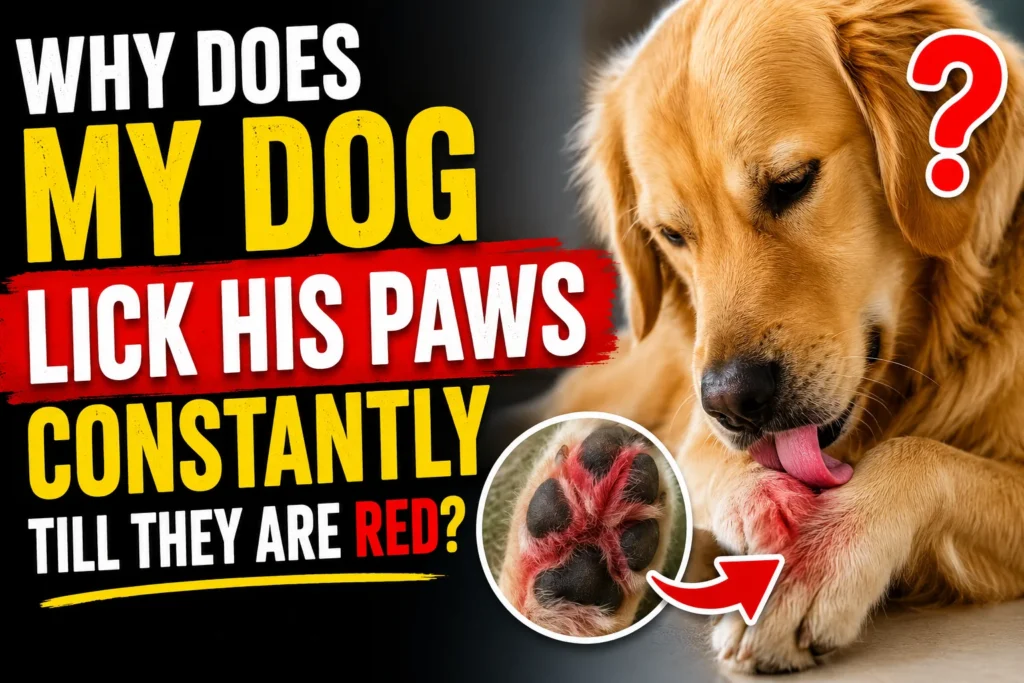
Why Does My Dog Lick His Paws Constantly Till They Are Red? As a veterinarian, I see this daily. A worried owner walks into my clinic, points to their dog’s feet, and asks, “Why can’t he stop?” The paws are often stained brown, wet from saliva, and raw with red, inflamed skin.
Paw licking is normal grooming behavior until it isn’t. When a dog licks constantly, obsessively, to the point of redness (erythema) or swelling, it is no longer a habit; it is a medical cry for help.
If you’ve noticed your dog spending hours nibbling between the toes or waking you up with that slurping sound at 2 AM, you need answers. Below, we break down the medical “why” and the practical “how to stop it.”
Why Does My Dog Lick His Paws Constantly Till They Are Red?
1. Allergies: The 1 Silent Aggressor
In my clinical practice, 85% of chronic paw licking cases trace back to atopic dermatitis (environmental allergies). Unlike a human sneezing, a dog’s allergy shows up in their feet.
- Environmental: Pollen, dust mites, mold, and grass. The paws absorb allergens directly from the ground.
- Food: Chicken, beef, dairy, or wheat. Food allergies often cause year-round licking, not just seasonal.
- Contact: New carpets, lawn chemicals, or floor cleaners.
The Veterinary Insight: Red paws from allergies are usually itchy first, red second. If your dog also licks his armpits, groin, or rubs his face, allergies are almost certainly the culprit.
2. Secondary Yeast and Bacterial Infections (The “Frito Feet” Clue)
Here is the vicious cycle: Licking makes paws moist. Moisture breeds yeast and bacteria. The infection itches more, so the dog licks more.
The Smell Test: Take a sniff. If your dog’s paws smell like corn chips or stale tortillas, that is Pseudomonas and Proteus bacteria (colloquially called “Frito feet”) mixed with yeast overgrowth.
- Redness: Usually between the toes and deep in the pads.
- Discharge: Brownish-red staining (porphyrins from saliva) on white fur.
Treatment warning: Antibiotics won’t stop the licking unless you stop the underlying cause. You must treat the infection and the itch.
3. Pain & Orthopedic Issues (The Limping Lick)
Dogs are masters of hiding pain. They don’t cry; they lick. If your dog is only licking one front paw, look higher up.
- Arthritis: Pain in the shoulder or elbow radiates down, causing neuropathic licking of the foot.
- Broken nails or cracked pads: A tiny thorn or grass seed (foxtail) lodged between the toes.
- Lyme Disease: Joint pain often presents as obsessive paw licking.
The Vet Test: Gently press between your dog’s toes. If he flinches or pulls away, you aren’t dealing with a habit you are dealing with a painful foreign body or joint issue.
4. Boredom, Anxiety & Canine Compulsive Disorder
We call these “lick granulomas” in the clinic. A dog left alone for 10 hours, under-stimulated, or suffering from separation anxiety will lick to release endorphins. It is self-soothing, akin to a human biting their nails.
How to spot behavioral licking:
- It happens mostly at night or when the owner leaves.
- The dog stops when you walk into the room.
- The redness is localized to one spot on the top of the paw (not between toes).
Crucial distinction: Behavioral licking starts as a habit. But once the skin is red and raw, it becomes medical due to secondary infection. You must treat both the brain and the skin.
5. Parasites (Beyond Fleas)
Fleas usually bite the back and tail, but Sarcoptes scabiei (mange mites) love the feet and elbows. Also, check for:
- Harvest mites (chiggers): Seen in late summer/fall. They appear as tiny orange dots between the toes.
- Hookworms: Rare, but some intestinal parasites migrating through the skin cause pruritus (itching) on the paws.
The “Red Paw” Grading Scale (When to see a Vet)
- Mild (Pink): Occasional licking after walks. Action: Clean with chlorhexidine wipes.
- Moderate (Red with staining): Licking multiple times an hour. Action: Vet visit for allergy meds.
- Severe (Bleeding, swelling, pus): Licking non-stop, limping, or whining. Action: Emergency vet. Risk of amputation if infection reaches bone.
Also Check: Why Do Budgies Lose Feathers Around Their Eyes?
5 Vet-Approved Steps to Stop the Licking TODAY
Step 1: The Cone is Not Punishment
Buy an inflatable donut or plastic e-collar. You cannot heal a red, open wound if the dog is re-traumatizing it with a sandpaper tongue every 5 minutes. Wear it at night.
Step 2: The “Soak & Dry” Protocol
Fill a tub with lukewarm water and Betadine (dilute to the color of iced tea) or chlorhexidine solution. Soak paws for 3-5 minutes. Crucially, dry completely between toes with a hair dryer on cool setting. Moisture is the enemy.
Step 3: Change the Diet (Elimination Trial)
Stop chicken and beef for 8 weeks. Switch to a novel protein (Venison, Rabbit, or Hydrolyzed protein prescription diet). You will not see results for 4-6 weeks. Be patient.
Step 4: Medicated Topicals (Do not use human creams)
Never use hydrocortisone cream on a dog who will lick it they ingest the steroid. Use Vetericyn Plus or Zymox (enzymatic) which are non-toxic if licked.
Step 5: Environmental Enrichment
For anxious lickers: Frozen KONG toys, sniffing mats, and 20 minutes of “nose work” (hiding treats) burns mental energy better than a 2-mile walk.
Final Veterinary Verdict
Do not wait for the paws to bleed. Chronic licking changes the skin’s structure (lichenification), making it permanently thickened, wrinkled, and prone to recurrent infection. The sooner you diagnose why allergy, infection, pain, or anxiety the sooner your dog stops suffering.
Action item today: Call your vet for a cytology test (tape sample of the red skin). It costs ~$40 and tells you exactly if you need antibiotics, antifungals, or allergy meds in 10 minutes.
Frequently Asked Questions (FAQ)
Is it normal for dogs to lick their paws?
Yes, a few licks as part of grooming (especially after eating or going outside) is normal. Constant licking (more than 5-10 minutes consecutively) that causes redness is pathological.
Will Benadryl stop my dog’s red paws?
Possibly, but rarely. Benadryl (diphenhydramine) is weak for dogs. A veterinarian-prescribed Apoquel or Cytopoint injection works within hours for allergies. Never give human dosages; ask your vet first.
Can I use apple cider vinegar on red paws?
No. Vinegar stings open, raw skin. It is acidic and can cause chemical burns on red tissue. Use diluted chlorhexidine or saline only.
Why are my dog’s paws red AND brown?
The brown color is porphyrin from saliva. When dogs lick, the enzymes in their saliva stain white fur rusty red or brown. It indicates chronic licking, even if you don’t see them doing it.
My dog only licks his paws at night. Why?
Nighttime licking usually signals boredom (quiet house) or environmental allergies (pollen settles on the floor during the day; at night, he lies down and feels the itch).
Could it be a food allergy if he also has ear infections?
Absolutely. The “Paw-Ear Axis” is real. 50% of dogs with chronic paw licking also have recurrent yeast ear infections (smelly, brown discharge). Treating the food often cures both.
How fast do antibiotics work for infected red paws?
You will see reduced redness in 3-5 days, but the licking behavior may continue for 2 weeks. Always finish the full course (10-14 days). Stopping early creates resistant bacteria.
What is a “lick granuloma”?
A thickened, raised, hard, red plaque of scar tissue usually on the front of the wrist (carpus). It is incredibly hard to cure because the dog gets “stuck” in a compulsive loop. Requires behavior meds like fluoxetine (Prozac) from a vet.
Do dog shoes/boots help?
Yes, for contact allergies (salt, grass, chemicals). No, for yeast infections (boots trap moisture and worsen yeast). Use boots only for short walks on treated lawns or hot pavement.
When is paw licking an emergency?
When the paw swells to double its size, has black/purple discoloration, or you see a red streak going up the leg (lymphangitis). Also, if the dog stops eating or has a fever. This indicates a bone infection (osteomyelitis) requiring IV antibiotics.