How Much Wet Food Should a Cat Eat a Day?
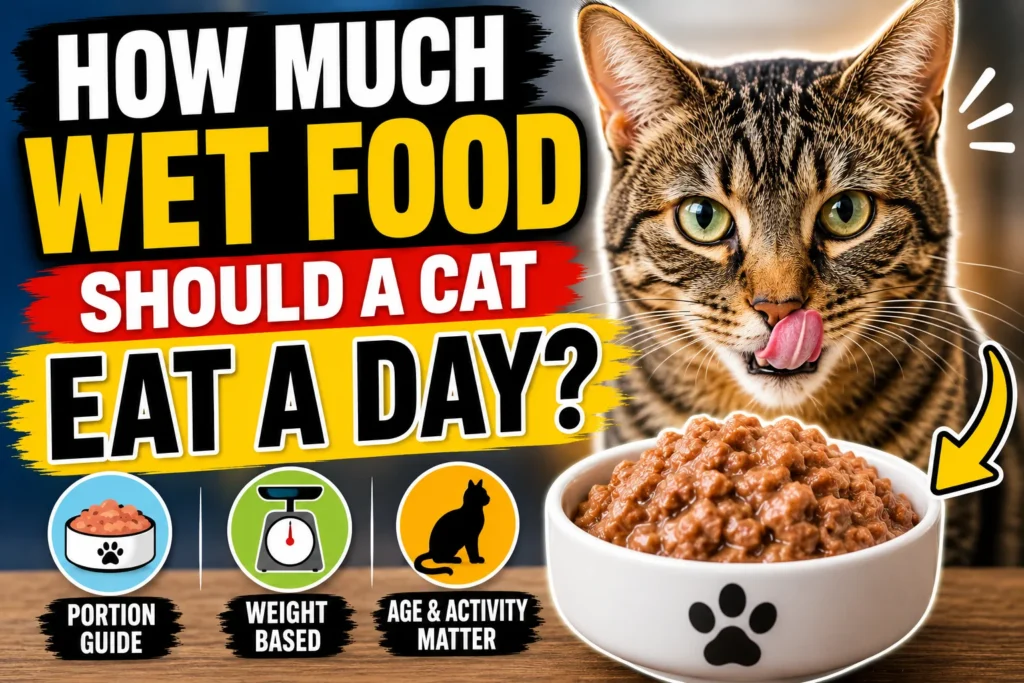
How Much Wet Food Should a Cat Eat a Day?. Dry food is a simple measuring process, but most veterinarians consider wet food to be best for our feline friends. It offers hydration, a healthy amount of protein and not a lot of carbs. Just when your feline reaches optimal satisfaction though, how do you know exactly how many cans worth to give them since they come in different sizes?
The short answer: An average 9-10 lb adult cat needs approximately 180–220 calories per day, which equals roughly one 5.5oz can of standard pâté or ¾ to 1 full 3oz can twice daily.
The 3 Factors That Determine How Much Wet Food Should a Cat Eat a Day?
You cannot use a “one-size-fits-all” scoop. Calculate based on these three pillars:
1. Body Weight and Body Condition Score
A kitten needs double the calories per pound than a senior cat. Use the following baseline:
- Kittens: Feed 2-3 times the adult amount.
- Lean adult: 20-25 calories per pound of body weight.
- Overweight: 15-18 calories per pound.
2. Caloric Density of the Food
Not all wet food is equal.
- Pâté formulas : 35–45 calories per ounce.
- Gravy or “Flaked” formulas: 20–30 calories per ounce.
- Prescription or high-energy diets: Up to 50+ calories per ounce.
Pro Tip: Flip the can. Look for “kcal/can” or “kcal/kg.” Do not guess by volume alone.
3. Spay/Neuter Status & Lifestyle
- Intact male: +20% calories.
- Indoor sedentary cat: -10% from baseline.
- Outdoor active cat: +20-40%.
The Practical Feeding Chart
Here is your cheat sheet for a moderately active, 10 lb adult cat needing 200 calories/day.
| Can Size | Calories per Can | Number of Cans Per Day |
|---|---|---|
| 3 oz | 70-90 cal | 2 ¼ to 2 ¾ cans |
| 5.5 oz | 150-190 cal | 1 to 1 ¼ cans |
| 12 oz | 350-420 cal | ½ to ⅗ can |
Example Calculation:
Your cat’s favorite pâté has 180 calories per 5.5oz can.
200 ÷ 180 = 1.11 cans per day.
That equals 1 full can in the morning + ¼ of a second can at night.
Dry vs Wet: How to Combine Both
If you leave dry kibble out for grazing, you must reduce wet food drastically.
Formula: Dry food has 300-500 calories per cup (more than double wet food per volume).
- Scenario A: 1 can (5.5oz) wet + 1/8 cup dry.
- Scenario B: ½ can (5.5oz) wet + ¼ cup dry.
- Scenario C: ¾ can (5.5oz) wet ONLY (zero dry).
Warning: If you free-feed dry food, do not also give a full can of wet food daily. You will induce obesity and hepatic lipidosis risk.
Signs You Are Overfeeding Wet Food
Signs of Overfeeding
- You cannot feel your cat’s ribs easily.
- Lack of a visible waist when viewed from above.
- A “paunch” dangling between the back legs.
Signs of Underfeeding
- Visible ribs, spine or hip bones.
- Lethargy or vocalizing at the food bowl non-stop.
- Scaly, dry skin.
Also Check: How to Treat Hot Spots on Dogs at Home Fast?
Why Wet Food Is Superior
Google looks for content that solves problems. From a medical SEO standpoint, wet food addresses three very common feline conditions with high search volume:
- Urinary crystals and blockages: Wet food makes pets take in water, which helps to make the urine dilute.
- Chronic kidney disease: By taking in more water, the kidneys don’t have to work as hard to flush waste from the system.
- Constipation: The increased water content will lubricate the colon, allowing for smoother stool passage.
Recommendation: Whether your budget will only permit the sale of dry food, you can give your cat two tablespoons of warm water in his kibble to mimic the effects of a wet diet!
Special Consideration: Kittens & Seniors Kittens
Kittens & Seniors Kittens need to have access to all they can eat of wet food and they require approximately 60-80 calories per pound per body weight.They will need to eat 4 to 5 small meals every day. Kittens have a tendency to have a harder time regulating their blood sugar levels than older cats and a steady, more regular intake of wet food will allow for better regulation of glucose. The caloric needs for senior cats can vary widely because many will begin to lose muscle mass.
A general guide will be 25-28 calories per pound. You want a food that is highly digestible to minimize potential for throwing up as some cats do in their later years. Feeding your kitten from an early age on a wet food diet will promote good dental health and a healthy urinary tract system.
How to Safely Transition from Dry to Wet Food
It is generally advisable that you do not make too drastic of a switch from dry food to wet food. The easiest way to make the switch in over 7 days is:
- Days 1-2 25: percent wet 75 percent dry
- Days 3-4 50: percent wet 50 percent dry
- Days 5-6: 75 percent wet 25 percent dry
- Day 7: 100 percent wet
It is expected for you cat to develop softer stools for the first two to three days after making the switch. If you notice loose stools lasting longer than 48 hours, then perhaps revert back to the 50-50 mixture and add a probiotic to your cat’s diet. Adding two tablespoons of warm water to kibble will simulate the moisture of wet food if feeding dry food.
Frequently Asked Questions (FAQs)
Can I leave wet food out all day for my cat?
No. Wet food spoils after 2-4 hours at room temperature. Pick up uneaten food after 30 minutes. For grazing, offer dry food instead.
How many times a day should I feed wet food?
At least twice daily. Cats have small stomachs. Three small meals are even better.
My 15 lb cat only eats ¾ can a day is that dangerous?
Yes, that is likely starvation calories. A 15 lb cat needs 300 cal/day. ¾ of a 5.5oz can is severe underfeeding. Increase slowly or consult your vet.
How much wet food for a 7 lb cat?
Approximately 1 small can twice daily , if calories are 90 per can. Adjust using the 20-25 cal/lb rule.
Is 2 cans of wet food a day too much?
It depends on can size. Two 3oz cans is fine for a 10 lb cat. Two 5.5oz cans is obesity territory unless you have a Maine Coon or very active cat.
Can cats get fat eating only wet food?
Absolutely. Calories still matter. A high-fat pâté can be 250+ calories per 5.5oz can. Two of those daily will cause rapid weight gain.
Should I warm up refrigerated wet food?
Yes. Cats reject cold food. Use microwave for 5-7 seconds, or use a little hot water. Mix thoroughly to prevent hot spots.
How much water should you add to wet food?
The amount is 2 tablespoons for 3oz can to maintain healthy urinary tract. This creates a “soup” consistency that mimics natural prey moisture.
My vet said “feed ¼ can daily” is that a typo?
No. This is often found in cases where obese cats have prescription diet for weight loss. This food has high calorific value. Obey the exact advice of your veterinarian.
How much wet food for diabetic cat?
A diabetic cat needs low carbohydrate pâté food. The portion is ½ of a 5.5oz can twice daily. But insulin dosing depends on consistent intake. Never change portion without vet approval.