
How to Keep an Active Puppy Quiet and Rested After Leg Surgery 2026
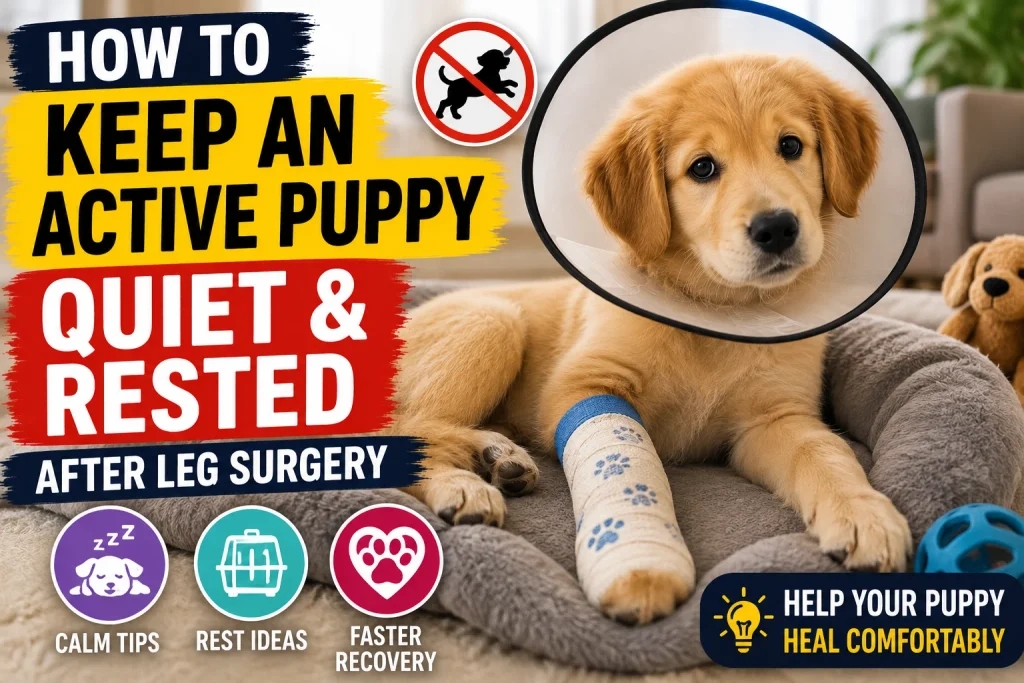
While bringing your puppy home after leg surgery is certainly a cause for celebration, very soon you might find that you have just swapped one concern for a thousand more. You are happy and relieve that surgery is over, but have the high-energy of your puppy bouncing around who truly has no idea why they aren’t allowed to jump and run and play.
This is perhaps the most difficult hurdle in caring for your recovering puppy. I, as a veterinary professional, can confidently say that holding an animal quiet isn’t just something that’s strongly encouraged after orthopedic surgery; the success of surgery often hinges on rest and recovery for 8-12 weeks (in cases for healing bone-plates/pins/sutures), or inadequate healing, inflammation, and potentially second surgery for hardware failure.
The Golden Rules of Post-Op Rest
As I said I wont go over all the fine details, I am trying to cover all the do’s that can’t be omitted. The veterinarian’s orders are supreme but the following holds true generally for all leg procedures.
1. Strict Confinement is Non-Negotiable
Your puppy’s world will need to shrink for a while. This means confining them to a crate, a small room, or an exercise pen when they are not under your direct supervision . This prevents them from sneaking off to jump on furniture or race up and down the stairs, which could jeopardize their recovery.
Prepare this space in advance. It should be comfortable, have a padded bed for joint support, and be large enough for them to stand and turn around comfortably, but not so large that they can work up a gallop.
2. The Leash is Your New Best Friend
Even if you have a securely fenced yard, your puppy must be on a short, fixed-length leash for every single bathroom break. This prevents the sudden, explosive sprinting that can happen when a pup gets excited to go outside. Lead them to their designated potty spot and lead them back in. This is not the time for sniffaris or backyard zoomies.
Also Check: Understanding Why This Gentle Giant is Prone to heart disease
3. Protect the Surgery Site
The dreaded “cone of shame” (Elizabethan collar) is the most effective tool to protect the incision . Your puppy may hate it, but it prevents licking and chewing, which can introduce infection, pull out sutures, or reopen the wound . Do not remove it early, no matter how much they beg . If they struggle with the plastic cone, ask your vet about alternatives like a soft, inflatable collar or a post-surgery bodysuit .
Practical Strategies for a Quiet Puppy
With the ground rules set, here’s how you can survive—and even thrive—during this period of forced rest.
Master the Art of Mental Enrichment
A tired brain is just as valuable as a tired body. Since physical exercise is off the table, you must exhaust your puppy mentally. The goal is to keep their mind engaged for as long as possible.
Start with food puzzles. Lick mats and puzzle feeders are a fantastic way to provide mental stimulation . Spread peanut butter, plain yogurt, or canned puppy food onto a lick mat and freeze it. A frozen treat takes much longer to finish, extending the enrichment period .
Make meals last. Instead of serving food in a bowl, scatter their kibble in a snuffle mat or use a maze toy . You can even hide their food around their confined area for a low-key “find it” game. The AAHA recommends using small-breed kibble to get more pieces for the same amount of food, keeping them busy longer without extra calories .
Introduce new, low-impact activities. Short, leashed “scent walks” where you simply let your puppy sniff around your yard or down the driveway can be incredibly enriching and tiring . If your puppy loves to watch things, consider putting on “Dog TV” or bird videos on a tablet for visual stimulation .
Consider Calming Aids
For naturally anxious or very high-energy puppies, you may need a little extra help to take the edge off. There are several veterinary-recommended options.
- Pheromone Diffusers: Products like Adaptil release a synthetic version of the calming pheromone mother dogs produce to soothe their puppies. A diffuser plugged in near their rest area can create a constant, reassuring scent.
- Calming Supplements: Ask your vet if a calming supplement like Zylkene could be appropriate for your puppy.
- Prescription Medications: If your puppy is truly struggling to settle, pacing, panting, or showing signs of distress, do not hesitate to contact your vet . They can prescribe safe, effective medications like trazodone or gabapentin to help your puppy relax during the crucial healing period without causing undue stress .
Rethink Your Interactions
Your own demeanor can affect how energetic your puppy is: if you’re jumpy and excited, they will be too. Work on calm, quiet interaction. When your puppy is about a month old, this is the time for soft, secure cuddles and stroking (instead of hyper-vigorous tummy rubs) and to talk to them in soft, calm tones. You can use this time to work with your dog’s love of being physically close: if your puppy’s “velcro dog” nature makes him feel insecure in a regular-sized crate, get an extra-large playpen that you can actually sit in with the puppy, to comfort him there without setting the precedent for him jumping up onto a sofa or a bed.
A Note on Your Puppy’s Progress
It’s incredibly common for puppies to seem like they’re walking well on their operated leg within just a few days of surgery. This is a great sign of their resilience, but it is not an indication that they are healed . The bone and internal tissues need 8 weeks or more to regain sufficient strength. Continue to enforce the rest protocol regardless of how well they appear to be moving .
Frequently Asked Questions (FAQs)
How long will my puppy need to be on strict rest after leg surgery?
The initial period of strict rest for most leg surgeries lasts at least 8 to 12 weeks. However, your vet will provide a timeline tailored to your puppy’s specific procedure, which may involve follow-up X-rays at 4, 8, and 12 weeks to monitor bone healing.
Can I take my puppy’s cone off for a while if I’m watching them?
It’s generally not recommended unless your veterinarian has given you the all-clear . Puppies are quick, and it only takes a second for them to lick or chew at their incision . If you must remove the cone for a brief moment, ensure you are giving them 100% of your undivided attention.
What can I give my puppy to chew on while they’re resting?
Chew items can really help but always check with your vet first because hard chews and food may not be appropriate after certain procedures. Long-lasting, high value chew items like frozen Kongs stuffed with approved puppy foods are usually a good and safe choice for your puppy.
Why is my puppy whining and pacing?
Your puppy may be in pain, stressed or bored. The first thing to do is rule out an empty bladder or bowel. If there are no medical reasons for pacing, offer them a new toy or mental puzzle. If pacing is very intense, you might want to consult your veterinarian as they can prescribe a mild sedative or offer extra pain relief if necessary.
Should I let my puppy play with the other dogs?
Unfortunately you shouldn’t, unless your other dogs are extremely gentle and you know they cannot overwhelm or play roughly with your puppy (which may also happen unintentionally).
What are the best toys to give a puppy post surgery?
Good options include: Lick mats, Snuffle mats, puzzle feeders and food dispensing toys. Ensure they start out relatively simple and don’t overfill the toy so that it becomes too difficult and your pup becomes frustrated, it may be worth initially having the easiest setting on puzzle or dispensing feeders. Consider introducing a new toy one at a time.
When can a puppy commence rehabilitation?
The majority of orthopedic surgeons have us start a rehabilitation program within about two weeks following the surgery, that often includes range of motion exercises and hydrotherapy. Your vet will guide you through this process.
How will I know if the wound is infected?
Daily checking of the surgical site is important. Watch for excessive redness and swelling, or for pain at the site, a foul odour from the surgical incision or pus or blood from the wound. Report any changes to your veterinarian.
But my breed is inherently hyper active so why would it not be possible to keep them quite?
It will probably be a challenge but it depends how determined you and your pup are and also how much additional work you are prepared to do mentally. If your pup is particularly prone to hyperactivity, the vet may prescribe a mild sedative for the first couple of weeks and you would probably need to rely heavily on mental stimulation to help keep them occupied during the healing process and be extremely consistent.
I have a small lump on my puppy’s leg near the surgery site what should I do?
Some mild swelling around the surgery site which extends down into the paw/ankle region is quite normal after orthopedic surgery especially within the first 2-3 days. However, excessive swelling and/or heat at the site or lameness over the swelling would indicate an infection or a blood clot forming that may need attention from your veterinarian.





3 Comments