
How To Reduce Separation Anxiety In Rescue Dogs Quickly?
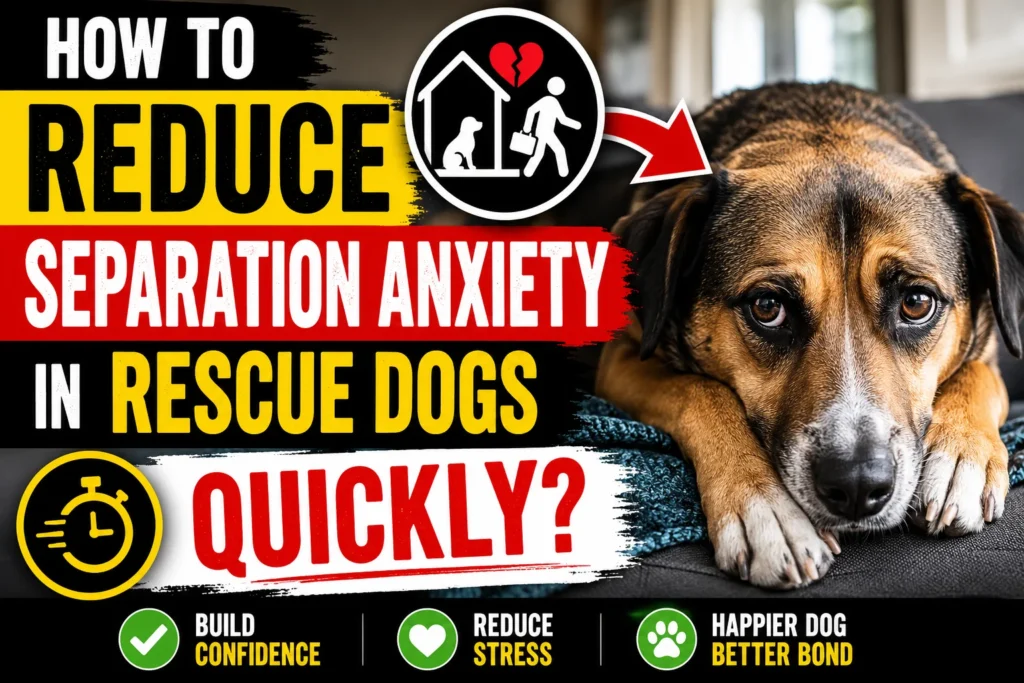
How To Reduce Separation Anxiety In Rescue Dogs Quickly? Opening your home and heart to a rescue dog is an incredibly kind thing to do. You’re giving a second chance to a life that has likely been filled with uncertainty, loss, and perhaps even a little fear. That’s a lovely new start!
Unfortunately, though, as any rescue dog parent can tell you, that lovely new start can quickly come with a truly heartbreaking hurdle: separation anxiety.
When your new friend begins to cry, bark, or even have full-blown meltdown at the sight of your keys or as soon as you leave the room, don’t consider it a behavior problem. – It’s a panic attack and it needs help. – As a veterinarian, I have the privileged experience of seeing this kind of emotional pain in my clinic. As a content writer specializing in animals, I want to empower you with the safe and practical steps that help transform a panicking dog into a confident one.
Understanding the Rescue Dog Unique Plight
First, you must understand that this is not about your dog being “bad” or “vengeful.” The destruction, vocalization, and house soiling are not acts of spite. They are symptoms of a profound emotional response triggered by the fear of abandonment .
Rescue dogs are particularly susceptible because their history often includes a traumatic change: being surrendered, losing a primary caregiver, or experiencing inconsistency and neglect . Studies show that dogs adopted from shelters are overrepresented in cases of severe separation anxiety . They have learned to associate the absence of their person with the loss of safety itself.
How To Reduce Separation Anxiety In Rescue Dogs Quickly?
The “Quick” Path to Calm: It’s About Consistency, Not Speed
There isn’t a “quick fix” for dog anxiety and it truly involves a systematic, controlled approach. But with this simple program, you can start to notice a remarkable change in a few short weeks instead of months. By teaching your dog that the fear triggering event will not result in panic, you prevent your dog from having to deal with that fear response again in the future.
Step 1: The Veterinary Foundation (Your First Stop)
Before any training begins, schedule a comprehensive veterinary check-up. This is non-negotiable.
Why? Underlying pain such as orthopaedic issues (hips, stifles) or gastrointestinal discomfort is a major, overlooked contributor to separation-related behaviors . If a dog is in pain, their threshold for anxiety is much lower.
- Rule out medical causes: Ask your vet to perform a thorough exam. Subtle pain can be hard to spot, so be prepared to answer detailed questions about your dog’s mobility and digestion .
- Discuss medical support: For severe cases, medication isn’t a crutch; it’s a bridge. Using some form of prescription (such as Fluoxetine or Clomipramine), you reduce your dog’s “baseline” anxiety and allow them to focus and be willing to work with you and the behavioural training that’s designed to resolve the issue long term. It is essentially giving your dog a break from the panic so they can focus on adopting some calm, new routines instead.
Step 2: The Emergency Protocol – No More ‘Cry It Out’
The single most critical piece of advice I can give you is this: Never leave a panicking dog to ‘bark it out.’ This approach is harmful and cruel. It only confirms their worst fear: that you are gone and they are trapped in a state of terror .
Until your dog is trained to be alone calmly, you must prevent them from experiencing a full-blown panic attack. You can do this by:
- Using a dog sitter or daycare: A reliable sitter or a well-managed daycare can provide companionship while you are away .
- Taking your dog with you: Wherever possible, bring your dog along for the ride .
Step 3: The Four Pillars of Anxiety Treatment
Pillar 1: Gradual Desensitization and Counterconditioning
This is the gold standard of treatment. It involves two key components :
- Desensitization: Slowly and patiently teaching your dog that being alone is safe. You start with the smallest possible duration of separation that your dog can handle with zero signs of stress even if that’s just stepping out of the room for one second and coming right back . Over many sessions, you gradually increase the time.
- Counter conditioning : You are teaching your dog to associate your leaving with something absolutely AMAZING . Prior to leaving, hand them a long lasting, high value treat: A KONG filled with xylitol free peanut butter, plain yogurt or a favourite brand of canned food only to be used during training.
The key is to return before your dog becomes anxious. If you see signs of stress pacing, lip-licking, whining you’ve gone too far, too fast. Step back a few seconds and try again .
Pillar 2: Habituation to Departure Cues
Dogs are masters of association. They quickly learn that the jingle of keys or the zip of a jacket means you’re about to leave .
- Bust the chain: A few times a day, do your “leaving process” (throw on your coat, grab your keys) but don’t go out. Sit on the couch, and watch TV. This decouples the cue (keys) from the scary event (you leaving), reducing their anticipatory anxiety .
Pillar 3: Creating a True Safe Zone
Avoid the crate! This is a critical piece of advice from experts. For a dog with separation anxiety, a crate can feel like a trap they can’t escape from, leading to dangerous attempts to break out and injure themselves .
Instead, create a safe zone:
- Use a small room (like a bathroom or mudroom) or block off a section of a room with a baby gate .
- Fill it with comfortable bedding, water, and a rotating selection of engaging, distraction-based toys .
- Include an unwashed item of your clothing. Your scent provides significant comfort .
Pillar 4: The Calm “Sandwich” (Departures & Returns)
How you act before you leave and when you return is just as important as what you do when you’re gone .
- Practice “Low-Key” Goodbyes: 15-30 minutes before you leave, stop giving your dog attention. Avoid emotional, long goodbyes .
- Practice “Low-Key” Hellos: When you return home, ignore your dog for the first 5-10 minutes until they are completely calm and relaxed. This may feel unnatural, but it prevents you from rewarding frantic, excited behavior and reinforces the idea that your return is just another normal, non-eventful moment .
Step 4: Patience and Professional Support
This isn’t going to be a quick fix. Don’t forget that your dog is being taught to let go of a conditioned trauma response. Take all the little wins along the way: even a couple seconds of relative peace while you’re in another room. You may need support along the way from a veterinary behaviourist or a CSAT who can tailor a plan that’s just right for your dog’s unique circumstances and can teach you to recognize the “finer nuances of your dog’s stress” and how to better help them out of it.
Also Check: Best Low Impact Exercises For Dogs With Hip Dysplasia
Conclusion
Easing a rescued dog through separation anxiety is one of the hardest, most difficult, and most rewarding things that you will ever do. It is, for all intents and purposes, love, plain and simple. Substituting a reliable routine and a happy ending for anxiety means you are not just teaching an unwanted habit a new trick; you are mending a fractured being and laying the groundwork for a trust that you both carry your whole lives.
Frequently Asked Questions (FAQs)
Why is my rescue dog suddenly showing signs of separation anxiety weeks after adoption?
This is super common. It’s called the honeymoon phase. Odds are they were initially overwhelmed and shut down and now that they’ve started to feel secure and bonded to you the inherent separation from you that creates anxiety begins to show up. This is actually a good thing in that your dog feels safe enough to trust you enough.
Can I use a crate if my dog seems to like it for sleeping?
If your dog likes to sleep in a crate when you are home then great! Use that. But when teaching to prevent SA – if you use the crate close the door and LEAVE… the confinement alone is panic inciting. So if confinement is necessary due to behavior then you must make use of a puppy proofed room.
How long does it take to see real improvement?
For many dogs the easy wins come within weeks when we are not setting them up for full panic and we are adding lots of small easy successes . Other more serious cases, such as dogs with complex histories can take months .
What do I do if my dog hurts themselves trying to escape?
Emergency If the dog is destroying and attempting to escape to a point of self harm they must NOT be left alone now you use a dog sitter or day care or travel with the dog… your vet MUST be consulted immediately about medicating and a proper training plan should be developed .
Is it okay to let my dog sleep in my bed?
While this does not directly cause SA one study revealed a positive correlation between co-sleeping dogs and puppies who show some SA behaviors… it is important to build independence in your dog and the easier your dog makes it for you to not have to separate from them (night or day), the harder it can be…
What are the best types of toys for an anxious dog?
Food distributing/ interactive toys (Kongs, puzzle feeders, treats releasing balls) as the interaction and mental engagement distract the dog, satisfy chewing, and redirect the anxious behavior to something positive
Will punishing my dog help stop the behavior?
NO punishing your dog, especially when they are panicking will only add anxiety and damage your relationship. They aren’t being ‘naughty,’ they are experiencing a panic attack that they have not learned how to manage.
Are dog appeasing pheromone (DAP) diffusers effective?
Some people find that these products (like Adaptil) can be a helpful part of a larger plan and can reduce some general anxiety in the dog as they mimic a mother’s calming pheromone but they are not a miracle cure.
My vet prescribed medication. Does that mean my dog is “broken”?
No- it means you are being a smart, resourceful pet parent! These types of meds are a bridge to help re-regulate a dog’s body chemistry so they can learn new coping behaviors. They work similarly to how a person may take anxiety meds.
How do I know if my dog has severe anxiety vs. Just being a bit lonely?
Dogs with full-blown SA will typically demonstrate extreme distress (panic, vocalizing, panting, pacing, destruction, self-harm) within 15-30 minutes of your departure. They generally cannot settle until your return. A slightly bored or lonely dog might pace or whine for a few minutes but usually settles.