
How to Stop Dog Barking at Visitors?
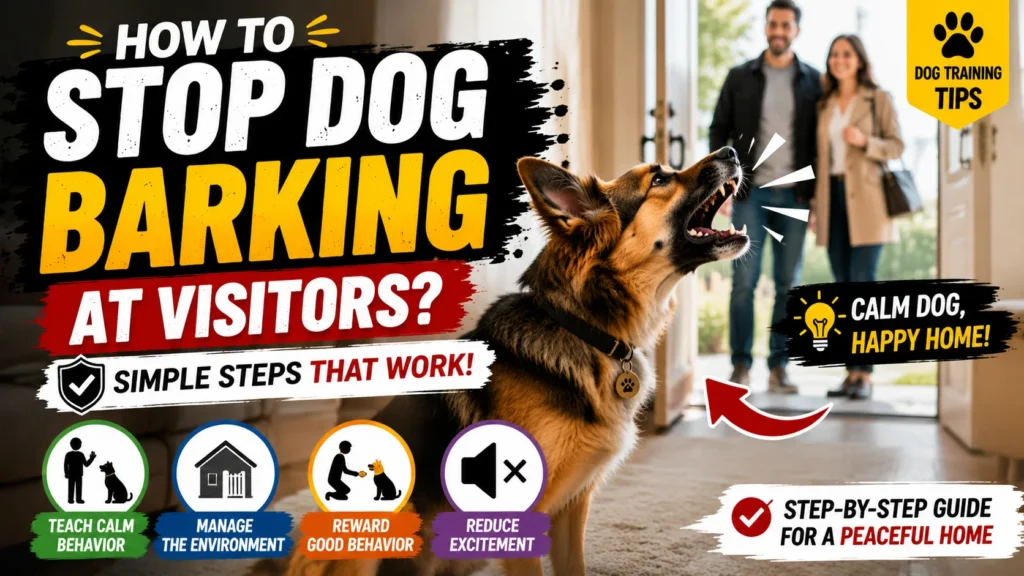
How to Stop Dog Barking at Visitors? Does the sight of a visitor transform your sweet dog into a barking, spinning tornado of sound? If so, take heart; you are far from alone. Problem barking at visitors is an extremely frequent and frustrating problem for dog owners. As a vet and pet behaviorist, I recognize the frustration, embarrassment and even anxiety it may generate.
It’s important to realize, however, that barking isn’t defiant behavior for your dog, it’s just canine communication. What you want to train your dog to do is respond to guests with an appropriate, quiet greeting instead of a vocal greeting. In this guide, I share a 100% original and proven strategy from an animal behavior expert that will explain why the problem behavior occurs and how you can effectively train your dog to stop greeting visitors with excessive noise.
How to Stop Dog Barking at Visitors?
1. Decoding the Bark: Why Does Your Dog Do It?
Identify your dog’s motive. Before you even think about solutions, you need to understand why your dog is making noise. Humans cry for a reason be it sad, angry, or in pain, and just like a human, dogs bark for a reason, too. Knowing your dog’s “why” is the first and arguably most important thing you need to do before you figure out how to stop the barking.
The “Territorial Guardian”
The Vibe: Doggy sees house as territory and guest as trespasser. The barking here can be loud, deep and threatening. He will be standing tall with an erect posture, and this bark can go on after guests are invited in .
The “Excited Socialite”
The Vibe: your dog is ecstatic about seeing someone new and, frankly, cannot hold back their excitement. These are usually high-pitched yelps, paired with a tail that can’t be controlled, plus lots of jumping and tail spinning.
The Message: “OMG new friend!! I am so pumped to meet you I’m going to combust!”
The “Fearful Anxious” Dog
The Vibe: Your dog is truly scared by the approach of an unfamiliar person into his comfort zone. This bark might sound like a high pitched yelp or a deep growl, and it’s often coupled with cowering, a tucked tail, and lip licking.
The message: “I am afraid of you. Stay away.”
The “Attention-Seeker”
The Vibe: You’ve conditioned your dog to bark in order to get your immediate focus. That focus can be positive attention (a toy) or negative ( yelling “No!”).
The message: “Notice me! Pay attention to me, if only for a second.”
Pro tip from Dr: Watch your dog when your next guest arrives. Is her tail wagging freely (excited) or is it tucked between her legs (nervous)? Is his body loose (comfortable) or is he stiff and front-leaning (ready to defend his turf)? The choice is a clear roadmap to your training plan.
2. Proven Training Techniques: How to Stop the Barking?
As soon as you figure out the underlying cause of problem behaviors, apply these time-tested and dog-friendly solutions. You may have heard these before, but remember, patience is key, as is consistency.
Technique 1: The “Go to Your Place” Command
It’s the single best tool to fix dog doorbells it gives your dog something positive and rewarding to do when the doorbell rings, instead of focus on a perceived danger or even excitement! Set a ‘Place’: This is usually the dog bed, a crate, or a small rug/mat tucked away somewhere the room. It needs to be always accessible and inviting .
Train the Command: Send your dog to the ‘Place’ with the help of some training treats, using your chosen ‘place’ command ie ‘Go to bed!’
Ring the Doorbell: When your dog reliably gets to the place on command, begin practicing with the actual doorbell!
Technique 2: The “Three-Bark Rule”
It’s not possible or fair to your dog to expect they never make a noise and while this requires you to accept some barking it teaches them what they need to know about signalling their awareness without going overboard.
Let your dog bark 3 times to signal that there is a problem.
- Then calmly give your “quiet” command such as, “Enough!”
- The instant they go silent offer lots of praise or give them a really delicious treat. If they don’t stop take them to their designated place and wait them out until they do stop.
- They’ll learn barking is accepted to a point but prolonged barking doesn’t bring them the goods.
Technique 3: Meeting on Neutral Ground
Change the entire greet at the front door for intense territory/fear barkers: The front door is far too exciting. A whole paradigm shift. Meet your visitor outdoors instead.
Leash the dog and step outside BEFORE the visitor arrives. Have your guest in the driveway or on the sidewalk’\/ far enough away that your dog does not bark. Have guest toss tasty treats to the ground at least 5-6 feet away from them and ask him to sniff them and eat. Once he has been calmly present for a couple minutes, then go inside with him and have guest follow after you. The “territory” is not so important now.
Also Check: Foods For Dogs With Sensitive Stomachs
Creating a Calm Environment & When to Get Professional Help
The easier your training environment is on your dog, the more effective your work will be. Set your dog up for success by:
Set Up a Safe Space
Create a sanctuary for your dog away from the front door. This could be a quiet room with a comfortable bed, water, and their favorite toys. You can place them here before the visitor arrives to prevent the barking from even starting .
Avoid “Aversive” Punishment
A voice raised in anger may seem a shouting to us, but in a dog, it is usually perceived as being “part” of the barking activity, therefore encouraging further vocalisation. Even the use of punishment and aggression to try and deal with the barking may well enhance fear, anxiety and result in the problem becoming even greater, use reinforcement techniques to reinforce desired behaviours.
When to Call a Professional
A voice raised in anger may seem a shouting to us, but in a dog, it is usually perceived as being “part” of the barking activity, therefore encouraging further vocalisation. Even the use of punishment and aggression to try and deal with the barking may well enhance fear, anxiety and result in the problem becoming even greater, use reinforcement techniques to reinforce desired behaviours.
Quick Reference: Training Techniques by Barking Type
| Type of Barking | Body Language | Strategy |
|---|---|---|
| Territorial | Stiff posture, low growl, deep bark | Meet outside. Practice “Place” command. Use a leash for control. |
| Excited | Loose body, wagging tail, high-pitched bark | Teach “Sit.” Use the “Three-Bark Rule.” Give a stuffed Kong to occupy them. |
| Fearful | Tucked tail, cowering, lip licking | Create a safe space. Have guests ignore them. Never force interaction. |
| Attention-Seeking | Barking directly at you | Ignore the barking (turn away, don’t make eye contact). Reward the silence. |
Frequently Asked Questions (FAQs)
Why does my dog bark at visitors even when they are not aggressive?
Barking doesn’t always mean aggression. It’s a complex form of communication often rooted in excitement, anxiety, or a strong territorial instinct to alert their pack (you) of a change in the environment . Your dog might simply be struggling to process their big feelings about a new person in their territory.
How can I use positive reinforcement to stop the barking?
Positive reinforcement is about rewarding the behavior you want to see more of. When a visitor arrives, keep treats handy. The moment your dog is quiet, even for a second, mark that moment with a “Yes!” and give a treat. Reward them for going to their bed and staying calm. This teaches them that quiet = treats and praise, while barking earns them nothing .
Should I discipline my dog for barking? Is yelling effective?
No and no. Using punishment like yelling, shock collars, or hitting is ineffective and can be harmful . Your dog may interpret your raised voice as you barking along, or it can increase their anxiety and fear, making the problem much worse . Positive, reward-based training is far more successful and builds trust.
What should I tell my visitors to do when they arrive to help?
Communication is key! Tell your guests: “Please ignore my dog completely until they are calm.” This means no eye contact, no talking to them, and no petting. This is not rude it’s a crucial part of the training. Ask them to toss a treat on the floor away from them to give the dog a positive, calming activity to focus on .
My dog is fine with visitors once they are inside, but goes crazy at the front door. Why?
The front door is the most intense point of entry. It’s the threshold of their territory, and the sudden sound of knocking or the doorbell triggers their protective instincts. For these dogs, the “Meet on Neutral Ground” technique is particularly effective . It diffuses the territorial aspect of the greeting and changes the initial association from a potential threat to a simple walk.
Is it okay to put my dog in another room when visitors come?
Absolutely. This is a fantastic management tool, especially when you aren’t in a position to train. Providing a “Safe Space” with a stuffed Kong or puzzle toy can prevent the barking from happening in the first place . It’s not a permanent solution, but it’s a kind and effective way to reduce everyone’s stress during a busy time.
How long does it take to train a dog to stop barking at visitors?
There is no one-size-fits-all timeline. It depends on your dog’s temperament, the duration of the habit, and your consistency . You may see small improvements in a few days, but it often takes weeks or even months of dedicated, consistent practice to fully reprogram this behavior . Patience is key!
What is desensitization, and how can it help my dog?
Desensitization is a training method where you gradually expose your dog to their trigger (a visitor) at a low intensity where they don’t react, and then reward them for their calm behavior . For example, you might have a friend stand at the end of the driveway while you reward your dog for being quiet. Over time, you slowly decrease the distance as the dog becomes comfortable.
I’ve tried everything, and my dog’s barking is still out of control. What’s next?
When a dog’s barking is accompanied by aggression, extreme fear, or is completely unresponsive to home training, it is time to call in a professional . Look for a certified trainer who uses positive reinforcement methods. Your veterinarian can also rule out any underlying medical issues that might be contributing to your dog’s anxiety.
My dog has a high prey drive and barks at the mailman through the window. What can I do?
This is classic territorial barking. The first step is environmental management . Block your dog’s view of the outside by drawing curtains, applying window film, or using privacy fencing. This prevents the dog from practicing the unwanted behavior. Then, use the “Place” command to call your dog away from the window and reward them for staying calm.
Conclusion
Learning how to stop dog barking at visitors is not about silencing your dog’s voice; it is about teaching them a better way to communicate their feelings. By understanding why they bark and using these humane, positive training techniques, you can create a more peaceful, welcoming home for both your guests and your canine companion