
Why Is My Puppy Breathing Fast While Sleeping?
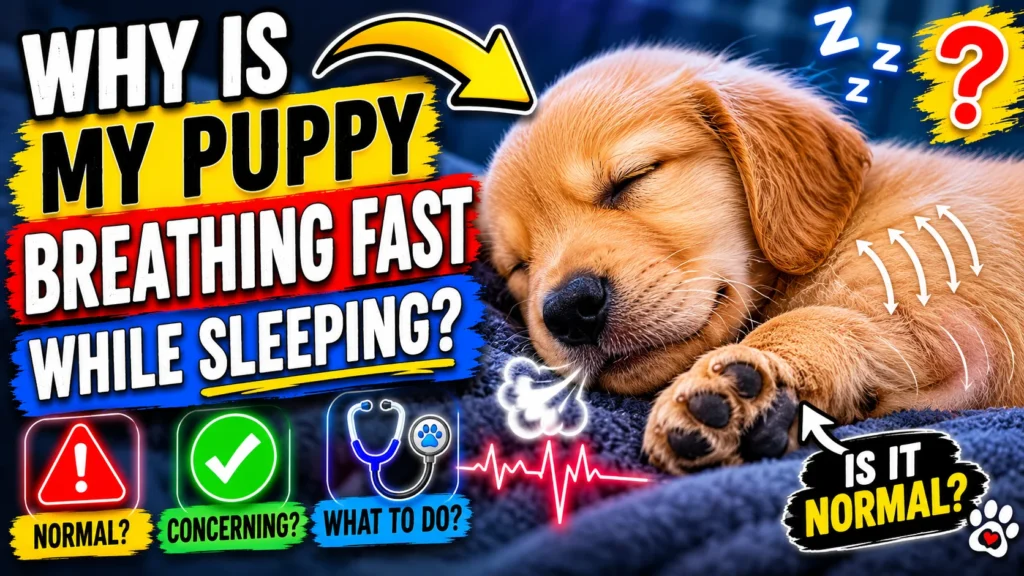
Why Is My Puppy Breathing Fast While Sleeping? The short answer is: Fast breathing in sleeping puppies is often completely normal. However, there is a fine line between “dreaming fast” and “dangerous fast.” You just brought home that fluffy, eight-week-old ball of energy. You finally get them to sleep. You tiptoe over to watch the peaceful rise and fall of their tiny chest and suddenly, you panic.
Are they breathing too fast? You count the breaths. Ten seconds. Twenty seconds. Thirty. It looks like they just ran a marathon, yet they haven’t moved an inch. If this sounds familiar, take a deep breath. You are not a bad pet parent. In fact, you are an observant one. As a veterinary doctor, I see this question daily.
In this guide, we will decode the rhythm of your puppy’s sleep, teach you exactly how to count breaths, and identify the three red flags that require an immediate trip to the emergency vet.
What is a “Normal” Sleeping Respiratory Rate?
First, let’s look at the numbers. A resting adult dog typically breathes 10 to 30 times per minute. Puppies are different. Their metabolism is a furnace, and their lungs are tiny.
The clinical norm for a sleeping puppy: 15 to 40 breaths per minute.
The “Watch Zone”: 40 to 60 breaths per minute.
The “Vet Now” Zone: Over 60 breaths per minute consistently.
How to measure correctly:
Wait until your puppy has been in deep sleep for at least 10 minutes (not just dozing). Set a timer for 60 seconds. Watch the ribs move in and out. One rise and one fall equals one breath.
The Good News Why Fast Breathing is Usually Normal (REM Sleep)
Puppies spend significantly more time in REM (Rapid Eye Movement) sleep than adult dogs or humans. REM is the dream state. While you are lying still during your dreams (sleep paralysis), puppies lack a fully developed pons (the brain structure that paralyzes muscles during sleep).
This results in the “twitchy, breathy, fast-breathing puppy.”
Also Check: Why is My Cat Shaking Her Head Repeatedly?
3 Common Scenarios That Are 100% Normal
- The Dream Chaser: If the fast breathing is accompanied by paw paddling, soft barks, lip smacking, or eye twitching they are simply chasing a squirrel in their dreams. This type of breathing is irregular; it speeds up and slows down randomly.
- Temperature Regulation: Puppies cannot sweat like humans. They pant to cool down. If your house is slightly warm (above 75°F/24°C) or they are buried under a blanket, fast breathing is their air conditioning system.
- Post-Play Exhaustion: Did your puppy just have a “witching hour” of zoomies? Their body is flooded with adrenaline and lactate. Even after falling asleep, their respiratory system takes 20-30 minutes to return to baseline.
If your puppy wakes up easily, acts hungry, and resumes hyper play within minutes of waking, the fast breathing was benign.
The Bad News: Pathological Causes (When to Worry)
If the breathing is effortful (not just fast, but hard), or if the puppy is difficult to wake up, we shift into the medical danger zone.
1. Lower Airway Disease (Asthma/Bronchitis)
Unlike adult dogs who cough, puppies often present with “increased respiratory effort” first. Listen for a wheeze on the exhale.
2. Fluid in the Lungs (Pneumonia or Congenital Issues)
Puppies are prone to aspiration pneumonia (sucking milk or water into the lungs). If the fast breathing is paired with a wet-sounding cough or nasal discharge, this is an emergency.
3. Pain
Internal pain (from parasites, bloating, or injury) causes rapid, shallow breathing. A painful puppy will usually sleep in a “praying position” (front legs down, butt up) or refuse to lie on their side.
4. Hypoglycemia (Low Blood Sugar)
Toy breeds (Chihuahuas, Yorkies, Maltese) are at high risk. If a puppy hasn’t eaten for 6+ hours, their blood sugar crashes. Fast breathing, followed by weakness and limpness, is a sign of a metabolic crisis.
The “Tummy Test”: If your puppy’s belly is moving dramatically in and out (abdominal breathing) and their nostrils flare with every breath, that is dyspnea (respiratory distress). This is never normal.
Breed Specifics: Brachycephalic Puppies (Bulldogs, Pugs, Boston Terriers)
If you own a flat-faced breed, the rules change slightly. These puppies have anatomical abnormalities (stenotic nares, elongated soft palates) from birth.
- The Norm: They will breathe faster and louder than a mixed breed. They will sound like snoring piglets.
- The Danger: If the gums turn blue/gray, or if the breathing stops being rhythmic and becomes a “gasping” pattern.
- The Fix: Brachycephalic puppies must sleep with a harness, not a collar, and in an air-conditioned room (below 72°F).
Step-by-Step Home Protocol (What to do at 2 AM)
You are lying in bed watching your puppy’s ribs move a mile a minute. Do this now:
- Don’t Panic (They feel your anxiety). Your increased heart rate changes your scent and sound.
- The Gentle Wake: Softly say their name. If they pop up, wag their tail, and look at you like “Why did you wake me?!” – They are fine.
- Check the Gums: Lift the lip. Healthy gums are bubblegum pink and moist. If they are pale, white, blue, or brick red, go to the ER vet immediately.
- Count for 30 seconds: Multiply by 2. Under 40? Go back to sleep. Over 60? Check step 3 again.
- Remove the Blanket: Sometimes they are just overheating. Uncover them for 10 minutes and recheck.
When to Rush to the Emergency Vet
Stop reading articles and call your vet immediately if fast breathing coincides with any of these Fatal Four symptoms:
- Cyanosis (Blue/Purple tongue or gums). This means zero oxygen.
- Unresponsiveness. You shake the puppy and they flop like a ragdoll.
- Open-mouth breathing in a cold room. If the room is 65°F and the puppy is panting with a wide open mouth, something is wrong.
- Retractions. You can see the ribs “sucking in” visibly with each breath (like an hourglass shape).
Conclusion
Is your puppy breathing fast while sleeping? Look at the whole picture. A happy, eating, playing, gaining-weight puppy who breathes fast for 10 minutes during a dream and then slows down is a healthy puppy. A lethargic, off-food puppy with a heaving chest is a medical crisis.
When in doubt, record a 30-second video of the breathing. You can always email this video to your vet’s triage line. Most of the time, the vet will write back: “Stop watching him breathe and go to sleep. He’s dreaming of treats.”
Frequently Asked Questions (FAQ)
Is it normal for an 8-week-old puppy to breathe fast while sleeping?
Yes. 8-week-old puppies have just left their littermates and have immature nervous systems. They spend 85% of their sleep time in REM. Breathing rates of 30-50 breaths per minute are the biological norm at this age.
My puppy is breathing fast but acting normal when awake. Should I worry?
No. This is the most reassuring sign. If your puppy wakes up, eats breakfast, plays, and has normal energy, the fast breathing was isolated to sleep physiology (dreaming or temperature regulation).
What does “labored breathing” look like in a puppy?
Look for “belly breathing” (the abdomen moves more than the chest), stretched-out neck, elbows sticking out (like a chicken wing), and nostrils flaring. If you see the chest sinking in at the breastbone, that is a medical emergency.
Can parasites cause a puppy to breathe fast while sleeping?
Yes. Severe hookworm or roundworm infestations cause anemia (low red blood cells). Anemic blood cannot carry oxygen, so the puppy breathes faster to compensate. If the puppy has a potbelly and pale gums, deworming is needed.
Does a fast heartbeat go with fast breathing?
In a dream state, the heart rate will spike and drop. However, if the heart rate is weak and the breathing is fast, that suggests shock or dehydration. You should be able to feel a strong femoral pulse (inner thigh) easily.
My 4-month-old puppy is breathing fast after a vaccine. Is this normal?
Mild fever (up to 103°F) is common 24-48 hours post-vaccine, which can cause faster breathing. However, if the fast breathing is paired with facial swelling, hives, or vomiting, it is an allergic reaction (anaphylaxis) requiring immediate epinephrine.
Why does my puppy stop breathing for a second and then gasp?
This is called “periodic breathing” or “sleep apnea.” It is common in brachycephalic breeds but dangerous in long-snouted breeds. If your puppy stops breathing for more than 10 seconds and then gasps, record a video for your neurologist.
How do I know if my puppy has fluid in the lungs?
Listen for a “crackling” sound (like stepping on dry leaves) when they breathe. You might also see clear or foamy pink fluid dripping from the nose. This is a sign of congestive heart failure or pneumonia.
Should I wake my puppy up if they are breathing too fast?
Yes, for diagnostic purposes. Gently wake them. If the breathing returns to normal (slower, deeper) within 30 seconds of waking, you have confirmed it was REM sleep. If the fast breathing continues while awake, call the vet.
When can I stop worrying about puppy breathing fast?
Most puppies “grow out” of erratic sleeping breathing by 6 months of age. However, if the breathing rate while sleeping is persistently over 40 breaths per minute and the puppy is overweight, start a diet. Fat tissue compresses the lungs.