Why is My Cat Yapping or Meowing at the Wall?
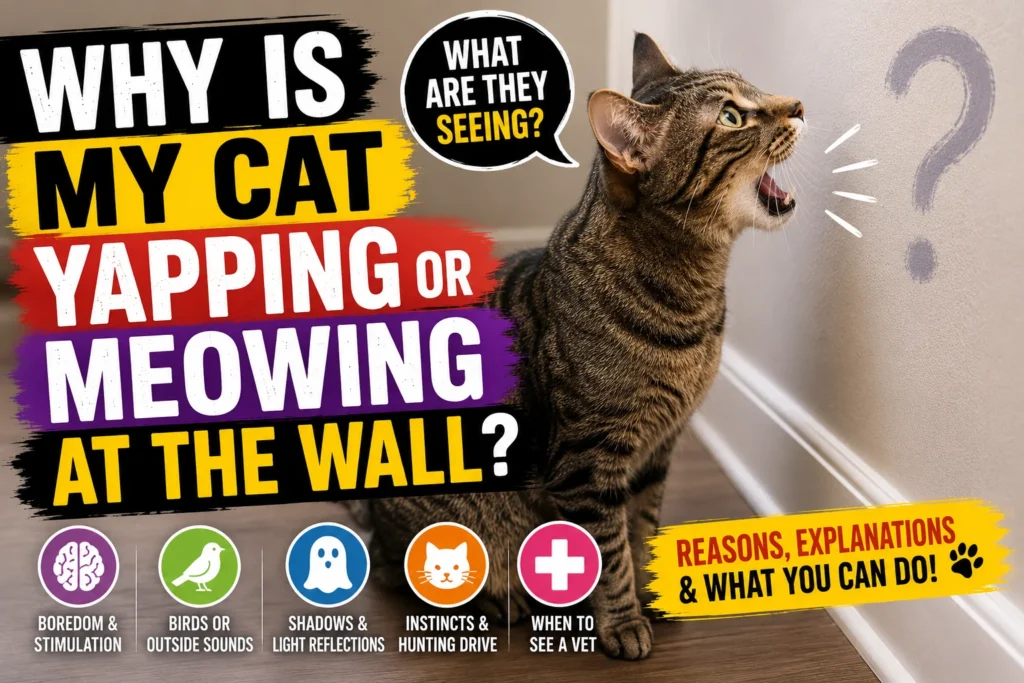
Why is My Cat Yapping or Meowing at the Wall? This is one of the most common and baffling question I, as a veterinarian, field from concerned pet parents: “Why is my cat yapping or meowing at the wall?” If you’re on the receiving end of this unusual chorus of meows and chirps, you are certainly not alone. In one fell swoop, your usually tranquil cat has turned into an inquisitor, zeroing in on what appear to be…nothing.
He or she seems either terrified or crazed, leaving you with the burning question: “What in the name of all that is feline is going on with my kitty?”
Rest assured, while this behavior can be startling, the culprit is almost invariably related to your cat’s superior feline senses, her natural behavioral tendencies, or even a medically treatable illness. This guide outlines the most common reasons for this behavior.
The Sensory World: Your Cat’s “Superpowers”
More times than not your meowing wall watcher is respond to something in the air or on the wall that your simply can’t sense with your own 5 senses. Their senses of hearing, seeing and smelling are way better then yours.
1. They Hear Things You Can’t
This is quite possible the number one most typical cause. Cats are incredibly delicate in their hearing, especially when it comes to high pitch noises. These include very soft noises, like a rustling little mouse or an insect, and also movement from inside the pipes within your walls. To them, the wall is not a solid barrier but a potential source of dinner. If your cat’s ears are pricked forward and swiveling, they are likely a hunter on a stakeout, pinpointing the location of prey they can hear but can’t reach . The meowing could be a sign of excitement or frustration at this hidden stimulus.
2. They See Movement You Miss
Cats’ visual system is extremely sensitive, designed to pick out the tiniest flicker of movement. They also see a few wavelengths of light, such as the UV spectrum, that are imperceptible to humans. That boring-looking, bland-looking bare wall can be a treasure trove for a cat-a wonderland of microscopic shadows, reflections, bits of dust shimmering in a sun-beam, or bugs skittering across a surface.
3. They Smell Something Interesting
With up to 200 million scent receptors in their noses (compared to our mere 5 million), cats live in a world of smell we can scarcely imagine . They can likely detect the scent of an animal hidden within the wall, which can trigger their natural curiosity and hunting instincts, leading to focused staring and vocalization .
Also Check: My Dog Rub His Face on the Carpet After Eating?
Behavioral and Instinctual Reasons For Why is My Cat Yapping or Meowing at the Wall?
At other times the response may not be target-related but could be used as an act of communication or expression of frustration.
4. The Echo Effect and Curiosity
Because cats love to play with things and investigate noises, it’s possible they are meowing just to hear the echo. The way a wall can affect sound could offer your feline a real laugh, all in a normal kitty behavior.
5. Boredom, Stress, or Seeking Attention
A cat that isn’t getting enough stimulation, both physically and mentally, will often find quirky ways to occupy themselves and grab your attention. If your cat yaps at a wall, he might be craving play or social time. Cats are creatures of routine, and new elements in the house, whether furniture, babies or even moving to a new home can create anxiety that results in excessive meowing. If your cat follows you around and then meows and paces toward a wall, he might be trying to invite you to play, or he may want to show you something in the wall he finds intriguing.
Territorial Behavior
Cats have scent glands in their paws. By scratching and pawing at a wall, they can leave behind pheromones to mark their territory . This is a way for them to create a sense of security and claim a part of their domain. The meowing accompanying this might be a way to announce their claim or simply a byproduct of their focus .
Medical Concerns: When to Be Concerned
Many can be easily overlooked, but it’s important to know if your cat’s behaviors could indicate underlying problems. Should you notice an abrupt behavior shift, it is never wise to fail to bring your cat to see your veterinarian.
1. Feline Cognitive Dysfunction (Feline Dementia)
This can be a real heart-breaker to see because they often develop a disease which closely parallels human Alzheimer’s. Fortunately, Alzheimer’s in older cats is pretty uncommon and occurs primarily in cats aged 12-13 years and older. Some common signs and symptoms include confusion, disorientation, and altered sleep-wake cycles. Staring at a wall and excessive vocalization, especially at night, are common symptoms .
2. Feline Hyperesthesia Syndrome
The skin is hyper-sensitive, often down the length of the back, as part of this very complicated illness. It can lead to compulsive behaviors, rippling skin, aggressive tail-chasing, and sudden episodes of frantic behavior followed by a blank stare at a wall .
3. Underlying Illness
Various illnesses can cause changes in behavior. Conditions like kidney or liver disease can lead to a buildup of toxins in the blood that affect the brain, causing confusion and staring spells . Seizure disorders can also cause unusual behaviors, including staring and vocalizing .
4. Head Pressing: An Emergency
Please note: This is different from the normal, affectionate head-butting cats do to mark you with their scent.
Head pressing is a serious neurological sign where a cat compulsively pushes the top of their head against a wall or other hard surface for no apparent reason. This is a veterinary emergency and can be caused by a number of severe conditions, including brain tumors, toxins, or trauma. If you see this, seek immediate veterinary attention .
What Should You Do?
As a vet I would always advise you to see the whole picture. Don’t disregard it, but don’t lose any sleep about it. Your first role will be to play the detective at your home.
- Scrutinize the surroundings: Can you actually find out something behind that wall? Could there be mice and mice droppings? Can you really find something you yourself find in the shadow of light reflection from?
- Check their needs: Does my cat have enough opportunities to play? Are there any toys where they can engage and participate? Is the cat under any stress. Exhausted cats tend to be happy cats.
- Playing regularly: as well as setting out puzzle feeders and window seats and many other interactive options, can prevent them from boredom and anxiety.
- Other symptoms: What else is going on? •Is your cat eating, drinking, and going to the litter box properly •Is your cat disoriented or walking in circles •Does your cat have accidents in the house or is confused If your cat shows any of these signs -especially if it’s an aging pet – your best course of action is to take your cat to the veterinarian for a checkup for possible issues, like chronic cognitive dysfunction or kidney disease.
Conclusion
Most of the time, your cat chattering or meowing at a blank wall or doorway is perfectly normal and inexplicable feline behavior they’re either using their incredible hearing to pick up on a minuscule creature, their sharp eyesight to chase dust, or just trying to get you to pay attention to them. Nevertheless, such antics can sometimes be an early and subtle warning sign of a more serious health issue, especially in older cats. Understanding your cat’s total health, offering appropriate outlets for stimulation, and getting the necessary checkups are key to a long and happy life for your cat.
Frequently Asked Questions (FAQs)
Do all cats do this?
Some do, some don’t. if your cat happens to do this, it’s most likely perfectly normal.
Is he seeing ghosts?
As amusing as the concept is, there’s no scientific evidence that cats can communicate with ghosts. What he’s likely experiencing is much more down-to-earth, such as an insect in the walls or a bug on the wall surface.
Should I ignore the cat when they do this?
Ignoring attention seeking behaviors can be part of the training protocol but if your cat is truly unwell then it’s not something to brush off, especially if its this accompanied by other signs.
Is this a health concern?
If wall gazing behavior is accompanied by other symptoms then you must seek help. These may include disorientiation, dizziness, increased appetite or drinking, seizures, toileting problems, loss of function, aggression or personality changes. As the cat gets old Feline Cognitive Dysfunction should also be taken into account.
Can head butting be something other than affection?
Head-butting or ‘bunting’ the way you’re thinking is when your cat rubs its head on your legs or furniture and is an act of affection or to mark it as his property.
My cat is scratching at the wall and meowing. Does that mean we have mice?
It’s a strong possibility. Cats can hear and smell rodents and insects moving inside walls. Their predatory focus and vocalization are often a reaction to a potential “prey” source hidden within the structure of your home .
What should I do to stop my cat from doing this?
First and foremost, try and identify what’s going on, whether it’s boredom (provide plenty of toys and playtime opportunities), environmental stress, pests (call a pest control professional), or anything else.
Is the ‘yapping’ sound different from a normal meow?
This chattering or chittering noise that your cat makes whilst on the watch for prey is, essentially, their way of expressing frustration and a deep-rooted sense of hunting desire. This should not be confused with a meow, a noise that’s meant to be used for communicating with owners .