Why is My Male Cat Spraying Inside the House Suddenly?
Why is My Male Cat Spraying Inside the House Suddenly? It’s annoying and puzzling when a musty, strong-smelling odor starts to emanate from your curtains, walls, and furniture one day for no apparent reason.
If you’re a cat owner dealing with the situation of your male cat spraying inside the house, chances are you’re both upset and anxious-and maybe even feel a bit betrayed-but he’s not being a “bad cat”; he’s telling you something important in his natural way of communicating.
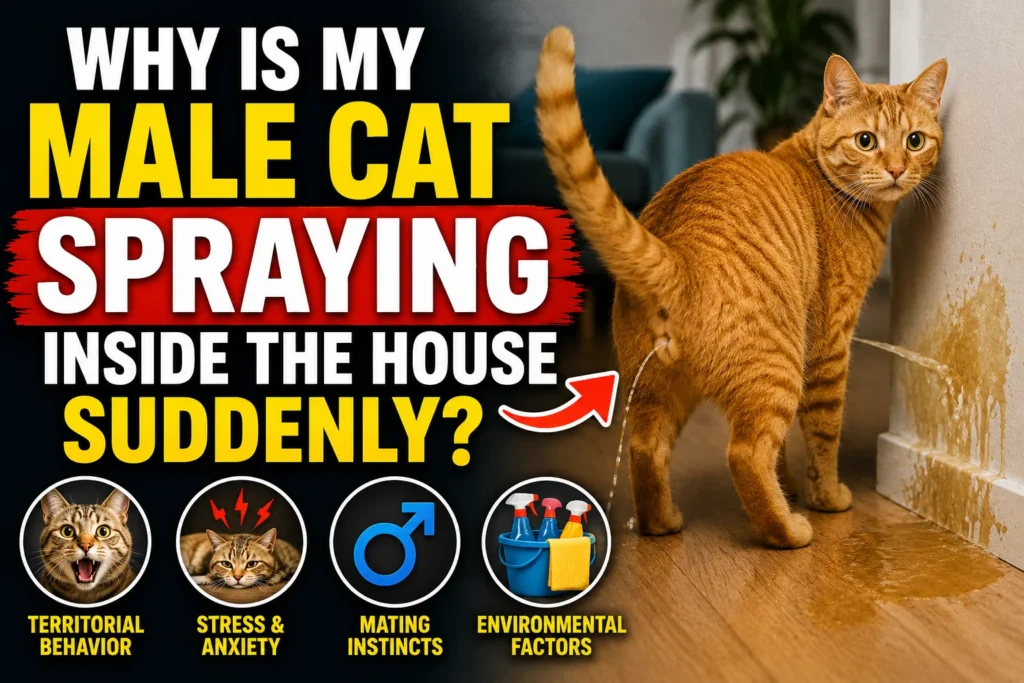
Cat spraying or urine marking: What to know: Spray behavior (also sometimes referred to as urine marking) is one of many forms of feline communication and is entirely different to cats pooping or peeing outside the litter box. With spraying behaviors cats walk up to a vertical surface, stand on 3 legs with one of the hind legs elevated while they spray their urine to the vertical surface behind them, usually with a whisk of their hind end (tail). This spray contains all the chemicals known as “pheromones”, and tells any of the local cats (either around your house or outside the window) everything they need to know about you.
The key to stopping any behaviour is to first identify and understand what is causing it. The sudden spraying in males can sometimes lead you directly to the specific trigger. Here are some of the most common explanations for male cat spraying.
The 5 Main Reasons for Why is My Male Cat Spraying Inside the House Suddenly?
1. A Medical Issue (Always Rule This Out First)
The first thing you should focus on is rule out a medical cause of spraying, because sometimes pain can cause the cat to spray outside the litter box or lose control of their urge to go .Around 30% of cats spray only due to some underlying medical problem such as; Feline Lower Urinary Tract disease (FLUTD). It mainly include issues such as; bladder stones, cystitis( inflammation of the bladder), urinary tract infections(UTIs) your feline’s pain or discomfort will compel it to resort to spraying, thus, a vet consultation is essential.
Key Signs to Watch For:
- Straining to urinate
- Crying out in pain while in the litter box
- Frequent trips to the litter box with little urine produced
- Blood in the urine
Your first and most important step is to take your cat to the veterinarian immediately. A vet can run tests to rule out these painful and potentially serious conditions .
2. Territorial Marking and Social Stress
If your cat gets a clean bill of health, the behavior is almost certainly behavioral. The most common reason for spraying is territorial marking . You’re seeing your cat mark their territory by leaving the scent of their body.
This is especially true in households with multiple cats. Social conflict between cats can arise if there is competition for resources (e.g., food bowls, litter boxes, favorite sleeping spots) or if a new cat is perceived as a threat to a long-time pet.
Common Triggers:
- Seeing an outdoor cat: A stray or neighbor’s cat wandering through your yard can be a major stressor. Your indoor cat sees an intruder in his territory and sprays to warn them to stay away .
- New pet or family member: The arrival of a new cat, dog, or even a human baby can disrupt the social hierarchy and make your cat feel insecure .
- You might not hear or see any active fighting, but some of these behaviours could indicate minor conflict between your cats, as when one cat blocks access to the food bowl or litter box.
3. Sexual Behavior (Especially in Unneutered Males)
For an intact male cat, spraying is essentially a highly ingrained reproductive behavior. When a tomcat reaches sexual maturity, generally at around 6 months old, he is flooded with testosterone.
Spraying serves two purposes: it signals his availability to nearby females and warns other males to stay away from his territory .
The urine of an intact male has a particularly strong, pungent, and musky odor that can be very difficult to remove . Neutering is the most effective solution for this, resolving the issue in up to 90% of cases .
4. Stress and Anxiety
Cats value routine and see it as security and familiarity. Any change in their environment can cause significant stress, and spraying is a common anxiety response . When they are stressed, marking an area with their own scent acts as a coping mechanism, making their environment feel more familiar and safe .
Even “small” changes can be major stressors:
- Moving to a new house
- Rearranging furniture
- Changes in your work schedule
- Having houseguests or renovations
- You start getting acquainted with new, unknown smells that enter your clothes or bags.
5. Litter Box Aversion
While spraying is often about marking territory, it’s important to distinguish it from inappropriate urination. If your cat is squatting and leaving a large puddle of urine on horizontal surfaces like the floor or your bed, it’s more likely a litter box issue .
Common Litter Box Problems:
- Dirty litter box: A box that isn’t scooped daily is a major turn-off .
- Box location: The box may be in a high-traffic, noisy area, or difficult to access .
- Too few boxes: The general rule is one litter box per cat, plus one extra .
- What type of litter: The material used in your litter may not be up to the scent of your feline.
Also Check: Signs of Wet Tail Disease in Syrian Hamsters
How to Stop Your Male Cat from Spraying
Once you understand the “why,” you can work on a solution. Here’s a step-by-step guide:
- A trip to the vet: This one isn’t negotiable it is the very first step to make sure that your cat’s issue isn’t a result of any medical condition. Your cat could be behaving differently due to illness or pain.
- Spay and Neuter: If you haven’t had your male kitty spayed/neutered, the single best thing you can do for him (and for society) is get this done. It dramatically reduces testosterone-driven spraying and is a responsible choice for his health and well-being .
- Reduce Stress and Conflict:
- Increase Resources: In a multi-cat home, provide multiple, separate feeding stations, water bowls, and litter boxes placed in different, quiet locations . This reduces competition.
- Block the View: If your cat is acting because of outside cats then your first best choice might be to block his view by closing curtains/blinds or putting on an opaque window cling so that he cannot see them.
- Create a Safe Haven: Make certain that your cat has places they can get away to such as ledges, cat trees or hidey holes where he is not able to easily see out and about.
- Use pheromones: A good choice to consider would be to use a synthetic feline pheromone (Feliway is common). These release calming “happy” messages that can help reduce anxiety and the urge to mark .
- Clean the Area: Thoroughly, Normal cleaners like Windex can even set into urine, which contains ammonia. Cats can sense this and be more drawn back to that spot for more spraying. You need a high-grade enzymatic pet cleaner to truly break down the urine and pheromones and make the smell go away.
A Final Word: Patience and Positivity
It’s upsetting when you’re dealing with a cat that’s spraying, but no matter how tempted you may be do not ever punish your cat. Shouting, striking or rubbing your cat’s nose in the spray will only increase fear and anxiety and will almost certainly worsen the issue. Your spraying cat is just letting you know there’s an unsatisfied need. With a bit of detective work (and your veterinarian) you can get to the bottom of this issue.
Frequently Asked Questions (FAQs)
Differences between a pee and a spray?
Spraying occurs in cats who are marking territory. This behavior involves urinating a very small amount onto a vertical surface, such as a wall, often combined with tail-quivering. Peeing involves a cat squatting over a horizontal surface (like the floor, a rug) to eliminate the urine of a full bladder. A pee generally signifies that a cat is dissatisfied with the litter box situation.
Can Neutered Cats Still Spray?
Yes they can, however not to the extent that intact males do. 10 percent of sprayed cats did remain in spite of being neutered. In those instances, spray behavior is attributed to stress or anxiety, no sexual drive.
My Cat Was Neutered. But now he’s spraying! What’s going on?
Once neutering a cat and it begins spraying, you should consider that something new has been introduced to stress out your cat or that he is possibly having a medical problem. You need to have him evaluated by your vet. Then, if health is not an issue, consider whether there are outdoor cats around or something new at your home.
Why is my indoor only cat spraying?
My indoor only cats do seem to spray. The outdoor cats in the neighborhood seem to be a strong influence on them. When other cats can be seen or smelled outdoors, cats seem to be more apt to spray indoors. Home stress can also trigger the behavior.
Does Feliway Really Work To Stop Spraying?
Yes, Feliway and other synthetic pheromone diffusers can be quite effective in stopping some spraying behaviors. These diffusers contain pheromones that mimic a cats feelings of safety and security, which can help to ease anxieties and urge a cat to stop spraying. I recommend that these also be coupled with behavior management tactics and enzyme based cleaners.
Why Does Cat Spray Smell Stronger Than PEE?
Cat spray carries pheromones, which are chemicals that play a role in communication between cats. Thus, spray has a considerably more pungent odor than simply passing urine, and may be stronger if unneutered males utilize spray for marking purposes.
What’s the best way to Clean Cat Spray?
The number one answer is to use an enzyme based cleaner, designed for pet stains and odor, for the odor and spray stains. These types of cleaners contain enzymes that attack the urines organic matter and rid of it for good. Other cleaners may be ammonia based, and ammonia can serve to attract further urine deposits in the same areas.
Should I Scold my Cat for Spraying?
The definite, absolutely sure answer to this is a huge NO! Punishment is not going to solve the issue. Your cat may be spraying because of some underlying stress, fear or anxiety which if you reprimand him may then turn into worse stress, fear or anxiety, leading him to spray even more.
When Do Male Cats begin spraying?
The male cat will usually become sexually mature and begin spraying between 6-8 months of age. If neutering the cat prior to this, spray behavior is significantly less likely to be observed.