How to Modify Your House for a Dog with a Spine Injury?
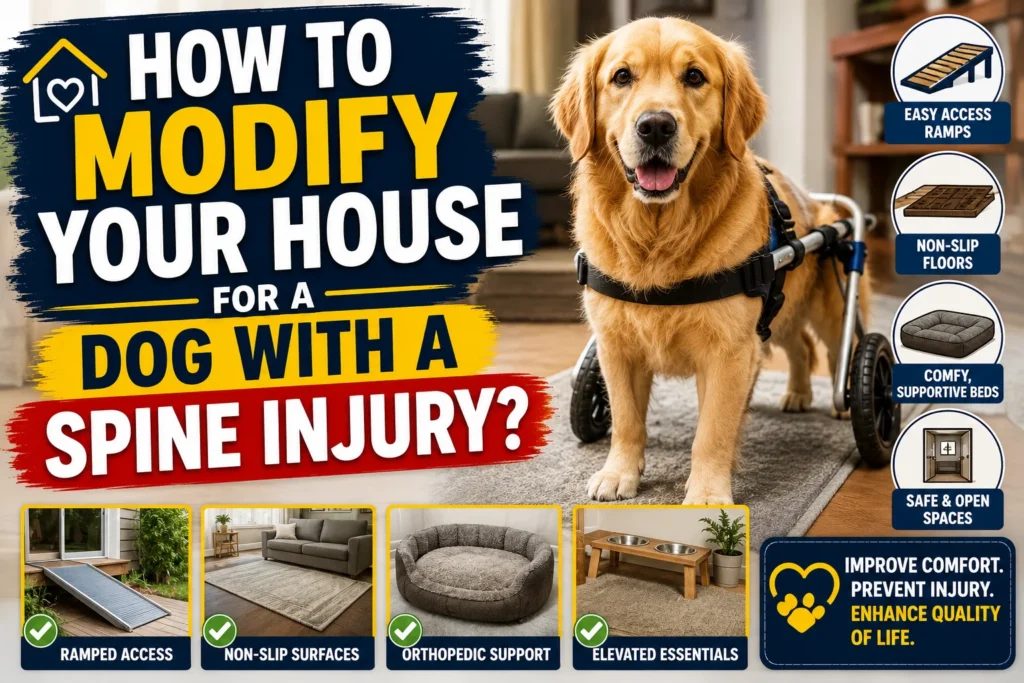
How to Modify Your House for a Dog with a Spine Injury? When a spinal injury affects a pet, this can be a worrying and devastating time for any owner. Having to watch your best friend in pain or discomfort or having difficulty with normal movement is something few pet lovers could go through without being heartbroken. The road to recovery is usually marked with hope, and preparing your home is the best single contribution you can make to helping your furry pal recuperate. As a vet, I cannot emphasize this fact enough.
How to Modify Your House for a Dog with a Spine Injury?
1. The Foundation of Recovery: Strict Rest and Confinement
The most important step before beginning any renovation is the strict rest and confinement protocol. Whether your dog has had surgery or you opted for conservative management, the wounded spine requires rest. Anything you may consider harmless-like jumping out of the truck or getting up on a slick surface-can re-injure the spine.
Confine the dog in a small, secure space for 4-6 weeks as a minimum. A small exercise pen or a large crate is ideal. Confine them to a space large enough for them to stand up, turn around and lie down without movement in between. Their entire world should be reduced and regulated, to ensure the only movement that happens in between those small spaces is movement that is smooth and not forced.
The healing time for an injured spine is many months sometimes over a year so patience is the most crucial medicine you can give.
2. Flooring: The Silent Threat of Slippery Surfaces
The absolute first and perhaps the single most important step you need to take is to make changes to the flooring. Hardwood, tile, vinyl are the enemy of a spinal-injury dog. They cause the legs to spread apart (like a froggie leg), put a great and unnatural amount of stress on the spine and the cause falls, further injury and lack of confidence when moving. The goal here is to create an instant and accessible safe place and provide traction for your dog on ANY surface he walks, stands, rests or sleeps on.
- Rugs and Mats: Cover all slippery floors with non-slip throw rugs, carpet runners, or yoga mats . This creates a stable surface for your dog to stand and walk on.
- Secure Them: Use a non-skid pad under every rug. This prevents the rug from sliding out from under your dog, which can be just as dangerous as a slippery floor .
- The “Bedroom” Foundation: Put a rug or mat directly under and around your dog’s bed. This ensures the first and last step they take is on a secure surface .
3. Managing Heights: The End of Jumping
For a dog that has had spinal trauma, avoid jumping from furniture, beds, or vehicles. The concussion that the impact on your dog’s spine receives when he lands over and over again. How to keep your dog from doing these jumps is to either, get Ramps or lift your dog from each one of these jumps and out of vehicles.
Ramps Instead of Jumping
Ramps are an essential piece of equipment, allowing your dog to safely navigate different levels in your home, like getting onto the couch or into the car . If you’re using or building a ramp, ensure:
- Sturdy Construction: The ramp must be solid and not wobble or swing when your dog uses it .
- Excellent Traction: Cover the surface with a material that provides grip, like carpet or a rubber mat . Raw wood is too slippery.
- Proper Width: The ramp should be at least three times as wide as your dog to prevent them from falling off the side if they stagger .
- Safe Design: Ensure there are no gaps between the ramp and the surface it connects to, as a dog’s paw can get caught .
Lifting: The Right Way to Handle Your Dog
For the initial recovery period, you may need to carry your dog to and from their bed or outside for toilet breaks. Proper lifting technique is crucial to avoid putting torque on their spine .
- Support your dogs’ body: to maintain a neutral straight spine line at all times.
- Large dogs: Place one hand at each side of the rib cage to support their back end and push with the second hand.
- For Larger Dogs: A harness is an absolute necessity. A “Help ‘Em Up” harness is specifically designed for dogs with mobility issues and has handles that allow you to lift and support the front and back ends safely and independently .
Also Check: Signs Of A Respiratory Infection In A Bearded Dragon?
4. Bedding: Comfort is a Medical Necessity
With your dog taking up such a long position, it is going to become important medical equipment. Since they will be lying for so long, it is going to become extremely easy for them to get bedsores (decubital ulcers), which are not only very painful but hard to treat as well.
- Orthopedic beds: Select a firm and substantial bed, preferably made from memory foam. This mattress will evenly distribute body weight to minimize the pressure applied to the bony structures of the hips and elbows .
- Waterproof Layers: Use “puppy pads” (disposable bluey sheets) or waterproof liners under the bed’s cover. This will help keep the mattress clean and dry in case of incontinence .
- Rotate Regularly: Like your dog does in the day, you need to rotate and move her to other positions a few times during the day to keep her from developing pressure sores.
5. The Medical Corner: Managing Incontinence
Many dogs with spinal injuries have poor bladder or bowel control as a result of damage to their spinal cord . This condition is called Incontinence and is arguably one of the most challenging aspects of caring for a dog at home .
- Bladder Care: Dogs who suffer with a high level of spinal cord damage will likely not be able to pee on their own. Your veterinarian will have to teach you to manually empty the bladder of your dog. It is vital you know how to do this in order to keep bladder infections, a serious risk, from happening. It is not enough to watch it on a video, you need your vet to show you.
- Hygiene: Urine and feces are caustic and will cause painful skin burns and sores if left on the skin . Check your dog frequently (every few hours), and gently clean them with a vet-approved, soap-free shampoo or pet wipes .
- Protective Clothing: “Brolly” sheets or other reusable waterproof bedding can be helpful to keep your dog’s area dry . While diapers are an option, they must be changed frequently to prevent skin irritation .
6. Rehabilitation Exercises: Passive Range of Motion (PROM)
- It’s still very important to take care of the dog’s joints although he needs to rest for some weeks. If joints are unused they can become stiff and painful. Passive Range of Motion( PROM) exercises is a way of maintaining this without the dog actually ‘using’ his affected spine. You are ‘ bicycling’ their legs for them.
- The Bicycle With the dog in side position on the floor pick up a leg at a time and take it through it’s range of motion, ie Flex the hip,knee, and ankle and extend the hip, knee and ankle.
- Short and Sweet 5-10 repetitions on the affected limb(s), 4-6 times daily. Short repeated bouts are far better than long bouts less frequently.
- Important: Exercise should ONLY be done that has been demonstrated to you by your vet or veterinary physiotherapist as incorrect manipulation of joints, especially in close proximity to the neck or lower back, could cause further injury.
7. Pain Management and Holistic Care
Your veterinarian will provide you with a multimodal pain management strategy that could incorporate NSAIDs, muscle relaxants and pain medication such as Gabapentin (used for nerve pain). You must never give your dog human medications, and you must never cease giving your dog their prescription pain medication without checking with your vet first. As a safe home treatment that your veterinarian will likely endorse, consider applying the following therapies: –
- Cold Therapy: In the initial 48-72 hours of pain, applying a cold therapy pack (a frozen bag of peas wrapped in a towel or a gel-based frozen pack that would be for people, also wrapped in a towel) on the area can reduce inflammation and pain. This can be done for 5-10 minutes at a time.
- Heat Therapy: After the initial 72 hours, applying a warm compress can soothe muscle spasms .
A Note for the Owner
Caring for a dog with a spinal injury is a marathon, not a race. Research has found that the average dog owner of a disabled dog spends many hours each week on care – 14 hours a week on a median basis – and the physical and emotional effort is intense. It is perfectly normal to feel stressed, exhausted, and at times overwhelmed.
Remember, though: your physical health matters.
Take breaks whenever you can; don’t hesitate to ask family and friends for help, and the medical support staff are there for you as well. Most of the disabled dog owners in one survey agreed that all the care and work had been worth it and had helped solidify the human-canine bond.
8. A Note on Survival and Recovery
Even dogs who permanently lose deep pain perception in their hind legs can develop a “spinal walk,” a reflexive way of walking that can give them a good quality of life . The decision to pursue care is a personal one based on your dog’s prognosis, your lifestyle, and your resources, but you can be confident that the veterinary world has made great strides in helping these patients.
Conclusion
Change of the outlook When changing over your home to the new setup for the spinal injury dog, one should adjust the mindset as the house can now be seen not just as a house, but a training facility. When all is done – ranging from the flooring, confined areas to techniques for lifting, sleeping with a medically designed bed etc, your home now forms the bedrock on which your canine partner can rise once more. This would call for persistence, affection and meticulous efforts, however in the long run you and your partner dog are more than sure to find solutions to the problem.
Frequently Asked Questions (FAQs)
How long does the dog’s crate rest need to be strict in case of spinal injury?
If it is severe, the strict period for resting in the crate should not be less than 4 to 6 weeks so that swelling may subside. Otherwise, your vet will advise the rest of long duration. You should abide by whatever he/she suggests, as excessive movement during the early weeks of treatment can prove harmful and can make a dog suffer the similar illness again.
What if they hate the crate?
Crate a crate an awesome spot for your dog. Include a comfy bedding, interactive toys, and even a chew for enrichment. You can also add a light blanket on the crate as if to be there den’. “The crate should ideally be in a place that you and your dog spend a lot of time”.
How should you carry an injured dog with a spinal cord problem?
The objective is to ensure you keep the spine as flat and horizontal as possible. For the smaller dogs, ensure that the head/front of their body is supported along with their hips/hindquarters. If your dog is larger, we recommend an assistive harness called the “Help ‘Em Up” harness as it allows you to support the front and back end separately with its’ carry straps.
My dog’s paws are knuckling under. Is that normal?
Yes, this is a common symptom of a spinal injury. It means your dog is losing “proprioception” the awareness of where their paws are in space . You can gently help them reposition their paw to a normal standing position. Your vet or physiotherapist may also show you exercises like “feather-light touching” of their toe pads to help rebuild this connection .
Can my dog go outside for a toilet break during crate rest?
Yes, but only for short, controlled bathroom breaks. You should carry your dog to the designated spot and use a harness and sling to support them while they go, then carry them right back to their crate. Do not allow them to walk around freely outside .
My dog has no feeling in their back legs. Will they ever walk again?
It is possible, but not guaranteed. Some dogs who are “deep pain negative” (unable to feel a painful pinch to their toes) can still recover the ability to walk over time, sometimes taking up to a year . They may develop a “spinal walk,” a type of reflexive walking that allows them to move around. Discuss your dog’s specific prognosis with your vet.
Are ramps or stairs better for my dog?
Almost all cases of spinal injury to the dog will benefit more from the use of a ramp than stairs. The risk of the repetition of movement of the back and neck moving sharply with going down or up the stairs puts additional stress and is less advisable than a gentle incline of a ramp.
What kind of food bowl should I use?
An elevated feeder will work best for your dog. This allows your dog to eat or drink with her head at the same level as her body. This prevents your dog having to bend her head down. This is less stressful to the cervical part of the spine.
What are the signs that my dog is in too much pain and needs to go back to the vet?
The signs are shivering, panting, yelping, restless movements, not eating, or the hunched “upright” posture of the dog’s back. Seek veterinary attention if your dog exhibits these signs, especially if they are on pain medication, as this may indicate the dosage needs to be increased or adjusted.