
How to Check a Dogs Pulse and Heart Rate in an Emergency 2026
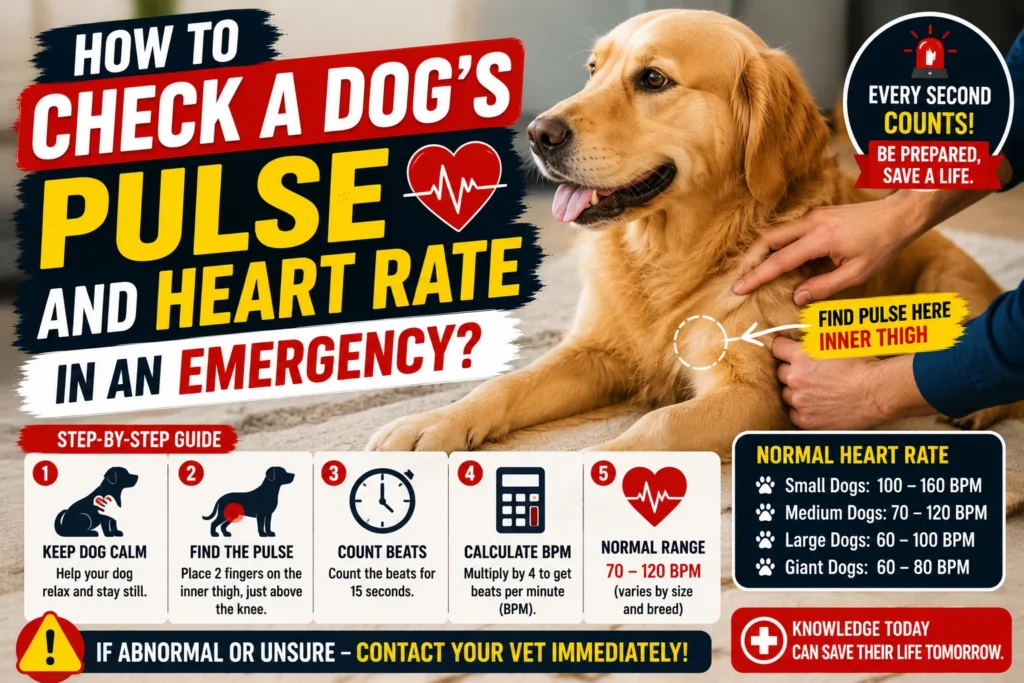
Learn How to Check a Dog’s Pulse and Heart Rate in an Emergency?. If you notice your dog suddenly collapsed, struggling to breathe or unresponsive, every second counts. While you’re in the process of calling your veterinarian, one of the first things that’s incredibly helpful for them is that you check your dog’s pulse and heart rate.
Learning to take this basic measurement can aid you in assessing the urgency and provide vital data to your veterinarian. In this article we’ll cover how to take a dog’s pulse and heart rate in an emergency, and normal dog heart rate.
Why Checking Your Dog’s Pulse Matters
It’s an indicator of how well the blood is getting pumped around. During an emergency situation, like:
- Trauma
- Heatstroke
- Poisoning
- Heart Disease
- Excessive
- Bleeding
- Shock Near Drowning
- Electric shock
Taking your dog’s pulse can give you information regarding the circulation and the rate and strength of the heartbeat.
Although taking the pulse is not a substitute for medical attention by a veterinarian, you will know quickly if there is an life-threatening issue.
What Is a Dog’s Pulse?
A pulse is defined as an arterial expansion that occur in correspondence with each and every heartbeat of an individual.
This expansion reflects in the arteries when the heart beats an entire time and it causes the arteries to pump blood at least an entire instance.
- Heart beats 100 times/minute, the pulse is of 100 beat/minute.
Normal Heart Rate for Dogs
Heart rate varies depending on age, breed, and size.
| Dog Size | Normal Heart Rate |
|---|---|
| Puppies | 120–160 beats per minute |
| Small dogs | 100–140 bpm |
| Medium dogs | 70–120 bpm |
| Large dogs | 60–100 bpm |
| Giant breeds | 50–90 bpm |
Healthy dogs may have slightly higher heart rates during excitement or exercise.
Signs Your Dog Needs an Immediate Pulse Check
Check your dog’s pulse immediately if they show any of these signs:
- Collapse
- Unconsciousness
- Difficulty breathing
- Severe injury
- Hit by a vehicle
- Heat stroke
- Excessive bleeding
- Weakness
- Pale gums
- Blue gums
- Sudden inability to stand
- Seizure recovery
- Suspected poisoning
Step 1: Keep Yourself Safe
You can try to touch the dog in a few seconds, first moving in safe place of dangers from cars. The dog who suffers pain, it will be able to injure you as an involuntary reflex. It is possible to muffle the dog if it can consciously still to breathe and to breathe freely.
Keep speaking to the dog in calm tones.
Do not ever put yourself into a vulnerable position.
Step 2: Position Your Dog
- If you can, turn the dog onto their side.
- Immobilize it
- If a spine is damaged, minimize the amount of movement.
Step 3: Locate the Femoral Pulse
The easiest pulse to find is the femoral artery.
How to Find It
Gently pull the hind leg up a little bit. Stick two fingers, NOT your thumb, just inside the upper part of the thigh. You’ll feel where the leg goes in to the hip.
Run your fingers along until you feel a nice regular pulse.
Don’t press to hard!
Other Places to Feel a Pulse
Where can you check for the femoral artery pulse if you can’t feel it:
- Back of the inner thigh closer to the hip, where it is the best.
- Inner front leg near the elbow Paw pads
- Base of tail
Step 4: Count the Pulse
Once you find the pulse:
Time for 15 seconds
multiply by 4.
- 22 in 15 secs:
- 22 x 4=88
beats per min If the pulse is too low for the 15 sec period take the time for 60 seconds
Step 5: Check Heart Rate Directly
Cannot feel a pulse:
Place the other hand flat on the side of the chest in the lower part, to the outside and back of the arm elbow.
The heartbeat should be readily palpable there. You could use a stethoscope if readily available.
How to Tell If the Pulse Is Strong or Weak
What a healthy pulse looks like:
- It should be easy to feel Even and equally spaced
- Weak or irregular pulses
The presence of weak or irregular pulse might show up due to factors such as shock, hemorrhage, profuse bleeding and shock, heart problems and severe dehydratration.
What an Irregular Pulse Means
Irregular rhythm can mean:
- Heart disease
- Electrolyte imbalance
- Poisoning
- Severe illness
Don’t just think an irregular rhythm is nothing. Get your dog seen right away by your vet.
Warning Signs That Require Emergency Veterinary Care
Seek emergency care immediately if your dog has:
- No pulse
- Extremely slow pulse
- Very rapid pulse while resting
- Blue gums
- White gums
- Collapse
- Difficulty breathing
- Weakness
- Loss of consciousness
- Continuous seizures
- Severe trauma
What If You Cannot Find a Pulse?
Keep it together.
- Ask yourself: Am I applying too much pressure?
- My fingers in the wrong place?
- Is he obese?
- Is the pulse very feeble?
In cases where the dog has collapsed, no regular breathing pattern can be detected, pulse and heartbeats absent, call your emergency vet right away. If pet CPR training has been given to you then apply this whilst transporting the dog to your nearest emergency vet practice.
How Gum Color Helps Assess Circulation
Inspect the gums when you’re feeling for a pulse. Healthy gum colors are pink. They should be pink and moist. Emergency gum colors are:
White Gums
Possible causes:
- Blood loss
- Shock
Blue Gums
Possible causes:
- Lack of oxygen
Gray Gums
Possible causes:
- Poor circulation
Bright Red Gums
Possible causes:
- Heat stroke
- Toxicity
Check the Capillary Refill Time (CRT)
- Press down gently on the gums so that they become white.
- Release the finger.
- Color should return to pink within 1 to 2 seconds. Poor refill indicates poor circulation or shock.
Common Emergency Heart Rate Changes
Fast Heart Rate
Possible causes:
- Pain
- Fear
- Heat stroke
- Shock
- Blood loss
- Fever
- Heart disease
Slow Heart Rate
Possible causes:
- Hypothermia
- Heart disease
- Certain toxins
- Severe illness
Common Mistakes to Avoid
Don’t:
- Use your thumb to feel for a pulse. Don’t press so hard. Don’t panic.
- Don’t delay seeking veterinary help.
- Don’t assume a normal heartbeat is good.
- Some deadly conditions can cause a normal heartbeat.
Should You Buy a Pet Heart Rate Monitor?
Home monitoring devices may have some benefits in pets diagnosed with heart disease, but should not be used as a substitute for a veterinary physical examination. Finding the pulse manually is an important skill.
When to Start Pet CPR
How Do I Perform CPR On My Dog? Start CPR only if:
- Your dog is unresponsive
- Your dog isn’t breathing properly
- You cannot feel your dog’s heart beat or pulse.
- When in doubt, call a nearby veterinary clinic immediately and wait for their instructions.
Also Check: How to Set Up a Low-Stress Tank for a Sick Goldfish?
Preventing Heart Emergencies
Steps To Take to Help Prevent Medical emergencies :
- Regular visits to your Veterinarian
- Maintaining a healthy weight
- Regular exercise Providing a healthy diet
- Helping your pet avoid overheating
- Keeping toxins out of the reach of your pet
- Proper treatment of heart conditions as prescribed by your veterinarian
Conclusion
Check the heart rate: Heart rate needs to be monitored for a minute before determining the normal or abnormal rates. Take the pulse: A simple way to assess pulse rate. Identify the weak pulse or absence: A dog will become limp. Look at the gums: Normal gums should be moist pink, whereas pale to bluish to deep red to almost black indicates underlying problems.
Frequently Asked Questions (FAQs)
When and where is the best place to count your dog’s pulse?
The best place to get an accurate reading is generally along the inner surface of the rear leg at the connection to the hip in the hip crease; that’s called the femoral artery.
What is a normal resting heart rate for a adult dog?
It generally falls between 60 to 140 beats per minute (bpm) for the majority of adult dogs. Smaller dogs have a resting rate faster than larger ones.
How long do you count your dog’s pulse for?
Multiply the number of beats that you count for 15 seconds by four.
If the pulse seems to be very weak, you may need to count it for 60 seconds.
How do I feel my dog’s heart rate with no stethoscope?
To take your dog’s pulse without a stethoscope, simply place your hand on your dog’s left side directly behind the elbow.
What should I do if I can’t feel the pulse?
Slowly run your fingers down the inner thigh of your dog’s hind leg to re- palpate your dog’s pulse. If you are unable to find your dog’s pulse, the dog is unresponsive and having difficulty breathing, seek immediate veterinary assistance and begin performing CPR if you are trained to do so.
Can a dog’s rapid heartbeat indicate an emergency?
Yes. In some instances, your dog’s pulse may indicate a life-threatening condition. While some fast breathing and panting may occur as a result of strenuous physical activity or stress or fear, the combination of a rapid heartbeat, weakness, collapsing and shallow breathing should be an immediate concern that warrants contacting your veterinarian right away.
What should I do to prepare for communicating with my veterinarian if my dog’s heartbeat seems different?
In addition to your dog’s heart rate, include the rhythm of the heartbeat, whether you can feel their pulse at the top of the mouth, gum color and if your dog collapsed.
Will learning my dog’s pulse save their life?
Yes, without a doubt! Checking your dog’s pulse and know when it’s not present or is very weak can save their life and you know the appropriate response during a canine emergency.