When Your Dog’s Back Legs Give Out Recognizing the Signs of Nerve Weakness 2026
When Your Dog’s Back Legs Give Out Recognizing the Signs of Nerve Weakness There is one symptom report of the backyard that pet moms and dads bring to the veterinarian, time and again.
Something which really tears us veterinarian’s to heart? That the rear legs are ” giving out “, it appears. You watch the pet or the cat, that is so complete, it suddenly drops and can not remain.
They limp or they simply can’t get started! While arthritis and other joint troubles will explain the slipping and slumping that happens so often at their joints, rear leg weak link might likewise point to issues further upward trouble controlling or even functioning their rear leg nerves and limbs. When the connection anywhere from the brain through to the rear leg, breaks down, then weakened nerves result and result in quite definite signs of weakness. Find a list here!
Sudden vs. Gradual The Speed of Onset is a Clue
The most important clue to diagnose the cause of hind end weakness is timing. Nerve issues can generally be split into two types based on development: Sudden (Acute) Weakness This requires an emergency evaluation. This means that if your dog suddenly cannot use its rear legs (normal one day, down the next), the possibilities are more alarming and can include: Fibrocartilaginous Embolism (FCE or “spinal stroke”)…
The “stroke.”
Type 1 Intervertebral Disc Disease (IVDD) A sudden burst to an intervertebral disc putting acute pressure on the spinal cord. Toxin Exposure or Immune Mediated Disease e.g. Botulism or Acute Idiopathic Polyradiculoneuritis Slowly Progressive Weakness The patient develops slowly over a weeks to months. The common types of conditions that cause this usually have a degenerative component: Degenerative Myelopathy (DM).
Type II IVDD.. A bulging rather than rupturing disc. Cauda Equina Syndrome Narrowing at the tail end of the spinal cord.
10 Key Signs of Neurological Weakness in the Rear Legs
Weakness is easy, but nerve signs can be confusing! A nerve weak puppy isn’t sore. He has shut communication with his own body parts! Check for the classic warning signs.
1. Ataxia A Wobbly, Uncoordinated Gait
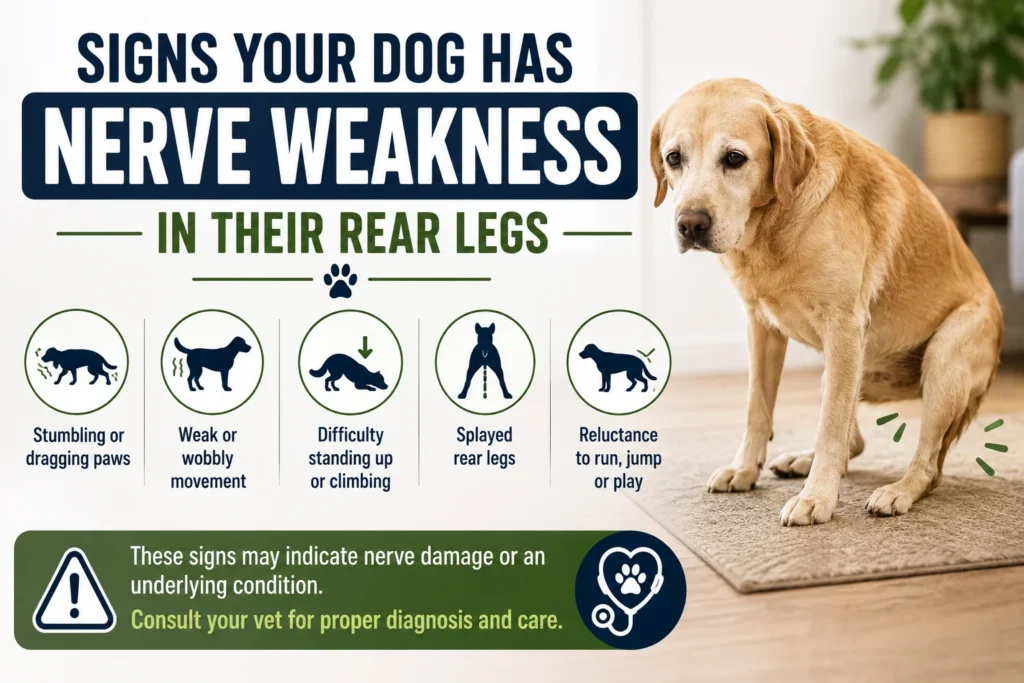
Ataxia is the veterinary term for Loss of Co ordination. Neurological damage in dogs tends to cause the dog to stand with a wide based stand at the rear, and to wobble when walking . The rear legs can appear to cross one over the other (scissoring) and can move uncoordinatedly. It does not look like the slow, stiff gait of arthritis, rather like the drunk wobbly gait
2. Knuckling The Paws Are Upside Down
One of the most apparent signs that there is something going on neurologically. You’ll see what they call ‘knuckling’ this is when the dog puts the top of its paw on the ground rather than the pads. A normal dog flipped over quickly corrects themselves with their paw.
A dog with nerve weakness may react very slowly or not at all ( loss of proprioception).
You may hear the nails scraping on the floor.
3. Scuffing and Dragging Toes
As the nerves deteriorate, the dog loses the ability to lift its paws properly. This leads to the toes and nails dragging on the ground. Over time, you’ll notice their nails wearing down to short stubs or the tops of their paws developing calluses and sores from the friction .
4. Weakness and Collapse
The muscles of the hind end of this animal have lost the ability to carry weight.
Signs that indicate hind end weakness can be: Dog Unable to Get up Lying down and then have difficulty when they do get to their feet and may fall before they get up or will be unsteady when they do manage it Falls Over in the hind quarters collapse, typically when the dog is going upstairs, walking around tight corners or may slip on a shiny floor Paraplegic. This is the extreme case where the dog loses all ability to walk on their rear legs and will become incontinent
5. Muscle Atrophy
When nerves are injured, the muscles supplied with signals from these nerves lose their stimuli for contraction. Eventually, the muscle atrophies and reduces the size of. For most, it will result in a shriveled appearance of your thighs and more exposed bones in the spine and on your hips.
6. Pain in the Lower Back or Neck
Difficulty identifying it can be difficult because nerve weakness does not always involve pain. For example, Degenerative Myelopathy is very well known for not producing pain. It’s much more likely that a dog with something like IVDD, or with Cauda Equina Syndrome will feel severe pain. Other symptoms associated with nerve weakness are your dog may cry out if his hind end is touched, the may not put his neck or his back end up to eat from a dish, or he may have a hunched appearance.
7. Tail Paralysis or “Limp Tail”
In some dogs, their tail can even be under nerve control. Nerve abnormalities in the lower back cause such a thing, causing a droopy and non-wagging tail
8. Urinary and Fecal Incontinence
As nerve compression gets worse, you can notice bladder and bowel control issues in your dog, instead of begging to go outside, they may dribble urine as you walk with the dog; urinate within the house; be terribly impacted as he cannot strain.
9. Loss of Sensation
Although this would be difficult to perform and assess in a home environment, this is an important prognostic sign. If you pinch a toes gently (between the toes are best) the dog should flinch and then watch you with your ears. Severe nerve damage is where the dog feels nothing.
10. Asymmetrical Weakness
You may see a weakness or unsteadiness, or more tendency to knuckling in one leg than the other: unlike most arthritis where both legs are equally affected many nerve diseases begin in one leg, before travelling to the other, although most have both legs, in due course.
Common Conditions that Cause Rear Leg Nerve Weakness
Recognizing these signs can reveal a handful of typical neurological “villains”:
Degenerative Myelopathy (DM): Occurs mostly in dogs 8+ and slowly worsens over 6 to 12 months from wobbling to paralysis, it is usually painless, but will have characteristic knuckling and dragging.
Intervertebral Disc Disease (IVDD): Can occur suddenly (Type I) or slowly (Type II). Weakness can be seen alongside pain, a hunched back and knuckling and dragging.
Cauda Equina Syndrome: Pain is the most prominent initial sign, quickly developing to weakness and incontinence. Most often seen in young, active, large breed dogs such as GSDs.
Botulism: The hallmark is “progressive, symmetrical, ascending weakness”, whereby the pet initially becomes weak in the hind end, then progresses through the body and up the front limbs and into the head. This is life-threatening!
What To Do Next
If you see these signs, contact your vet to book a checkup. In case of sudden weakness or extreme pain, the situation becomes critical. Visit your vet immediately for a state of the art facility, the ideal course of action will be a full neurological evaluation.
They will check reflexes, pain, and proprioception (the knowledge of where the paw is).
Depending on what they find out through the exam, your vet may want to run additional diagnostics, like a spinal x-rays, CT or MRI scan, or a cerebrospinal tap ( CSF analysis).
For More Info : Can Dog Hydrotherapy Swim Sessions Help with Spinal Recovery 2026?
Frequently Asked Questions (FAQs)
What is “knuckling” in dogs and why does it happen?
Knuckling occurs when a dog walks on the top of its paw rather than the pads. It happens because the nerves that tell the foot how to position itself are not functioning properly, a sign of neurological deficits . It is often accompanied by a delay or failure to correct the paw when it is flipped over.
My dog is weak in the back legs but doesn’t seem in pain. What could it be?
A lack of pain often points to Degenerative Myelopathy (DM) . Unlike spinal disc disease or arthritis, which cause inflammation, DM is a painless deterioration of the spinal cord. However, the compensating movements can lead to secondary pain and sores .
What is the difference between arthritis and nerve weakness in dogs?
Arthritis typically causes a slow, stiff gait, and pain when getting up or after exercise. There is no knuckling, wobbling, or dragging of toes. Nerve weakness specifically results in incoordination and a loss of feeling or control, often without the same level of joint-specific pain .
Which dog breeds are most at risk for neurological weakness?
German Shepherds are particularly predisposed to Degenerative Myelopathy . Other large breeds like Boxers, Huskies, and Labrador Retrievers are also at higher risk. Cauda Equina Syndrome is also common in large, active breeds . Border Collies can have hereditary neuropathies .
How does a vet test for nerve function in a dog’s back legs?
A vet will perform a neurological exam that includes checking reflexes (like the knee jerk), testing for proprioception by flipping the paw over to see if the dog corrects it, and assessing the dog’s ability to feel pain. They may also observe the dog’s gait and posture .
Why is my dog’s tail suddenly limp along with rear leg weakness?
A limp tail (flaccid paralysis) combined with rear leg weakness often points to nerve compression in the lumbosacral area (lower spine) or conditions like Cauda Equina Syndrome. The nerves that control the tail and hind legs originate in this area .
What is “ascending weakness” in dogs?
Ascending weakness is a hallmark of some diseases like botulism . It means the weakness started in the rear legs and gradually progresses up the body to affect the front legs, neck, and head. This is an emergency requiring immediate veterinary attention.
Can nerve weakness cause incontinence in dogs?
Yes. The nerves that control the bladder and bowel sphincters are located in the lower spine. When these are compressed or damaged (by IVDD, DM, or Cauda Equina), a dog may lose the ability to hold urine or feces, leading to dribbling or accidents .
Can a dog recover from paralysis in the back legs?
Recovery depends entirely on the cause. If the spinal cord is severely damaged (like in severe IVDD or advanced DM), recovery is often poor. However, prompt surgery for IVDD can allow for recovery. Conditions like botulism may recover if the dog is supported with intensive care during the acute phase .
Is it possible to prevent nerve weakness in older dogs?
While you cannot prevent genetic diseases like DM, maintaining a healthy weight, providing joint supplements, and using a harness (rather than a collar) to prevent neck strain can help support overall mobility. Regular vet check-ups allow for early detection of conditions like IVDD before they cause severe damage.