
Your Dog’s Wearable Alerted Low Heart Rate 2026
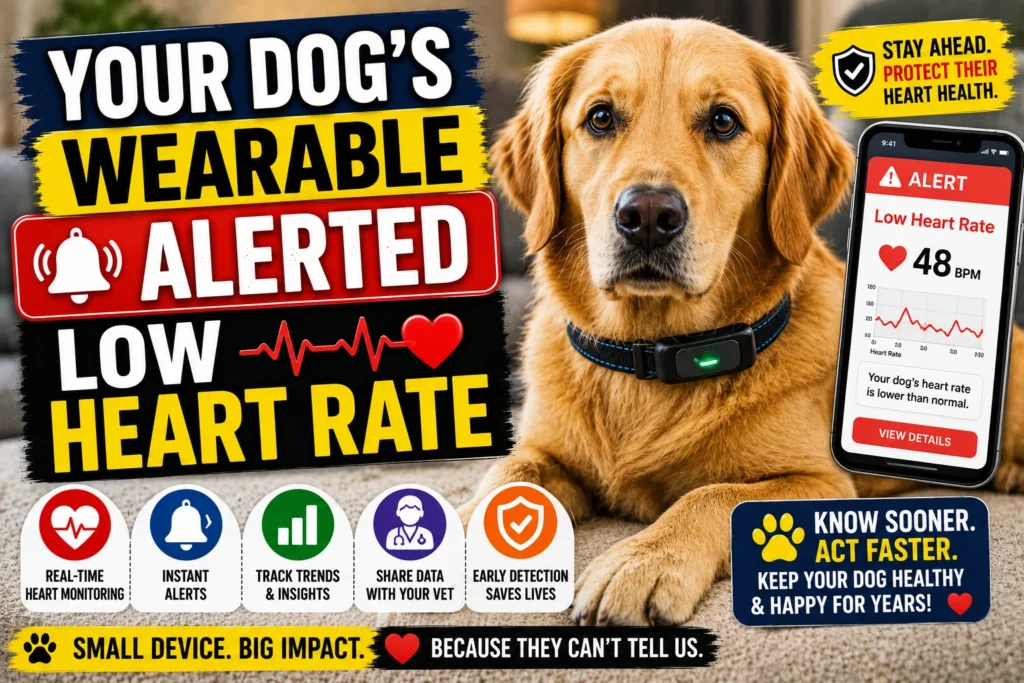
Low The buzz of a smartphone notification is usually a welcome interruption. But when that alert comes from your dog’s health wearable, indicating a “low heart rate,” it can instantly trigger a wave of panic. It’s a moment of high anxiety, but it’s also a critical opportunity to act as your dog’s best advocate.
This guide, created from a dual perspective of veterinary expertise and practical pet ownership, will walk you through exactly what to do when your smart collar alerts you to bradycardia (a slow heart rate). It provides a clear, step-by-step action plan to help you stay calm, assess the situation, and take the right steps for your furry family member.
First, take a deep breath. Your dog’s wearable is a powerful tool for early detection, but it’s not a standalone diagnostic device. Your observation and subsequent actions are just as crucial.
Don’t Panic, Do Verify the Alert
Your immediate reaction should be to assess your dog’s physical state. A low heart rate alert can be a true emergency, but it can also be a false alarm or a sign of a benign condition. Do not rush to the car just yet. Instead, perform a quick, hands on health check of your dog.
Check for a Pulse Manually
Confirm the reading from your wearable. The best places to find your dog’s pulse are:
- On the chest: Place your hands on both sides of your dog’s chest, right behind their elbows .
- On the inner thigh: Feel for a pulse by placing two fingers inside the thigh, where the leg meets the body .
Count the number of beats for 15 seconds and multiply by four to get the beats per minute (bpm) . Compare this to the normal resting heart rates for dogs: 70 to 140 bpm for small and medium dogs, and 50 to 120 bpm for larger breeds .
Assess for Clinical Signs
The most critical question is: Is your dog showing any symptoms of distress? A low heart rate (bradycardia) is a medical concern when it leads to a lack of oxygen rich blood being pumped to the body’s organs. Watch closely for these warning signs :
- Weakness or Lethargy: Is your dog unusually sluggish, unwilling to move, or “wobbly“?
- Collapse or Fainting (Syncope): Has your dog lost consciousness, even briefly?
- Respiratory Distress: Is your dog breathing rapidly, shallowly, or having difficulty catching its breath?
- Pale or Bluish Gums: Check the color of your dog’s gums. Healthy gums are a vibrant “bubblegum” pink. Pale, white, or blue gums indicate poor oxygenation and are a sign of a severe emergency .
- Altered Consciousness: Is your dog disoriented or unresponsive?
Veterinary Insight: A slow heart rate that is not accompanied by any of these clinical signs might be benign. Sinus bradycardia, for instance, can be a normal finding in highly athletic dogs or can occur during sleep . However, it can also be secondary to other systemic issues like respiratory, gastrointestinal, or neurological diseases .
Perform Immediate First Aid for an Emergency
If your dog is showing signs of distress or has collapsed, you are dealing with a life threatening emergency. Your priority is to get them to a veterinarian immediately. If possible, call the veterinary clinic on your way so they can prepare for your arrival .
Important: Do not begin CPR unless you are certain your dog has no heartbeat and is not breathing. Performing CPR on a dog with a beating heart can cause serious harm .
Here are the steps to take if your dog is unconscious and you cannot find a pulse :
- Open the Airway: Gently extend your dog’s neck and clear the mouth and throat of any obstructions.
- Check for a Heartbeat: Place your hands on both sides of the chest behind the elbows. Feel for a beat for 10 seconds.
- Begin Chest Compressions: If there is no heartbeat, place your dog on its side.
- For dogs over 30 pounds, place your hands on the widest part of the chest cavity .
- For dogs under 30 pounds, you can perform compressions directly over the heart .
- Administer 1 to 2 compressions per second (100-120 beats per minute) for 30 seconds.
- Give Rescue Breaths: After 30 compressions, give two “mouth-to-snout” breaths. Close your dog’s mouth, extend its neck, and blow into its nostrils until you see the chest rise .
- Continue CPR: Repeat cycles of 30 compressions and 2 breaths until you reach the vet or your dog shows signs of life.
Consult Your Veterinarian
Even if your dog seems perfectly fine after the alert, you must contact your veterinarian. Do not dismiss the alert as a “glitch.” A single instance of a low heart rate, even if asymptomatic, warrants a professional evaluation.
When you call, be prepared to share the following information:
- The heart rate reading from your wearable.
- The time the alert occurred.
- Your dog’s behavior and any symptoms observed.
- Details of any recent changes in activity, appetite, or behavior.
Why This Matters: Wearable technology is a fantastic tool for monitoring, but it has its limits . Your veterinarian will use their clinical expertise and diagnostic tools to determine the root cause. They may recommend tests like an electrocardiogram (ECG/EKG), Holter monitor, bloodwork, and a physical exam to check for underlying conditions like heart disease, electrolyte imbalances, or other systemic issues .
“The high level of agreement observed between OSS and VPM for HR measurements suggests that such wearable devices may be considered as an auxiliary monitoring method for the early detection of cardiac rhythm disorders.”
This means your wearable is a valuable “assistant,” but the final diagnosis must come from your vet.
Work with Your Vet on a Long Term Plan
Based on the diagnosis, your vet will recommend a course of action. Treatment options range from none at all to more advanced interventions .
1. Monitoring and Rechecks
If the bradycardia is mild and asymptomatic, your vet may simply recommend periodic rechecks to monitor your dog’s condition .
2. Medical Management
If an underlying cause, such as an electrolyte imbalance or a systemic disease, is identified, treating that primary issue often resolves the bradycardia . Medications like Mexiletine, Sotalol, or Diltiazem are sometimes used to manage different types of arrhythmias, though treatment is specific to the underlying cause .
3. Pacemaker Implantation
For more serious, symptomatic bradyarrhythmias (like third-degree AV block), a pacemaker is the definitive treatment . A pacemaker is a small device implanted to regulate the heart’s rhythm, ensuring it doesn’t beat too slowly. Dogs with pacemakers generally require rechecks every 6-12 months to ensure the device is functioning properly . Long-term survival is excellent following this procedure .
Your Role as a Proactive Pet Parent
Navigating this situation is stressful, but your quick thinking and action are what make the difference. Your dog’s health wearable is a powerful addition to your toolkit, but it works best when combined with your love, observation, and partnership with your veterinarian.
For More : The Ultimate Guide to Adding Goat Milk Kefir to Your Dog’s Kibble Bowl 2026
Frequently Asked Questions (FAQs)
What is considered a “low” heart rate in a dog?
Generally, a heart rate below 60 to 70 bpm in a large dog and below 80 to 100 bpm in a small dog is considered bradycardia . However, athletic dogs can have lower resting rates, and a diagnosis depends on the overall clinical picture .
Can a dog’s heart rate drop due to non medical reasons?
Yes. A slow heart rate can be benign and normal during sleep, periods of high vagal tone, or in conditioned, athletic dogs . It can also be a response to pain or a vagal maneuver .
My dog seems fine. Do I still need to go to the vet?
Absolutely. Even if your dog appears normal, the alert signifies a potential underlying issue that should be evaluated by a professional to rule out conditions like heart disease or electrolyte abnormalities .
How accurate are dog wearables for heart rate monitoring?
Veterinary studies show that wearable devices can have a high level of agreement with clinical monitors for heart rate, especially in low-activity situations . However, they are considered an “auxiliary monitoring method” and should not be the sole basis for a clinical diagnosis .
What is the difference between a slow heart rate and an arrhythmia?
An arrhythmia is an abnormal heart rhythm, which can be too fast, too slow, or irregular. A slow heart rate (bradycardia) is a specific type of arrhythmia . An alert for a slow heart rate could indicate a bradyarrhythmia.
What are the common causes of a dangerously slow heart rate in dogs?
Causes can include primary heart disease (like sick sinus syndrome or AV block), or secondary conditions that affect heart rate, such as respiratory disease, gastrointestinal issues, neurological problems, electrolyte imbalances, or drug toxicity .
What should I do if my dog has a low heart rate alert and collapses?
This is an emergency. Immediately call your vet while an route. Check for breathing and a pulse. If you find none, begin CPR (chest compressions and rescue breaths) and continue until you reach the vet .
What is a pacemaker for dogs?
A pacemaker is a small device surgically implanted to regulate a dog’s heartbeat. It’s used to treat severe bradyarrhythmia (like third degree AV block) by ensuring the heart beats at a sufficient rate .
Can certain dog breeds be more prone to heart rhythm problems?
Yes. Breeds like Boxers, Doberman Pinschers, Great Danes, and Irish Wolfhounds are predisposed to certain types of arrhythmias .
Is it safe to exercise my dog after a low heart rate alert?
No. You should wait until you have consulted with your veterinarian. Exercise can exacerbate an underlying heart condition, and you should follow your vet’s specific guidelines regarding activity restriction .