Why Is My Cats Stomach Bloated and Hard?
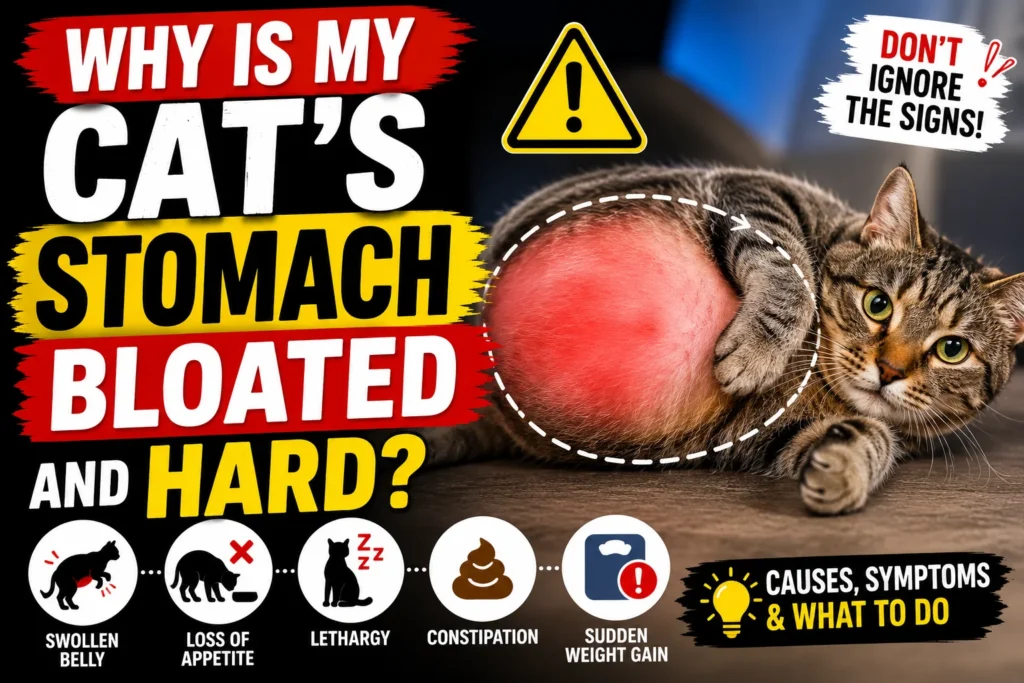
Why Is My Cats Stomach Bloated and Hard? As a veterinarian, I see this specific symptom often in emergency triage: A cat with a belly that looks like a drum. If you have touched your cat’s abdomen and it feels hard (not just squishy fat) and looks distended, you are likely dealing with a medical emergency.
A bloated, hard stomach is not a disease in itself it is a clinical sign of several potentially fatal conditions. Because cats are masters of hiding pain, a rigid abdomen often means they have stopped pretending to be fine.
Here is the differential diagnosis for a rock hard feline belly, ranked from “rush to the ER” to “manageable chronic issues.”
Why Is My Cats Stomach Bloated and Hard (The Silent Killer FIP)
The most common infectious cause of a hard belly in young cats is “wet” FIP.
- What it is: A mutation of the coronavirus.
- The Mechanism: The virus causes blood vessels to leak fluid (effusion) into the abdomen. As the fluid accumulates, the belly becomes tight, distended, and hard.
- The “Ballotable” Sign: You may feel a shifting dullness when you tap the belly. The abdomen will feel like a water balloon filled with concrete.
- Action: Requires immediate veterinary testing (Rivalta test, PCR).
Also Check: Why Does My Cat Bite My Ankles When I Walk?
2. Feline Urinary Obstruction (Urethral Blockage)
This is the 1 emergency for male cats.
- The Danger: If your male cat is straining to pee and cannot pass urine, the bladder swells to the size of a peach.
- The Feel: A hard, round, immovable mass in the mid to lower belly (the bladder). It feels like a rock.
- Concurrent Signs: Howling in the litter box, vomiting, lethargy.
- The 72-Hour Rule: Without treatment, the bladder ruptures or the kidneys fail within 48–72 hours. This is a 100% fatal condition without immediate veterinary surgery/catheterization.
3. Pyometra (The Pus-Filled Uterus)
For unspayed female cats only.
- The Mechanism: The uterus fills with bacterial pus. As it expands, it pushes against the abdominal wall.
- The Feel: A tubular or elongated hard mass deep in the belly.
- Clinical Signs: Drinking excessive water, lethargy, fever, possibly a foul vaginal discharge (if the cervix is open).
- Action: Emergency spay (Ovariohysterectomy) is the only cure.
4. Intestinal Blockage (Foreign Body Obstruction)
Cats love string, ribbon, and hair ties (linear foreign bodies).
- The Mechanism: The object bunches up the intestines (plication). Gas and fluid build up behind the block, causing the abdomen to become taut and painful.
- The Feel: Generalized firmness; the cat will likely cry or flinch when you palpate the gut.
- Concurrent Signs: Regurgitation of water, anorexia, constipation or absence of stool.
- Action: X-rays and abdominal ultrasound are required. Surgery is necessary.
5. Severe Constipation (Obstipation)
- The Mechanism: Rock-hard feces lodged in the colon.
- The Feel: A beaded or lumpy-hard texture along the lower back/belly side.
- The Cause: Dehydration, hairballs, or pelvic injuries.
- Action: Enemas (Vet only never use human enemas on cats; they are toxic) and hydration.
6. Aortic Thromboembolism (Saddle Thrombus)
- The Mechanism: A blood clot lodges at the aortic trifurcation (where the artery splits to the back legs). This causes paralysis and extreme pain.
- The Feel: The belly is hard due to severe muscle cramping and pain. The back legs will be cold to the touch.
- Action: Extremely painful. Requires oxygen and intensive care immediately.
Why Is My Cat’s Stomach Bloated and Hard?
When is it NOT an Emergency?
There is one scenario where a hard belly is less urgent, though still requires a vet visit Massive obesity with ascites. However, a true hard belly usually rules out simple fat.
A note on worms: While worms can cause a pot bellied appearance in kittens, that belly is usually soft and doughy, not hard. If it’s rock hard, it is not just parasites.
What You Must Do Right Now
The Pinch Test:
Gently try to lift the skin over your cat’s shoulder blades. If it stays tented (does not snap back), your cat is severely dehydrated, compounding the hard belly issue.
Do NOT:
- Massage the belly (could rupture a bladder or FIP cyst).
- Give human gas medicine (Simethicone is useless for obstruction).
- Wait until morning.
Go to the Vet: This is a “true emergency” signal. Expect diagnostics: Bloodwork, X-rays, and possibly an abdominal tap (abdominocentesis).
Prevention & Long-Term Care
- For Male Cats: Ensure unlimited fresh water to prevent crystals that cause blockages.
- For Females: Spay your cat before her first heat (prevents Pyometra and mammary cancer).
- Environmental Enrichment: Prevent string/ribbon ingestion by securing sewing kits.
- Vaccination: While not 100% effective, FIP vaccines exist in some regions; discuss with your vet.
Frequently Asked Questions (FAQs)
Can a hard bloated stomach kill my cat?
Yes, immediately. If the cause is a urinary blockage or twisted intestine, death can occur within 24 to 48 hours. Do not delay treatment.
Why does my cat’s belly feel hard but she is acting normal?
Cats hide pain instinctively. “Acting normal” is often subtle lethargy (sleeping 22 hours instead of 18). Tumors like lymphoma can make the belly hard gradually, but by the time you feel it, they are in late stages.
My cat is eating but has a hard belly. Is that okay?
No. Cats with intestinal blockages often try to eat and then vomit immediately. Eating drive does not rule out a fatal obstruction.
What is the difference between a fat pad and a hard belly?
A fat pad (primordial pouch) hangs down and is floppy. A hard belly is taut across the sides and under the ribs. If you poke the side and it doesn’t indent, it is fluid or organs pushing out.
Will my cat survive if the belly is hard due to FIP?
Historically, FIP was 100% fatal. However, as of 2024-2025, antiviral drugs (GS-441524) are legally available through veterinary channels in many countries, offering remission rates of 80%+ if caught early.
Can stress cause a hard belly?
Indirectly. Stress can cause Feline Idiopathic Cystitis (FIC), which leads to a urinary blockage in males. The stress doesn’t bloat the belly; the resulting inability to pee does.
How does a vet diagnose the cause?
Vets use a triad: Palpation (feeling the mass), Radiographs (X-rays for poop or foreign bodies), and Ultrasound (for fluid or pyometra). Blood work checks kidney values.
My cat is 18 years old with a hard belly. Is it cancer?
Statistically, yes. The most common is Abdominal Lymphoma or a massive liver tumor. While scary, palliative care (steroids) can buy comfortable months.
Should I give my cat olive oil or laxatives for a hard belly?
No. If the cat has a foreign body, olive oil will not pass the obstruction; it will just cause explosive diarrhea behind the block, increasing pressure and risk of rupture.
How much does emergency surgery cost for a hard belly?
Costs vary, but generally: $1,500 – $5,000 USD for foreign body removal or urinary blockage surgery. Stabilization (fluids, catheter) runs $500 – $1,500. This is why pet insurance is crucial.