
Signs of Hip Dysplasia in German Shepherd Puppies 2026
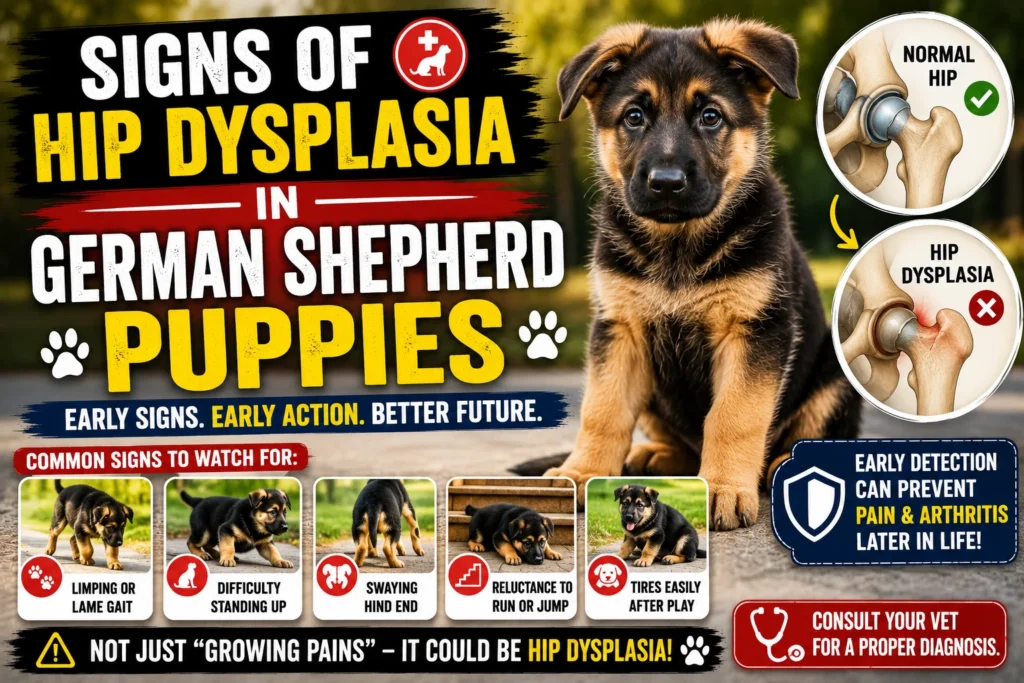
As vets, one of the most frequent and distressing questions that I am asked by GSD owners concerns hip dysplasia and for perfectly good reasons. The breed itself is especially prone to this defect that causes lameness in the hind legs of German Shepherds, and the success of early management.
Why German Shepherds Are Prone to Hip Dysplasia
Hip dysplasia is not a diseases that puppies are born with. It is actually a disease of developmental. Imagine the hip joint being a ball that fits into the cup.
Normally, as the canine grows and developes, the balls fits well into the cup.
When a canine breed which carries a predisposition to hip dysplasia will, the hip ball does not quite form right so as the cartilage wears down so is there movement of the ball around the cups which causes pain and eventual wearing of the joints.
Genetics and Environment: This condition is primarily hereditary, passed down from parent dogs . However, it’s a multifactorial disease, meaning environmental factors like rapid growth, improper nutrition, and excessive exercise during puppyhood can significantly worsen its severity . It’s not just about “bad genes”; it’s about how those genes are expressed.
The Critical Puppyhood Window: While the disease can be detected as early as 3 to 4 months of age, symptoms most commonly become apparent between 6 and 18 months . This is a crucial time. The signs can be subtle, and many owners dismiss them as “puppy clumsiness.” . In fact, research shows that dogs with a genetic predisposition may show joint laxity at six months, even if they go on to develop a normal hip conformation later . This is why understanding the early signs is paramount.
Recognizing the Early Warning Signs
As a responsible owner, you are your puppy’s best advocate. German Shepherds are stoic creatures, bred for work and resilience, which means they can often hide pain until it’s quite advanced . Therefore, you need to become a detective for the subtle, daily changes. The signs of hip dysplasia can vary, and they don’t always correlate with the severity seen on an x-ray . A puppy in severe pain might not show it as clearly as one with a different pain threshold.
1. The “Bunny Hop” Gait
One of the most classic and recognizable signs is a “bunny-hopping” gait. Instead of a smooth, alternating stride with their back legs, your puppy will move both hind legs together like a rabbit, especially when going up stairs or running . This is a conscious effort to reduce the range of motion in their painful hips.
2. Exercise Intolerance and Reluctance to Play
At the dog park, are you the one whose puppy is the last ones playing, settling down while the other kids bounce off the walls? Do they lack interest in the romp in the yard or chase with a ball? Puppies with hip dysplasia have tendency of tiring quickly, so don’t just dismiss lethargic behavior and instead watch for the reluctance of high-energy play you’d normally expect of your puppy especially in breed that should be rambunctious and determined.
3. Difficulty Getting Up or Lying Down
Just observe him when he stands from a resting state (lying or sitting). Does he stumble or seem to struggle a little? Is he a bit reluctant to get up after a nap? This post-exercising stiffness is the most common symptom seen with OA that’s caused secondarily from hip dysplasia and stiffness usually does dissipate with exercise, however; this stiffness can certainly alert you to painful hips.
4. Limping or Lameness in the Hind Legs
The most apparent symptom is an intermittent lameness that occurs after significant effort or, once OA develops, after lying down after a rest. The lameness can be subtle and intermittent and so easy to dismiss as a muscle strain, but is the hall mark of an unstable or arthritic hip.
5. An Abnormal, “Swaying” Gait
The German Shepherd will bring their center of gravity over their front legs and out of their hind legs when the dog has hip pain which helps take pressure off their rear end. The gait or way in which the dog moves will often be swaying or appear to be “loose” and shaky or unstable. German Shepherds normally should be moving around in a strong manner, covering a great deal of ground; motion of this sort would indicate they are being weak in the rear end.
6. Difficulty with Stairs and Jumping
Difficulty jumping into the car or onto the couch/bed Or when climbing the stairs If your puppy seems to be afraid or is completely unwilling to jump into the car, in the bed or even to go up stairs, there’s a high probability that he’s suffering from hip dysplasia as pain associated with this condition can makes such actions impossible.
7. Changes in Sitting Posture
Take a look at how your puppy sits. A dog with a normal hip joint will typically sit with their legs tucked neatly under their body. A puppy with dysplasia might sit with one or both hind legs extended out to the side (a “lazy sit” or “frog sit”) to take the pressure off their painful hips .
8. Audible “Clicking” or “Crackling” Sounds
The Click or Pop Clicking or popping may be heard coming from the hip with movement as hip has become lax and degenerated. It can result from looseness of joint and will either be due to the bone grinding against itself or against other bone OR from a condition termed “crepitus” which is feeling a grind within the hip joint.
9. Muscle Atrophy in the Hind Legs
One major clue that there’s something up with your puppy’s hind legs is atrophy (loss of muscle) in the rear part of the thigh. This occurs because they are bearing less and less weight on the hind legs and increasing the weight born by the forelimbs. The back end looks much less toned and solid when compared with the sturdy forequarters that make a puppy. This is a recognized indicator that has a specific name for a cause of hip disease.
10. A “Painless” Puppy? The Silent Danger
This one is, without a doubt, the most misleading of them all. Because the problem initially arises from instability of the hip joint and not because of arthritis, a lot of young puppies will never demonstrate any outward evidence of pain. These dogs may still appear totally uninhibited and unstoppable even with hip dysplasia which is actually at it’s worst point. This really underlines the importance of pre-screen and early hip x-rays on all breeding stock, or, unfortunately a lot of dogs present later in life in ‘growth spurs’.
Also Check: Why Fermented Vegetables Are a Game Changer for Your Dog’s Gut Health 2026?
Action Steps to Take
If your puppy shows any of these signs, don’t panic. Hip dysplasia is manageable, especially with early intervention.
1. See Your Veterinarian
This is the most important step. Don’t wait to see if it gets better. Schedule a physical exam with your vet. They will perform a series of physical manipulation tests like the Ortolani sign to check for joint laxity .
2. X-Ray and Diagnosis
X-rays are the gold standard for diagnosing hip dysplasia. Your veterinarian may take standard hip x-rays or recommend the specialized PennHIP (Pennsylvania Hip Improvement Program) method. Unlike traditional x-rays, PennHIP can be done on puppies as young as 4 months and is considered the most accurate method for measuring joint laxity, allowing for a more precise prediction of future risk .
3. Discuss Treatment Options
Treatment for this condition is very personalized and includes medication options, surgical options. Your vet will consider treatment depending on the puppy’s age, the seriousness of the disease and their lifestyle.
Medical Management (Conservative Care):
- Body Condition: One of the single most important things you can do is keep your puppy in lean condition. Each extra pound on its body puts a lot of stress on the joints.
- Exercise: Controlled exercise (leashed walks at a consistent pace, not a frolic), or swimming (hydrotherapy) is very good. High-impact exercise such as jumping, throwing a ball for the puppy to retrieve, or having the puppy run around for a significant amount of time (e.g. Hours of field time in a large yard) is not a good idea. A good rule of thumb for puppy exercise is five minutes of exercise per month of age, twice daily.
- Supplementation/Diet: A quality, large-breed puppy food that slows growth is extremely important. Omega-3 fatty acid supplements andglucosamine may help the joints as well.
- Medication: Your vet may prescribe NSAIDs to combat any inflammation.
Surgical Interventions:
Surgery can be a life-changing option, especially for young dogs.
- Juvenile Pubic Symphysiodesis (JPS): This minimally invasive surgery is performed on puppies between the ages of 12 and 20 weeks, where a growth plate in the pelvis is fused. This forces the hip socket to enlarge and accept the femoral head. Early age prevention is the key with this procedure .
- Triple/Double Pelvic Osteotomy (TPO/DPO): This surgical treatment is used for younger animals (around 8 months) in which significant arthritis has not yet begun to develop. This is achieved by cutting and rotating the pelvis, making the hip socket cover the hip ball more effectively .
- Total Hip Replacement (THR): This the most promising procedure for older dogs with severe arthritis, whereby the hip is removed and replaced. This procedure achieves great pain relief and functional use of the limb .
The Role of Reputable Breeding
Breeding Back from hips goes a long way In searching out German Shepherd puppies, ask your breeder if their stock has been screened according to the OFA (Orthopedic Foundation for Animals) or the PennHIP protocol. OFA hips certification demands the dog to be of age at least two years, and involves a static evaluation process. A responsible breeder can give you these numbers of his or her breed stock. Although not a sure thing, it will considerably improve your odds of having healthy young German Shepherds.
Frequently Asked Questions (FAQs)
At what age do German Shepherd puppies commonly start showing signs of hip dysplasia?
While present from as early as 3 months, most apparent to the layman the symptoms may be seen between 6 and 18 months.
Can a puppy just grow out of hip dysplasia?
The puppy can’t “grow out” of it, although by about a year the surrounding muscles and connective tissues have tightened and scarred so may sometimes help hide the pain. The genetic defect remains and eventually Arthritis should set in.
What do OFA and PennHIP mean for your German Shepherd Puppy hip testing?
OFA: this requires an old-school x-ray performed when the dog is two years and older, examining final conformation. PennHIP: this involves nothing more than taking an x-ray picture of the hip at 4 months; this examination is for loose hips and represents your dog’s odds of later developing hip dysplasia.
Is the presence of hip dysplasia in a German Shepherd only genetic in nature?
Hip dysplasia has the tendency to become inherited but environmental factors and the pace of growth can certainly play a large part in whether the condition will appear to any degree. As an example a pup with a genetic makeup for healthy hips may appear to have Hip Dysplasia to its new owner if fed improper nutrition that lead to rapid weight gain while a poorly bred dog may appear relatively unaffected with ideal weight, nutrition and exercise.
What is the “bunny hop gait” of puppies?
This refers to puppies’ ability to move both hind legs together as one. Many veterinarians look for this while the puppies are playing, because this is an indicator that the hip joints are painful and the puppies are compensating for this pain.
Can diet prevent hip dysplasia?
Yes. Diet is one important factor in preventing the development of hip dysplasia when it comes to large- breed puppies. A large- breed puppy food should not cause overgrowth of the bone- growth plates and consequently will not excessively stress the hip joints while developing. Do not free- feed or over feed.
What are some tests that the vet might do to try to rule hip dysplasia out?
When the dog is physically manipulated for joint luxation, vets might test out on hips for this, using things like the Ortolani test and might include x-rays or radiograms, while other times the vets do not take an x-ray of a dog suffering from hip dysplasia.
For a German Shepherd hip dysplasia is easily seen in younger dogs?
So, for all breeds in general which are plagued byhipdysplasion onleash walks or swimming can be beneficial. Games like “Jump,” and “Fetch,” and“Frisbee” are an unhealthy pursuit when this joint disease exists in dog; owners should refrain from these sorts of endeavors, completely.
What does one do with Junior?
( Juvenile Pubic Symphysiodesis surgery ) Preventive surgical intervention Juvenile pubic symysiodesis is a procedure intended for very young dogs that are only a bit older than twenty weeks of age.
With this procedure, a region of bone growth within the pelvis, as a form of preventing abnormally slow progress so as not to affect the fit.
Will my dog still have a nice, and long life if he haship dysplasia?
Most assuredly yes! Whenever discovered, most hip dysplasia dogs which manage weight at acceptable values; correct feeding regiments and a controlled exercise routine may certainly prolong and increase the happiness and life quality for the dog even with the diagnosis ofhipdysplasia.
Conclusion
Hip Dysplasia in German Shepherd Puppies is a process, not an emergency. Even though that diagnosis sounds scary, the veterinary field has learned how to keep puppies with this condition a lifetime happily loved companion. Catch it early with The Bunny Hop “Warning”, reluctance to play, awkward sit and take action with your vet. That you will be loving you German Shepherd for a lifetime is a certainty especially after finding a very good German Shepherd vet now as you want them able to do those things for you 10 years down the road and 12 and15, years.