Can a Cat Live a Long Life with Feline Leukemia?
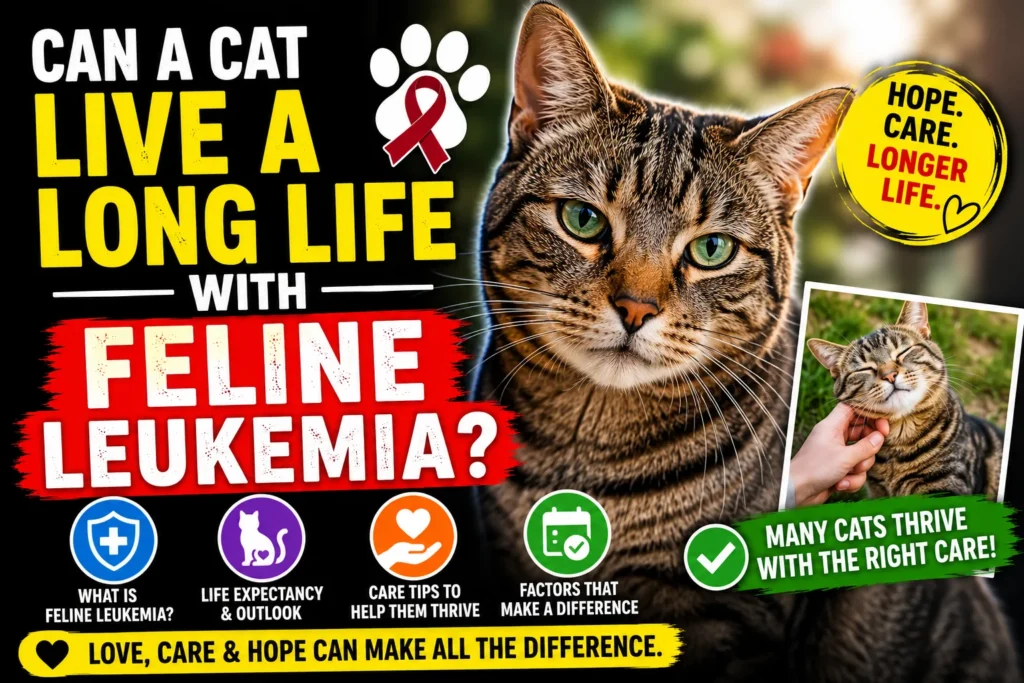
Can a Cat Live a Long Life with Feline Leukemia? The bottom line is, it depends. But that’s just the beginning. It’s heartbreaking when you learn your adorable felines tested positive for Feline Leukemia virus (FeLV).
Believe me as your veterinarian, I have watched the dread fill the eyes of my clients the moment they receive that positive diagnosis. Naturally, the first thing that comes to your mind is, “How much time do we have left?”
Actually the situation is not really a simple statistic. FeLV is a lethal, incurable virus. However, with correct treatment and management a diagnosis is not always a death sentence and many FeLV infected cats can live happily for years after being diagnosed. What’s in a virus… and what it is not It is really essential that a diagnosed cat and their owner fully understand this virus, and what different forms of infection entail, as well as the dedicated and sometimes intensive treatment required to support the cat.
Can a Cat Live a Long Life with Feline Leukemia?
Understanding FeLV: It’s Not One-Size-Fits-All
This is a retrovirus that can ultimately compromise a cat’s immune system and bone marrow in cases of severe illness. If a cat does have one or more symptoms, it is important to rule out underlying secondary issues like lymphoma (cancer), anemia, or predisposition to infection. Thankfully, not every cat who is exposed to FeLV will actually develop the condition or live a decreased lifespan. The result of FeLV exposure depends on such factors as a cat’s age, status of health, and immunological status, and may result in three outcomes:
1. Abortive Infection
A small few have a strong immune system that either combat’s the virus off in the early days of exposure, that would never be identified by testing, nor has ever had health problems.
2. Regressive Infection
The immune system of the cat has the virus under control, but it may never entirely be cleared. A very small number of virus particles may remain dormant in the cat’s bone marrow but the cat will not shed virus and will not be capable of transmitting the virus to other cats. Many regressive infections are in cat’s who live normal lives, show no symptoms, and can have normal life spans. However, the virus has been known to become reactivated in rare cases many years down the road if the cat develops immunosuppression from other causes.
3. Progressive Infection
Most catastrophic outcome of disease. Virus in this category continues replicating and the virus travels through blood stream throughout the whole body and the result is that the infected cat experiences viremia for the rest of its life. FeLV associated diseases and shortest expected lifetime are in most instances related to this group of virus.
Also Check: Can A Dog Get A Cold From Being Out In The Rain?
What Does the Data Say About Life Expectancy?
But the FeLV life expectancy numbers really aren’t the full picture life expectancy A study at a sanctuary with 75 uninfected, FeLV-negative cats and 49 FeLV-positive cats, published in 2025, said the median age FeLV-positive cats survived to was 41.5 months (not even 3.5 years) vs greater than 13 years for their uninfected companions.8 One web source cited the data saying 80-90% diagnosed as positive and HIV positive will not live for greater than three to four years.
Regressive vs. Progressive disease: The most significant determining factor of whether your cat will live is the status of the infection (progressive or regressive). According to one study, cats with the more harmful progressive infection only lived 30 days post diagnosis, on average! The same study indicates cats that the infection was regressible (the immune system cleared the cat from shedding virus), had no impact on survival.
Key Takeaway: The single most important factor in determining your cat’s prognosis is distinguishing between a regressive and progressive infection through confirmatory testing.
Critical Steps After a Positive Test: Getting the Full Picture
But if your cat is positive for one of the illnesses on her initial ELISA (enzyme-linked immunosorbent assay)-usually a SNAP test-at their first well-being examination, relax but take them to your veterinarian for secondary testing. Your vet should, according to AAFP (American Association of Feline Practitioners) guidelines, utilize another form of test. This one is an IFA (immunofluorescence assay).
Test Two Comes Back Negative: This strongly suggests a regressive infection is in order and your feline should have a long, positive quality of life. If you are able to reach out to another veterinarian to get a second opinion that would give you further piece of mind! This indicates a progressive infection, your feline will remain viremic and may need to be managed throughout his or her life by your veterinary. Feline Immunodeficiency virus may need to be tested at this time because co-infection of these diseases may impact prognosis.
Treatment and Management: Giving Your Cat the Best Quality of Life
There isn’t a cure for a progressive FeLV infection yet. Supportive care to make your cat comfortable and handle any secondary conditions that pop up is how it is managed.
Key Management Strategies for FeLV-Positive Cats:
Leave the Door Shut: It is best to keep your cat indoors. It will make it less likely that they will encounter other, contagious cats or viruses, nor they get in a fight with another animal that might require some treatment from the vet.
Regular Veterinary Exams: A vigorous, no-nonsense approach to your cat’s care is important. Your cat should see a vet at least twice annually. It should get blood work done each visit to watch for anemia and changes in blood cell levels.
Quality Diet: Your cat should eat a high-quality, balanced and nutritious diet. Avoid all raw meat diets, as the meat is often laced with the bacteria that your cat cannot fight off as easily as other felines.
Swift treatment of disease: Watch very carefully for symptoms of sickness–lack of appetite, l ethargy, sneezing, or a fever and have them seen immediately by your vet. They will typically want to give your cat longer courses of antibiotics than you would think they might need, even in as in gular case of illness.
Antiviral Treatment: While this medicines still undergoing development some hope is on the horizon.
Some antiviral medications: such as AZT have been developed, yet have only proven a bit effective and come with a good amount of unpleasant side effects. These type of medications and even itegrase inhibitors (e.g., ralte gravir )are being studied and researched at this time for disease control, with good results appearing promising for cat lovers.
Treating FeLV-Associated Conditions:
Modern day vets actually have treatments for many of the other problems that can result from FeLV.
Cancer (Lymphoma): Chemotherapy treatments for FeLV-infected cats are actually available for cases of lymphoma. While those cases do not fare as well as with uninfected animals they can at least go into remission for some time and gain improvement.
Anemia: Severe anemia can be effectively addressed with a blood transfusion and treated with the synthetic hormone, darbepoetin, to build more red blood cells and, sometimes, with steroids. Infections Some FeLV-positive cats develops Gingivitis stomatitis (a mouth inflammation in cats with bleeding and swollen mouth tissue, and is one of the common conditions affecting cat and this could be treated with extraction of teeth which could relieve a source of chronic pain.
A Note on Vaccination
Vaccination is a preventive step in the process. The FeLV vaccine has limitations, it is definitely recommended for every kitten and for cats that go outdoors. The new and improved vaccine called Nobivac NXT FeLV, uses revolutionary RNA particle technology, creating a very secure and multi layered coverage without the use of any adjuvants and has shown incredible and high efficiency in prevention of viremia in cat. It is the only person that can make recommendations about your cat, that should not be treated with this vaccination and is perfectly healthy! The vaccine prevents the transmission.
Conclusion
An infection doesn’t necessarily mean it’s the end of the road, only a turning point one that kicks off a more vigilant and more pro-active new phase of committed cat care. Most FeLV+ cats, especially those with regressive infections will live normal, love-filled lives of appropriate longevity. Our aim is to maximum quality of life while minimizing suffering. Your veterinarian is truly your partner on the path toward effective disease management.
Frequently Asked Questions (FAQs)
Can a cat live a normal life with FeLV?
Yes, many can, and whether this is possible truly depends on the subtype of infection. A cat with a regressive form of FeLV can experience a fully normal life span and never show a sign of the disease. Conversely, a cat with a progressive form of FeLV will have a shortened lifespan, but a satisfying number can still live with their families for years if supportive care is given diligently.
How long can a cat live after being diagnosed with FeLV?
Depending on the severity of a progressive infection, the median life expectancy may be as little as 30 days from diagnosis (often if the cat is already debilitated). Studies have shown the life expectancy of infected cats can be as high as 3 to 4 years, although a cat in the regressive stage of FeLV can live just as long as an uninfected cat.
What is the difference between regressive and progressive FeLV?
This is the most critical question to ask regarding an FeLV diagnosis. A regressive infection is controlled by the body, meaning the cat may never present symptoms or ever infect another animal with the disease. In a progressive infection, however, the virus is multiplying unchecked throughout the cat’s body, killing their immune cells and severely increasing their risk of secondary infections and a diminished lifespan.
Is FeLV treatable?
No, there is not really a “cure” for FeLV; treatment focuses only on treating the symptoms and any secondary conditions that arise as a result of it.
How are cats with FeLV identified?
Symptoms associated with feline leukemia virus may vary but commonly include weight loss, lethargy, fever, loss of appetite, anemia, poor coat and fur, constant or recurring infections, among others. Enlarged lymph nodes also may be present.
Do you need to keep a FeLV-positive cat away from other cats?
Yes. Since FeLV can be spread through saliva (biting, licking, grooming, and sharing food or water bowls) anything a cat has is risk factors to uninfected cats. Therefore, it’s advisable to keep FeLV positive cats away from all healthy cats except those in the household that are also tested FeLV positive.
Is FeLV a human concern?
No. Feline Leukemia Virus (FeLV) only affects felines. Humans, dogs and other animals are not at risk for developing FeLV disease.
Is FeLV vaccination effective for cats infected?
No. It prevents you from developing FeLV virus in future, but that’s all.
What treatments are available for FeLV?
The care a cat with progressive FeLV requires includes a significant amount of commitment, effort, and time focused on improving the quality of life and reducing further risk factors of FeLV. For the owner, it means giving her feline the best quality diet, providing supportive and consistent care while also attempting to treat current infections, such as infections, skin diseases, etc.