The Ultimate Guide to Using Food Grade Diatomaceous Earth
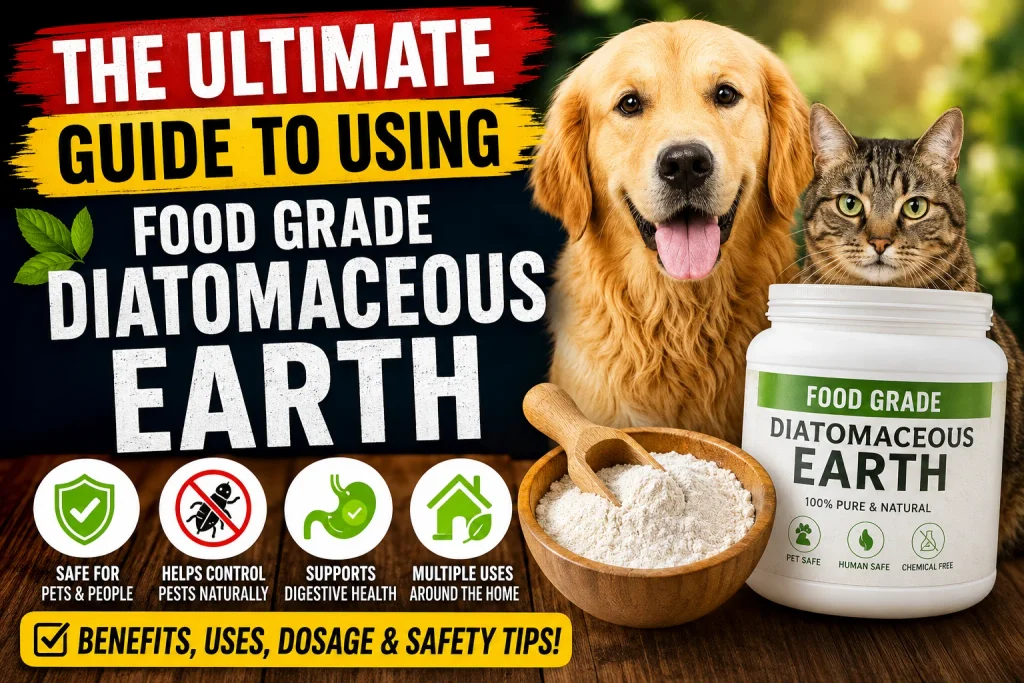
The Ultimate Guide to Using Food Grade Diatomaceous Earth. If you’re reading this, chances are you’re in battle. Your opponent is small, mighty and can drive your dog absolutely bonkers! Whether you’ve used shampoos, sprays or even a couple home remedies to get the job done, it seems you simply cannot get those fleas to stick to their side of the fence. If you are searching for a potent solution, devoid of nasty chemicals you may have heard murmurs of diatomaceous earth.
What Exactly is Diatomaceous Earth (DE)?
To really grasp why DE works you first need to know a little bit about what it is Diatomaceous earth. Diatomaceous earth (DE) is soft, creamy-white, siliceous, sedimentary rock and is easily pulverized into a fine powder composed of the crushed skeletal remains of fossilized, microscopic, aquatic organisms called diatoms.
Under a microscope, these fossils look like tiny, sharp cylinders of glass. While it feels like a harmless powder to us, it’s a lethal weapon against pests with exoskeletons, like fleas, ticks, and mites .
How Does DE Kill Fleas?
And this is where it’s so amazing, food grade diatomaceous earth isn’t a chemical insecticide but a mechanical one. Once the flea comes into contact with it, the tiny sharp edges on fossilizeddiatomshave a waxycoating (which every insect needs to prevent from dehydrating from its exoskeleton and keep moisture inside the insects body), is stripped from the fleaxouter coating. DE is therefore adesiccant. This basically means that DE is porous so, by its amazing absorbent properties, will pull the lipids and oils from the exoskeleton and suck the fleadry and dehydrate it, meaning you flea can’t build up immunity.
The Golden Rule: You MUST Use Food Grade DE
This is the most important tip I can offer you on diatomaceous earth. If you read labels on your store bought, shelf products, you will find that the various food-grade diatomaceous earth are labeled to kill different pests.
Always choose 100% food-grade diatomaceous earth. This version is “Generally Recognized as Safe” (GRAS) by the FDA. It contains a very low level of crystalline silica (less than 2%) and is safe for use around animals and humans.
Always avoid swimming pool, or filter grade diatomaceous earth. Diatomaceous earth used for filters is chemically and heat treated, it contains greater than 60% of crystalline silica which is poisonous to breath into humans, pets, or animals.
Step-by-Step Battle Plan: How to Get Rid of Dog Fleas Using DE
There’s only one way to win your war against fleas: A coordinated effort. DE is not an “all in one” solution. In fact, you’ll need to get busy with this product for a while.
Step 1: Prepare the Battlefield (Your Home)
The other 95% of the flea population lives off of you: in your house in the form of fleas at various stages of life (eggs, larvae and pupae) not on you and your pet! So you must work the environment as well.
- Vacuum until the cows come home (or fleas die); before treating your pet and home with the DE, vacuum your home from wall to wall- including floor crevices, carpet, rugs, upholstery, bedding, and the baseboards.vacuuming helps by sucking up eggs and larvae that may already exist in the environment. Vacuuming also irritates the pupae, causing it to release a mature flea, which is attracted to the DE.
- Immediately take the bag or emptied canister from the vacuum to an outdoor garbage can, tie it shut and put it in the trash.
- Apply the DE. With a duster, a shaker type item, or through a sock stuffed with DE, a light amount of DE can be lightly puffed or settled over your carpet, area rugs, upholstered items, pet bedding etc. This is one time the old saying “less is more” will benefit you tremendously. Too much DE will repel the flea and won’t kill it, but a thin coating that you can hardly see should do a bit of a dirty work for your family!
- Let it rest. To be sure, leave the DE laid over the house for at least 48 hours and up to several weeks if infestation is severe for the newly hatched and emerging fleas to die. If your pets and children can’t be kept off for that amount of time, then don’t worry!
Step 2: The Direct Approach (Your Dog)
- The Light Dusting: You can use food grade DE directly on your dog. Apply a very light dusting of DE to your dog’s coat. Rub it gently against the grain of the fur to help it reach the skin . Be extremely careful to avoid your dog’s eyes, nose, mouth, and ears .
- A Controversial Point: Note: Many veterinarians advise against applying DE topically due to the risk of skin and respiratory irritation . If you choose to do this, use it sparingly and monitor your dog closely. An alternative to direct application is to simply rely on the environmental treatment. As your dog walks on the DE-dusted carpets, the fleas on them will eventually come into contact with it.
- Internal Use (Deworming): Some sources and product labels suggest that food grade DE can be used internally as a natural dewormer to help control internal parasites like hookworms and roundworms . This is a controversial practice and you must consult your veterinarian before adding any supplement to your dog’s diet. Dosages are extremely weight-dependent and must be followed precisely .
Step 3: Patrolling the Perimeter (Your Yard)
- Outdoor Application: Fleas love shaded, moist areas. You can dust DE in your yard, focusing on under decks, around doghouses, and in other shady spots where your dog likes to rest .
- The Moisture Problem: DE only works when it is dry. Rain, sprinklers, and morning dew will render it ineffective and require you to reapply .
Step 4: Persistence is Key (The Break the Cycle)
Flea eggs are not killed by DE . This means new fleas will continue to hatch for weeks after your initial treatment. To truly get rid of fleas:
- Repeat the Process: Vacuum thoroughly and reapply a light dusting of DE to your carpets and pet bedding once a week for at least 30 to 45 days . This ensures that you kill new adult fleas as they emerge, preventing them from establishing a new breeding cycle.
Also Check: The Complete Guide to Naturally Managing Persian Cat Tear Stains 2026
Critical Safety Precautions for Using DE on Dogs
Food grade DE is non-toxic, but it can be an irritant. You must treat it with respect.
- Avoid Inhalation: The fine dust can be an irritant to the respiratory tracts of both you and your pets . When applying DE, wear an N95 dust mask and use it in a well-ventilated area. Remove your pets from the room while you are applying the powder.
- Protect Your Dog’s Eyes and Nose: DE is abrasive and can cause significant eye, nose, and skin irritation. Be incredibly careful when applying it near your dog’s face .
- Bathe Your Pet: If your dog has a heavy amount of DE on their coat, you can bathe them with a gentle, natural shampoo to remove the excess and the dead fleas after a day or so .
- Monitor Your Cat: Cats are more sensitive than dogs and groom themselves more frequently, increasing their risk of ingesting large amounts of DE. They are also more prone to respiratory irritation . Many veterinarians recommend not using DE on cats. Use extreme caution or avoid use altogether in households with cats.
The Verdict: Is DE a Solution?
Food grade diatomaceous earth is a powerful, natural tool in the fight against fleas. It’s effective, pests can’t become resistant to it, and it’s an excellent choice for pet owners looking to avoid harsh chemicals . However, it is not an instant fix. It works slowly and requires a dedicated, multi-week effort to break the flea life cycle.
It may still have a slower kill time than some other treatments and not be suitable as a fast relief option for your pet if they are badly infested with fleas or has a bad allergy. If your dog has an acute infestation or a severe allergy, it might be best to take a quicker veterinary method first.
Frequently Asked Questions (FAQs)
How long does it take for diatomaceous earth to kill fleas?
DE can kill fleas within a few hours to a day , however for best results leave powder on carpets for 48 hours to provide fleas an opportunity to come in contact with it.
Can I put diatomaceous earth on my dog?
Yes, but food grade and carefully. Light application sprinkled around as close to the dog, but avoid eyes, nose, mouth. Better is to do it only where you can control it, and prevent dog, pets from entering the area.
Is diatomaceous earth inhalation OK for a dog?
No, the dust is very abrasive. If inhaled, the dog can sneeze and cough, then could struggle for breath if too much is in the air. Use where ventilation is very good, and dog is out of the area.
When should I put diatomaceous earth on my carpet for fleas?
Vacuum well and apply a light dusting once a week for 30-45 days to eliminate flea life cycles.
Why isn’t my diatomaceous earth working?
These can be several causes: you might be using pool grade DE rather than food grade, applying too much and creating an impassable layer; or you may be applying the powder to a wet surface (DE can only work dry). You just need to keep at it once weekly.
Does DE kill flea eggs?
No, it doesn’t kill flea eggs. For that reason, we recommend staying at it to be able to kill adult fleas once they hatch from the eggs.
Can I use DE and other flea treatments on my dog at the same time?
We really don’t recommend mixing different flea treatments without speaking with your veterinarian first. Your vet knows what treatments are safest for your dog and recommends the proper dosage schedule.
Does the wetness affect my diatomaceous earth’s ability?
Yes! Diatomaceous Earth doesn’t work when wet, it must be dry. If for some reason you get your application wet, you’ll just have to Re-apply again after drying.
My dog ingested a small amount of DE, can he get sick?
Food-grade diatomaceous earth is non-toxic and can even be added to pet feed to prevent clumping. A single large gulp won’t typically do any harm, but to be safe keep all store-bought DE out of your dog’s access.
What is the Difference: Pool Grade vs Food Grade DE?
Always purchase the Food grade if you intend on using it for your dog and around your home. It is safe for both animals and humans. The Pool grade DE is dangerous to use around animals and pets, even breathing it can be harmful and it is meant for swimming pools.