
How to Implement the 3-3-3 Rule for Newly Adopted Shelter Rescue Dogs
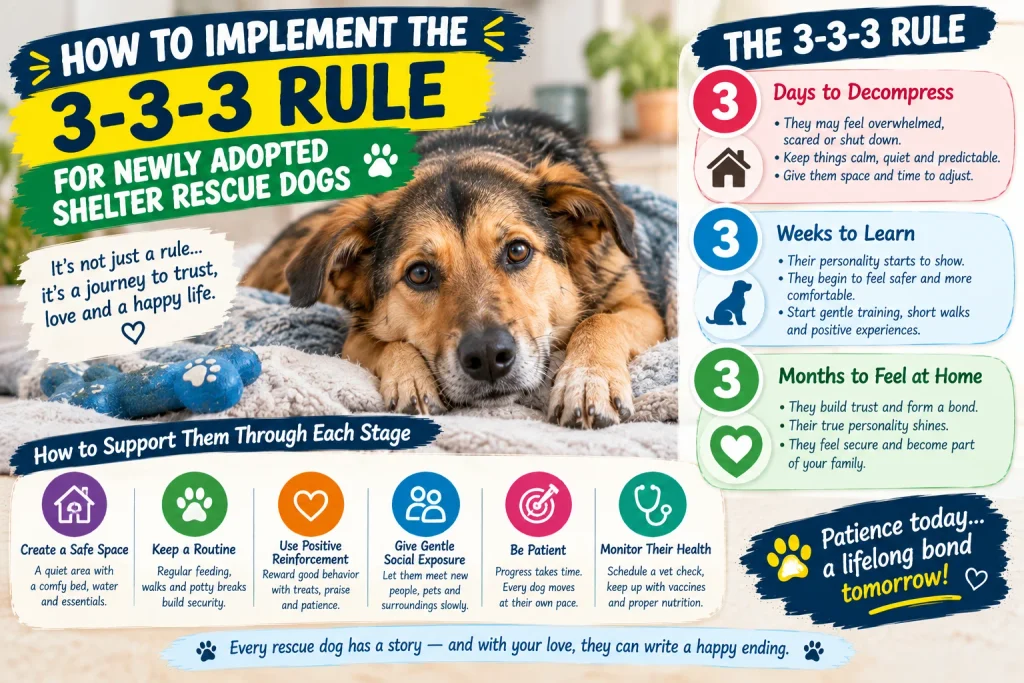
How to Implement the 3-3-3 Rule You brought home a rescue dog. At the shelter, the two of you hit it off and everything felt perfect. Now you are home, and the same dog is hiding under the dining table, refusing to eat and looking at you as if you are a stranger.
You have not done anything wrong, and your dog is not broken. Your dog is adjusting to a huge change, and a popular guideline called the 3-3-3 rule can help you understand what is happening and how to support them.
What Is the 3-3-3 Rule?
The 3-3-3 rule is a rule of thumb used by shelters, rescues and adopters. It splits a rescue dog’s adjustment into three stages:
| Stage | What it is for | What to expect |
|---|---|---|
| First 3 days | Decompression | Stress, shyness, sleeping a lot, little appetite |
| First 3 weeks | Learning the routine | Settling in, and the first “real” personality and problem behaviours appear |
| First 3 months | Trust and bonding | Feeling at home and a secure bond with you |
It is a guide, not a rule, and not a deadline. Every dog arrives with a different history, so some dogs settle faster and many need longer.
Is the 3-3-3 Rule Backed by Science?
Only partly, and it is worth being honest about that. A 2023 study from Ohio State University (Bohland et al., PLOS ONE) followed 99 dogs adopted from five Ohio shelters. Owners filled in a behaviour questionnaire 7, 30, 90 and 180 days after adoption. The lead researcher noted that the first three days make sense, because the stress hormone cortisol spikes when a dog enters a new environment and then comes back down within a few days. The three-week and three-month marks, however, have no real scientific basis.
What the study did show is useful for every adopter:
- Some behaviours increased over six months: stranger-directed aggression, excitability, touch sensitivity, training difficulty and chasing.
- Separation-related behaviours, attachment and attention-seeking decreased by 180 days.
- Even so, about 75% of owners felt their dog’s behaviour had improved by six months, and most were very satisfied with their dog.
In short: the pattern of “quiet first, real personality later” is real, but the exact calendar is not. Use 3-3-3 as a map, not a stopwatch.
The First 3 Days: Decompression
What is happening
Shelters are loud, busy and stressful. Many dogs arrive home exhausted and overwhelmed. It is common for a dog to sleep heavily for the first days as their body catches up.
What you may see
Some dogs shut down: they hide, avoid eye contact and barely eat or drink. Others do the opposite and pace, pant and cry. Both are stress reactions, and neither shows who the dog really is. Some dogs also go through a “honeymoon period” and look calm, sleepy and perfectly behaved. That can simply be a dog holding back while they work out their new world.
Keep things quiet
For the first few days, most dogs do best with:
- Short, leashed toilet breaks near home instead of long walks or busy places
- No visitors and no dog park trips
- No meeting pets that live at home, beyond a calm introduction outdoors, handled by an adult
- No being left alone for long periods
- No bathing or grooming
- No routine vet visits, unless your dog seems unwell or needs medical care
What to do instead
- Create a quiet den. Set up a bed or crate in a calm corner. Leave the crate door open and put a soft bed and a few treats inside.
- Be calm and low-key. It is tempting to shower your dog with attention. Instead, sit nearby, speak softly and let them come to you.
- Set a toilet routine straight away. Even adult, house-trained dogs can have accidents in a new home. Take your dog out on a leash every 1 to 2 hours to the same spot and reward them.
- Feed predictably. Many rescue dogs eat very little for the first 2 to 3 days. Offer fresh water, and if you can, start with the same food the shelter or foster was giving to avoid stomach upset.
- Prevent escapes. A scared dog can bolt through a door or slip out of a collar. Use a harness and a collar (or a martingale collar) with a secure leash, keep doors and gates shut, and make sure the microchip details are updated with your contact information.
The First 3 Weeks: Routine and Personality
What is happening
As your dog feels safer, their real personality begins to show. This is when many owners notice behaviours they did not expect: separation anxiety, resource guarding of food or beds, pulling and reactivity on walks, or toilet accidents from a dog who seemed house-trained. This does not mean your dog is getting worse. It often means they are finally comfortable enough to be themselves.
Build the routine gradually
Think of these weeks as slow, gentle exposure. You do not need to do everything at once.
- Week 1: focus on the basics: regular meal times, toilet breaks, bedtime and simple house rules.
- Week 2: add structure: short, calm walks, car rides and gentle crate practice, with the door open at first.
- Week 3: add new experiences slowly: one calm visitor at a time, calm dogs met outdoors, and one new room at a time.
Training in this phase
Keep it simple. Use treats, praise and routine to teach easy cues like “sit” and “come”. Avoid punishment and harsh corrections: many rescue dogs have already had difficult experiences, and fear-based methods can damage trust.
If you use a crate, let your dog get used to it over one to three weeks, with the door open most of the time. Forcing a dog into a crate on day one can make them refuse it for good.
Book the first vet visit
Schedule a check-up within the first week or two, especially for puppies, seniors or dogs with unknown history. Bring every record you received: vaccinations, deworming, microchip details and spay or neuter papers. Your vet can tell whether a behaviour is an adjustment issue or a health problem and advise on vaccines, parasite prevention and nutrition.
The First 3 Months: Trust and Bonding
By around three months, many dogs know the daily routine, feel safe with you and show their full personality: their quirks, favourite things and fears. Many adopters say this is when they truly feel they know their dog.
The Ohio study reminds us that the path is not always a straight line. Some behaviours become more noticeable as the dog gets comfortable, then ease over the following months. Touch sensitivity, for example, may go unnoticed until the first nail trim.
Helping with separation anxiety
Separation-related problems are one of the common reasons adopted dogs end up back at shelters. To build independence:
- Practise short absences in another room, then increase the time slowly: seconds, then minutes.
- Keep arrivals and departures calm and unexciting.
- Vary your “leaving” cues, such as picking up keys, so they do not become a trigger.
- Teach your dog to relax on a mat or in a crate.
- Leave a puzzle feeder or chew toy for time alone.
When to Get Professional Help
Call your vet, a certified trainer or a veterinary behaviourist if:
- Your dog refuses food for more than a day or so, or has vomiting, diarrhoea, coughing or signs of pain
- Fear, reactivity or separation anxiety is not improving after several weeks
- Your dog growls, snaps or bites
A sudden change in behaviour can be a medical problem, not a training problem. Even a healthy-looking rescue dog can have intestinal parasites, heartworm or flea and tick problems, so ask your vet about testing and prevention.
Common Myths About the 3-3-3 Rule
Myth 1: It is a scientific law. It is a rule of thumb from the rescue community, not a proven timetable.
Myth 2: Your dog will be “fixed” after 3 months. Some dogs need longer. Treating day 90 as a finish line can make owners feel they have failed when they have not.
Myth 3: A calm first week means a calm dog forever. Many dogs hold back at first. Their real personality shows as they feel secure.
Myth 4: Giving space means ignoring your dog. Space means low-pressure attention: sitting near them, speaking softly, tossing treats and letting them approach you.
Frequently Asked Questions
Is the 3-3-3 rule scientifically proven?
No. It is a helpful guideline from rescue communities. Research supports the idea that stress is highest in the first days and that behaviour changes over the first months, but the specific windows of 3 days, 3 weeks and 3 months have not been scientifically validated.
What if my dog settles in faster than 3 months?
That is wonderful. The rule is a framework, not a minimum. If your dog is comfortable, follow their lead.
What if my dog needs longer than 3 months?
That is also normal, especially for dogs who spent a long time in a kennel, lived as strays or have a difficult history. Adjust the timeline to your dog.
Should I take my rescue dog to the vet in the first 3 days?
Only if your dog seems unwell or needs medical care. Otherwise, schedule a wellness exam for the first week or two to avoid extra stress during decompression.
Can I introduce my rescue dog to my other pets right away?
Go slowly. Resident dogs should ideally meet your new dog outdoors on neutral ground first. Introduce cats and small animals gradually, using barriers such as baby gates and supervised, leashed meetings.
How do I handle toilet accidents?
Expect some. Take your dog out every 1 to 2 hours, reward success, clean accidents with an enzymatic cleaner and never punish.
What if my rescue dog will not eat?
Many dogs eat very little for the first 2 to 3 days. Offer fresh water and the same food they had at the shelter, and try hand-feeding or scattering kibble. If your dog still refuses food after a day or so, call your vet.
Final Thoughts
The 3-3-3 rule is a compass, not a countdown timer. The first 3 days are for decompression, the first 3 weeks for routine and personality, and the first 3 months for trust and bonding. But the dog in front of you is an individual. A dog surrendered from a loving home may adjust quickly, while a dog from a long-term kennel or a hard background may need six months, a year or more.
What matters most is not the number of days, but the relationship you build: calm routines, safe spaces, gentle handling and good veterinary support. One day your dog will jump onto the couch beside you, sigh and fall asleep, and you will know they are home.