Why Does My Cat Refuse to Eat Wet Food?
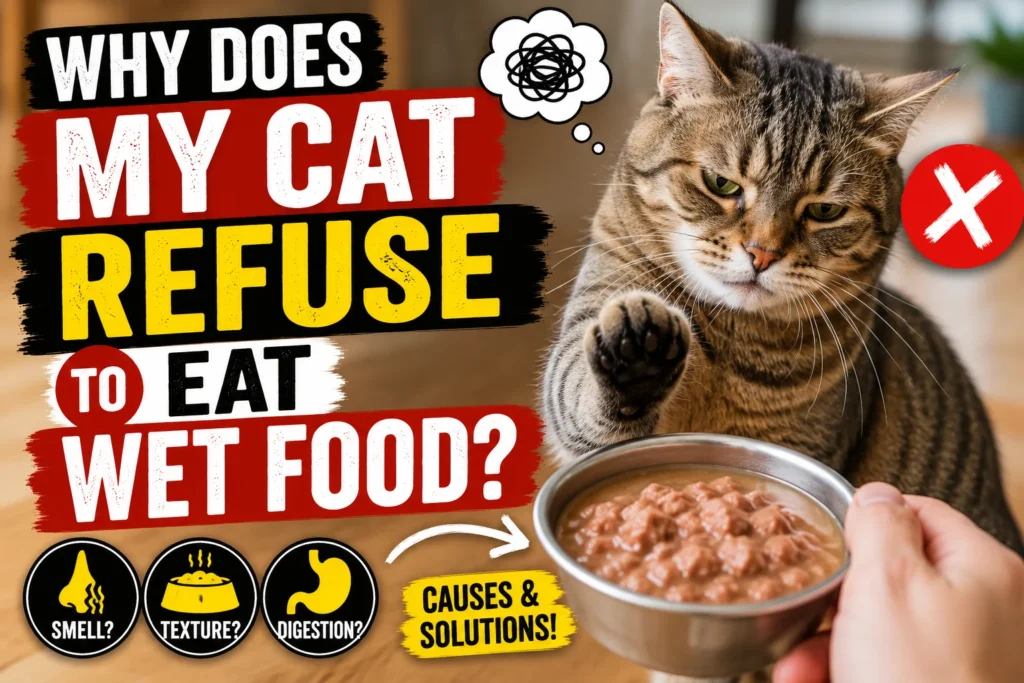
Why Does My Cat Refuse to Eat Wet Food? You just peeled open a can of premium, smell-test-approved wet food. Your cat walks over, sniffs once, performs a phantom burying motion (scratching the floor like they’re covering waste), and stalks off.
Frustrating? Yes. Dangerous? Sometimes.
As a practicing veterinarian, I see this “wet food refusal” weekly. While dry kibble is convenient, wet food provides critical hydration that prevents kidney disease and urinary crystals two top killers of domestic cats. Understanding why your cat refuses is the first step to saving their health.
The Texture Terrorism: Pâté vs. Flakes vs. Slices
Cats are texture connoisseurs. Unlike dogs, a cat’s food preference is hardwired by their first solid meal (a phenomenon called imprinting).
- The Issue: If your cat was weaned on dry kibble or only jelly-based chunks, a smooth pâté feels like eating cold pudding. Many cats gag on mushy textures.
- The Fix: Don’t give up on wet food. Instead, change the format.
- Try shreds in gravy (e.g., Tiki Cat, Weruva).
- Try minced loaf (e.g., Royal Canin Instinctive).
- Try mousse (ideal for senior cats with dental pain).
Vet Tip: Mash a teaspoon of their favorite dry food on top of the wet food like a crouton topping. This bridges the texture gap.
Whisker Fatigue: The Silent Torture Device
This is the 1 reason I diagnose for “refusing wet food” that owners miss. Your cat’s whiskers are super-sensitive proprioceptors (touch sensors). When a deep, narrow bowl forces their whiskers to bash against the sides repeatedly, it triggers neurological overload.
- The Signs: The cat reaches the bowl, extends their neck tentatively, paws at the floor, then walks away without eating.
- The Fix: Ditch the ceramic bowl. Immediately.
- Serve wet food on a flat plate, saucer, or a wide, shallow whisker-friendly bowl (e.g., Dr. Catsby or Mr. Peanut’s).
- Spread the food thin like butter on toast. Remove the pressure.
Case Study: In my clinic, 70% of “wet food refusers” start eating normally within 48 hours of switching to a plate.
Also Check: Best Food for Goldfish To Grow Faster
Temperature & Smell: The Cold Reject
Cats are obligate carnivores evolved to eat fresh-killed prey (body temperature: ~100°F). Canned food straight from the fridge is thermally dead to their senses.
- The Science: Refrigeration dulls volatile aromatic compounds. If your cat can’t smell it, their brain doesn’t register it as food.
- The Fix: Warm it up.
- Add a tablespoon of hot (not boiling) water to the pâté.
- Microwave for 5–7 seconds (check with your finger no hot spots).
- Stir into a soup. The steam carries scent molecules directly to their olfactory system.
Warning: Never serve wet food that has been left out for >4 hours. Bacteria growth will cause vomiting/diarrhea, creating a negative learned aversion that lasts months.
Learned Food Aversion: The Past Trauma
Here is the most underdiagnosed psychological reason. Cats have excellent associative memory. If your cat ate a specific brand of wet food three weeks ago and then vomited (due to hairballs, not the food), they now believe that texture/smell = poison.
- The Signs: Your cat sniffs, hisses slightly, or gags without actually ingesting anything.
- The Fix: The 30-Day Reset.
- Stop offering that exact brand for 30 days.
- Introduce a completely different protein (switch from chicken to rabbit, duck, or venison).
- Use a different bowl material (stainless steel vs. ceramic) to break the environmental cue.
Medical Red Flags: When “Picky” is “Painful”
Before you blame personality, rule out pathology. A cat that used to eat wet food but suddenly refuses is a medical emergency until proven otherwise.
| Condition | Why they stop eating wet food | Urgency |
|---|---|---|
| Dental Disease (stomatitis, tooth resorption) | Wet food hits exposed nerve roots. The cat acts hungry but yelps/backs away from bowl. | High |
| Nausea (kidney disease, pancreatitis) | The smell of rich wet food triggers active gagging. They prefer bland, odorless dry food. | Immediate |
| Upper Respiratory Infection | Blocked nose = no smell. If they can’t smell it, they can’t taste it. | Moderate |
Vet Advice: If your cat refuses wet food for >24 hours alongside lethargy, drooling, or weight loss, skip the internet. Get a vet exam, bloodwork, and a dental X-ray.
Proven Steps to Switch a Kibble-Addict to Wet Food
If you are currently free-feeding dry food, your cat is literally addicted to the carbohydrate spray (palatants) on kibble. Here is my clinical protocol:
- Stop Free-Feeding: Pick the bowl up. Hungry cats try new foods. Offer scheduled meals (morning and night).
- The Sandwich Method: Place a ½ teaspoon of wet food between two layers of their favorite dry food.
- Use Toppers: Crush freeze-dried chicken or salmon treats into powder. Sprinkle heavily on wet food.
- Gradual Ratio: Week 1: 90% dry / 10% wet. Week 2: 70/30. Week 4: 50/50. Goal: 80% wet / 20% dry.
- Parfait Technique: Layer wet food, then dry food, then a drizzle of tuna juice (packed in water, not brine).
- Patience: Do not starve your cat. If they skip two meals, revert to the previous ratio. Slow progress is progress.
- Celebrate the Lick: If they lick the gravy and leave the meat, that’s a win. Tomorrow, mash the meat into the gravy.
The “Spoiled Cat” Myth
Owners often ask me, “Should I just wait him out? He’ll eat when he’s starving, right?”
Wrong. Unlike dogs or humans, cats cannot fast for more than 48 hours safely. Fasting triggers hepatic lipidosis (fatty liver syndrome) a potentially fatal condition where the body floods the liver with fat trying to survive.
You have 24-48 hours to solve this problem. After that, you need a vet.
Conclusion
Your cat is not being “rude.” They are communicating one of five things: Pain, Overstimulation, Texture disgust, Bad memory, or No smell.
Start with the easiest fix first: Switch to a flat plate and warm the food. Nine times out of ten, that solves “why does my cat refuse to eat wet food.” If not, follow the medical checklist. Your cat’s urinary tract health depends on you winning this battle.
Frequently Asked Questions (FAQ)
Is it OK if my cat only eats dry food and refuses wet food completely?
Not ideal. Chronic dehydration from dry-only diets increases risk of kidney disease, constipation, and urinary blockages (especially in male cats). Aim for at least 25% wet food.
Why does my cat lick the gravy but leave the meat chunks?
They want flavor without texture. Mash the meat with a fork into the gravy, or puree it into a smooth pâté. They may also have sensitive teeth.
Can I mix water into dry food instead of switching to wet?
Yes, but it’s a short-term hydration fix. Wet food provides complete, balanced moisture and lower carbohydrates than soaked kibble.
How long can a cat go without eating wet food before it’s dangerous?
Any cat refusing all food (wet or dry) for 24 hours needs a vet. A cat refusing only wet food but eating dry normally can wait 72 hours, but do not let them fast completely.
Why does my cat refuse expensive wet food but eat cheap brands?
Cheap brands spray more artificial “animal digest” palatants (similar to MSG for cats). Expensive natural brands have less flavor enhancers. Wean them off cheap food slowly.
My cat refuses wet food in the morning but eats it at night. Why?
Morning nausea. Cats fast overnight, building stomach acid. Offer a tiny amount of dry food first (a tablespoon) to settle their stomach, then offer wet food 30 minutes later.
Does whisker fatigue apply to all bowls?
Yes. Even stainless steel bowls can be too deep. The rule: The bowl’s diameter must be wider than your cat’s whisker span (approx. 4–5 inches).
Can stress cause a cat to refuse wet food?
Absolutely. Moving houses, new pets, or a dirty litter box can suppress appetite. Once the stressor is removed, preference usually returns.
What is the single best wet food brand for picky eaters?
There is no universal best, but clinically, Fancy Feast Classic Pâté (yes, the grocery store brand) has the highest palatability success rate in veterinary studies due to its strong aroma and fine grind.
My senior cat suddenly refuses the wet food she’s eaten for 10 years.
This is a vet visit, not a recipe change. Sudden refusal of a lifelong favorite food is a classic sign of chronic kidney disease, dental resorption, or oral cancer until proven otherwise.