
Why Does My Cat Bite My Ankles When I Walk?
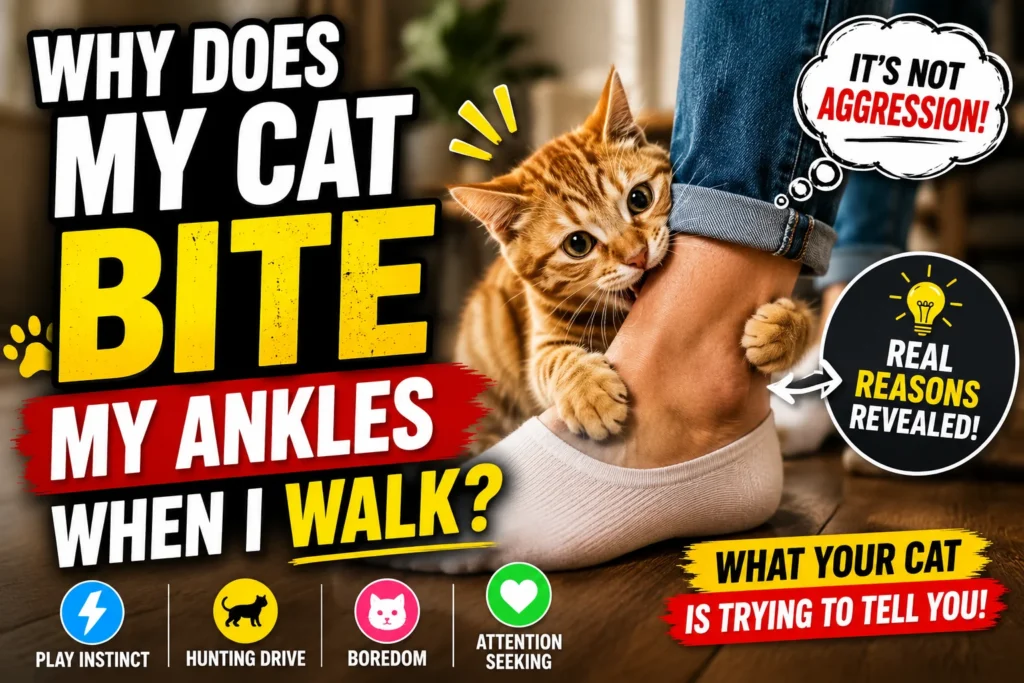
Why Does My Cat Bite My Ankles When I Walk? You’re walking down the hallway, perhaps heading to the kitchen for a snack, when suddenly chomp. A pair of tiny fangs sink into your bare ankle. You yelp, hop, and look down to find your feline friend staring back with wide eyes, looking innocent one second and predatory the next.
If this scenario sounds familiar, you are not alone. “Ankle biting” is a surprisingly common complaint among cat owners. While it can be startling and painful, the good news is that this behavior is rarely aggressive. As a veterinary behavior expert, I’m here to decode why your cat turns your lower legs into a chew toy and how to stop it without damaging your bond.
Is This Play, Predation, or Aggression?
Before we dive into the solutions, it is vital to understand the motivation. True aggression in cats usually involves flattened ears, hissing, and a puffed tail. Ankle biting is usually predatory play or frustration.
Think of your moving feet. To a cat, a foot sliding under a blanket looks exactly like a mouse scurrying under grass. Your ankle is the trigger, but the behavior is instinct.
The 5 Primary Reasons: Why Does My Cat Bite My Ankles When I Walk?
1. The Predatory Instinct (You Look Like Prey)
Cats are obligate carnivores. Their brains are wired to chase moving objects. When you walk, your ankles move erratically, slide in and out of pants, and make soft shuffling sounds. To a cat, this mimics a small rodent or bird fleeing. The bite isn’t malicious; it is a failed hunting drill.
2. Attention Seeking (Learned Behavior)
Does your cat bite and then you immediately stop walking, look down, or shout? Congratulations you just rewarded the behavior. Cats learn quickly that an ankle bite is the fastest way to get you to stop ignoring them. Even negative attention (yelling) is still attention.
3. Frustration & Redirected Energy
This is huge. If your cat sees a bird outside the window but can’t reach it, or if they hear another cat in the yard, their pent-up hunting energy has to go somewhere. You walking by provides the perfect “outlet.” They cannot attack the bird, so they attack the next best moving thing: your ankle.
4. Overstimulation & Petting-Induced Aggression
Sometimes, you have just finished petting your cat. They were purring, but then their tail started twitching. As you walk away, they bite your heel. Why? Cat skin is sensitive. After a few minutes of petting, the sensation shifts from pleasant to irritating. The bite is them saying, “I’ve had enough, and you are leaving before I calm down.”
5. The “Zoomie” Ambush
Most common in kittens and young adults (under 2 years). Cats have bursts of energy called “zoomies” (frenetic random activity periods). During a zoomie, their inhibition disappears. If you walk through the living room at 10 PM during a zoomie, your ankle is simply an obstacle in their race track.
Also Check: Why is My Cat Shaking Her Head Repeatedly?
How to Stop Ankle Biting
Do not punish your cat. Hitting, spraying water, or yelling will increase anxiety and may turn play biting into fear aggression. Instead, use this 3-step behavioral modification plan.
Step 1: The “Redirection” Method (Most Effective)
Keep a small toy (mouse or kicker) in your pocket while walking through high-risk zones. The moment you see your cat crouch or wiggle their bottom (the pre-pounce stance), toss the toy away from you.
- Why it works: It fulfills the hunting sequence (Stalk -> Chase -> Pounce -> Kill) without using your body as the target.
Step 2: The “Freeze & Disengage” Technique
When the bite happens, do not pull away. Pulling mimics prey trying to escape, and they will bite harder.
- Stop walking immediately (remove the movement).
- Go completely still and silent.
- Do not make eye contact.
- Wait 5 seconds, then calmly step away.
- Why it works: Predators lose interest when the “prey” stops moving.
Step 3: Increase Environmental Enrichment
Ankle biting is often a symptom of boredom. A cat with nothing to hunt will hunt your feet.
- Install a shelf highway: Vertical space reduces ground frustration.
- Automated toys: Use a laser pointer (end on a physical toy) or a remote-control mouse.
- Schedule play sessions: Two 15-minute sessions of “Fish Pole” play before meals will drain the predatory drive.
When to Worry: Red Flags
Occasional ankle nibbling is normal, especially in kittens. However, you need a veterinary check-up if:
- The biting is accompanied by hiding, hissing, or flattened ears.
- The cat is older than 5 and this is a new behavior (could indicate hyperthyroidism or dental pain).
- The cat destroys furniture or blocks doorways aggressively.
Quick Reference Table: Why vs. Fix
| The Behavior | The Likely Cause | The Best Fix |
|---|---|---|
| Soft bite, then runs away | Predatory play | Toss a toy immediately |
| Hard bite, stares at you | Frustration / Redirected energy | Block window views (temporarily) + play |
| Bites only when wearing socks | Mistaken identity (prey) | Wear slippers or pants |
| Bites at night only | The “Zoomies” / Excess energy | Heavy play session before bedtime |
The Bottom Line
Your cat bites your ankles because they are a tiny predator living in a human world. They are not being “bad” or “mean” they are acting on 10,000 years of hunting instinct. By redirecting that instinct onto toys and managing their energy levels, you can walk through your home bite-free within two weeks.
Frequently Asked Questions (FAQs)
Is ankle biting a sign of aggression in cats?
No, usually not. True aggression involves ears pinned back, growling, and swatting. Ankle biting is almost always predatory play or attention-seeking. If your cat bites and then purrs or rolls over, it is definitely play.
Why does my cat only bite my ankles when I wear specific socks?
Cats rely heavily on movement and contrast. Fuzzy, striped, or brightly colored socks moving over a carpet look exactly like a furry animal. Bare ankles or solid pants are less stimulating.
Do kittens grow out of biting ankles?
Usually, yes, by 18 months of age. However, if the behavior is reinforced (you laugh or run), it may persist into adulthood. Start redirection training early.
Why does my cat bite my ankles and then run away?
That is a classic “prey sequence.” In the wild, a cat bites to immobilize prey, then retreats to ensure it is safe to return. Your cat is just following biological wiring.
Does my cat hate me if she bites my ankles?
Not at all. Cats reserve true biting for serious threats. Ankle biting usually happens with cats who are comfortable with you. Think of it as a dysfunctional invitation to play.
Should I use a spray bottle to stop ankle biting?
No. Veterinary behaviorists advise against this. Spray bottles create fear of you, not the behavior. Your cat will simply learn to bite you when you aren’t holding the bottle.
Why does my cat bite my ankles when I walk away from the food bowl?
This is likely “status” or excitement. They associate you with food. When you walk away, they want you to come back. The bite is a demanding “Wait, don’t go!” signal.
My cat only bites my ankles, not my spouse’s. Why?
You likely have the more “reactive” movement style. If you walk fast, shuffle, or wear noisy shoes, you trigger the prey drive more. Also, your spouse may have unknowingly trained the cat by ignoring the bites.
Can a bell on the collar stop ankle biting?
No. A bell warns birds, but it does not reduce the cat’s urge to hunt your feet. Your movement is the trigger, not the sound.
Is it safe to let my cat bite my ankles through jeans?
No. Even through fabric, cat mouths contain Pasteurella bacteria. A bite that breaks the skin (even a tiny pinprick) requires immediate washing with soap and water and a tetanus shot check. Do not encourage the behavior.