How To Stop A Dog From Pulling On Leash?
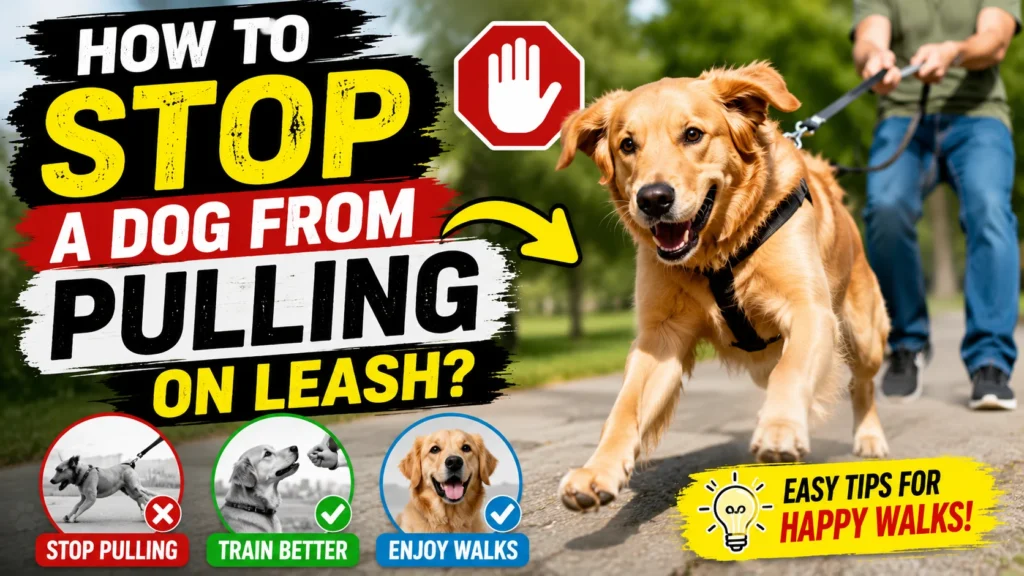
How To Stop A Dog From Pulling On Leash? Going on a walk with your dog should be a fun and relaxing exercise and a bonding experience for you both. Unfortunately, for millions of dog owners, a trip down the street with Fido turns into a fight against the pull. The minute you snap the leash taut, you feel the pull as your dog lunges towards every intriguing tree, every suspicious fire hydrant and every enticing squirrel. It’s a strain from the very first step, and it can feel like you’re in for a never-ending uphill battle.
Leash pulling is one of the most widespread dog behavior issues-and it can be completely overcome. This is not an issue of dominance or a “bad” dog, but rather a conditioned habit driven by an innate instinct. Your dog moves faster than you, their world is rich with scents and it simply hasn’t yet learned another way to walk. Success hinges on patience, consistency, and positive reinforcement.
How To Stop A Dog From Pulling On Leash? Understanding the “Why”
Before we can find a solution, we need to acknowledge the problem. The reason dogs pull in the first place is quite logical and quite biological. Dogs pull because it gets them somewhere. Every single time the dog takes off, the leash pulls.
Most of the time the dog receives some kind of reward by moving in that direction and sniffing the interesting object or chasing that tantalizing squirrel. The dog learns that the pull of the leash means forward movement.
Leash-pulling is an “operant behavior” a voluntary action that is reinforced by its consequence . It is also an instinctive behavior. Dogs naturally walk faster than humans. Couple that with their intense curiosity and a world full of fascinating stimuli, and you have a recipe for a dog that wants to lead the way .
The Golden Rule: Stop Moving Forward
The single most important rule in loose-leash walking is simple: pulling should never be rewarded with forward movement .
If your dog is pulling on his leash, you need to become a statue. Just stop in your tracks and wait. As soon as your dog responds by giving you a slack in the leash, turns to look at you, or anything that shows they are yielding the position, praise with a “Yes!” or a click from your clicker, and immediately continue on your way.
You are demonstrating to the dog that the ONLY way to get where they want to go, is on a loose leash.
Step-by-Step Training System to Stop Leash Pulling
1. Start with a Calm Mind and the Right Gear
Before you even step out the door, set your dog up for success.
- Burn Off Extra Energy: You have probably noticed your dog’s ability to concentrate is inversely correlated to his or her energy levels. Do a quick game of fetch, tug-of-war or a puzzle feeder with your dog in the yard prior to heading out on your walk. The “pre-walk workout” or “pre-walk mental games” help decrease your dog’s initial excitement level and make them much more receptive to working with you.
- Choose Your Equipment Wisely: The right tools can make a world of difference.
- Use a Harness, Not a Collar Your dog’s collar could stress his neck too much when he tugs and jerks on the lead. A front-clip harness is suitable for this job. A front-clip harness is secured on your dog’s chest, and gently discourages him from pulling as it will swivel him towards you when he attempts to, making pulling the full strength quite uncomfortable. PetSafe Easy Walk Harness,
- Hounds Design Freedom Harness and Ruff wear: Front Range Harness are highly recommended options for a front-clip harness.
- Leash Use a traditional, non-retractable leash (4-6 feet in length). A retractable lead will keep steady tension, training your dog to pull.
- Use High-Value Treats: Don’t bring dry, boring biscuits. Pack soft, smelly treats like small pieces of chicken, cheese, or hot dogs. These are powerful motivators that can compete with the distractions of the outside world .
2. Master the “Stop-and-Go” and “Turn-Around” Drills
This is the core of the practical training.
- The “Red Light, Green Light” Method: As soon as the leash goes taut, stop. Don’t yank or pull back, as this engages a dog’s oppositional reflex and can turn the walk into a frustrating tug-of-war . Stand still like a statue. Wait for the dog to turn and look at you or back up to create slack. The moment that happens, say “Yes!” and move forward again. This teaches them that slack in the leash is what allows progress .
- Change Direction: When the going is just getting a bit tough and the only thing that your dog wants is to go that one particular direction, just turn around and take the road to the other direction. No need to drag them, just turn around and make your dog follow you. This makes them attentive to your movements instead of theirs, and if you are inconsistent in the way you change direction your dog will be confused and paying close attention to what you are up to.
3. Begin Training in a “Boring” Environment
A major mistake is starting training in the middle of a busy, distracting neighborhood. You are setting your dog up for failure.
Begin indoors. Start in a hallway, a quiet room, or a fenced backyard with no distractions. Practice the stop-and-go method there . Lure your dog to your side, take a step, and reward them for staying close. Click and treat for every step where the leash is loose. Only when your dog is consistently successful in this low-distraction environment should you slowly “up the challenge” by moving to a quiet street, and then eventually a busier one .
4. Honor Your Dog’s Needs: The “Sniffari” Strategy
This is perhaps the most revolutionary and humane approach to stopping leash pulling, recommended by top behaviorists. Many dogs pull because their natural needs like using their incredible sense of smell are being constantly denied .
A dog’s nose is their primary way of understanding the world. By not allowing them to sniff, we are effectively “torturing” them with frustration, which leads to pulling . The solution is to give them structured sniffing time.
- Designate a “Go Sniff!” Cue: Use a phrase like “Go Sniff!” or “Find it!” to signal to your dog that it’s their time to explore.
- Alternate Sniffing and Training: Break your walk into different phases. A powerful structure is to start with a high-energy training session (rapid-fire cues and rewards), then give a “Sniffari” break, and finally work on loose-leash walking . By fulfilling their need to sniff, they become much calmer and more willing to walk politely by your side .
- Try an Out-and-Back Walk: A dog may be too excited during the out part of a walk, but mellows out on the way home once it has had the chance to sniff out all there is to sniff.
Also Check: Is Freeze Dried Beef Liver Safe for Puppies with Sensitive Stomachs?
5. Be Consistent and Avoid Common Mistakes
Training is simple, but consistency is hard. The biggest mistakes owners make include:
- Pulling Back: Yanking the leash triggers a dog’s oppositional reflex, causing them to pull harder .
- Inconsistency: If you let your dog pull “just this once” because you’re in a hurry, you are undoing your training. The rule must be the rule 100% of the time .
- Popping the Treat: Do not jump too far too soon. Your dog learns to get the reward when he’s being good. When you stop rewarding, the dog stops being good. You keep reinforcing until loose-leash walking is established.
Frequently Asked Questions (FAQs)
What is the fastest way to stop my dog from pulling on the leash?
For immediate relief, the quickest solution is a front-clip no-pull harness combined with immediately implementing training. When you need to stop your dog mid-pull, stop moving and wait. Move only when the leash goes slack.
Which is the best harness to stop a dog pulling?
Harness experts consider PetSafe Easy Walk Harness to be the top product on the market, while the martingale loop helps to gently curb pulling. Other options such as the 2 Hounds Design Freedom Harness or the Pet safe 3-in-1 Harness, for durability, are also high rated by users.
Can I use a shock collar on a dog to stop pulling?
You can not Aversives can harm the relationship of trust, create anxiety and/or increase aggression. From a scientific perspective, reward training is the most effective method of training.
My dog pulls at the beginning of our walks only, why?
This often happens due to excitement and extra energy. Try pre-walk exercise such as fetch, or practice the “stop-and-go” technique before stepping out. Teach your dog to walk calmly with a tight grip or relaxed movement to receive a reward.
How do I stop my dog from pulling if they lose it over other dogs or squirrels?
The goal is to increase the distance from the trigger. Before your dog reacts, walk the opposite direction. Find a safe distance where your dog can still see the trigger, but will still focus on you, and continue to train stop and go. The positive reward strengthens your relationship and reinforces the idea that trigger means reward.
What is “loose leash walking” (LLW)?
The ultimate goal of walking training. LLW indicates the leash hanging with no tension, forming a “J”. A dog walking on a loose leash does so beside you in a relaxed, calm manner, without pulling.
How long does it take to stop my dog from pulling?
There’s no set timeline-it all depends on the individual dog’s age, temperament, training consistency, and age. The average timeframe is 3 to 10 weeks of daily, consistent work, although results may be seen sooner for some dogs.
Can I use a long leash to stop pulling?
Sometimes, yes. A longer, eight to ten foot leash can reduce some of the frustration in dogs by removing the sense of being restrained, however for very strong pullers this may give them additional power and space to accelerate their pull and can actually worsen the problem. Stick with a standard six-foot leash when teaching new walking habits.
For an extreme puller, head halter or harness?
If your dog is especially large and powerful with serious pulling strength, a head halter such as a Gentle Leader can offer additional control by turning his head to you to guide him. Head halters can be uncomfortable to the dog and must be introduced in a positive manner. Most people and their dogs will find a front-clip harness a safer, and much more enjoyable option.
Should I consider a professional dog trainer?
If you’ve tried training techniques for several weeks with little to no improvement and the pulling has resulted in dangerous situations, consider consulting with a dog trainer. When choosing a trainer, look for someone who uses positive reinforcement methods, and has a CPDT-KA or similar credential.
Conclusion
Pulling to Stop on Your Own Walking With your Dog. One of the most gratifying dog training challenges to take on with your dog is learning how to stop him from pulling on the leash. This training isn’t about dominating your dog. It’s about having conversations, forming a connection and learning how to walk in tandem as a partnership.
It will be a trip that takes time and patience, and will likely be completely and utterly worth it. If you have learned what guides your dog, selected the appropriate equipment and tools, begun practicing in a quiet location, and been practicing positive reinforcement, your walks will go from frustrating and arduous to pleasant and playful, on a leash. Celebrate each win along the way with a walk.