
Signs of Wound Infection After Dog Mass Removal Surgery
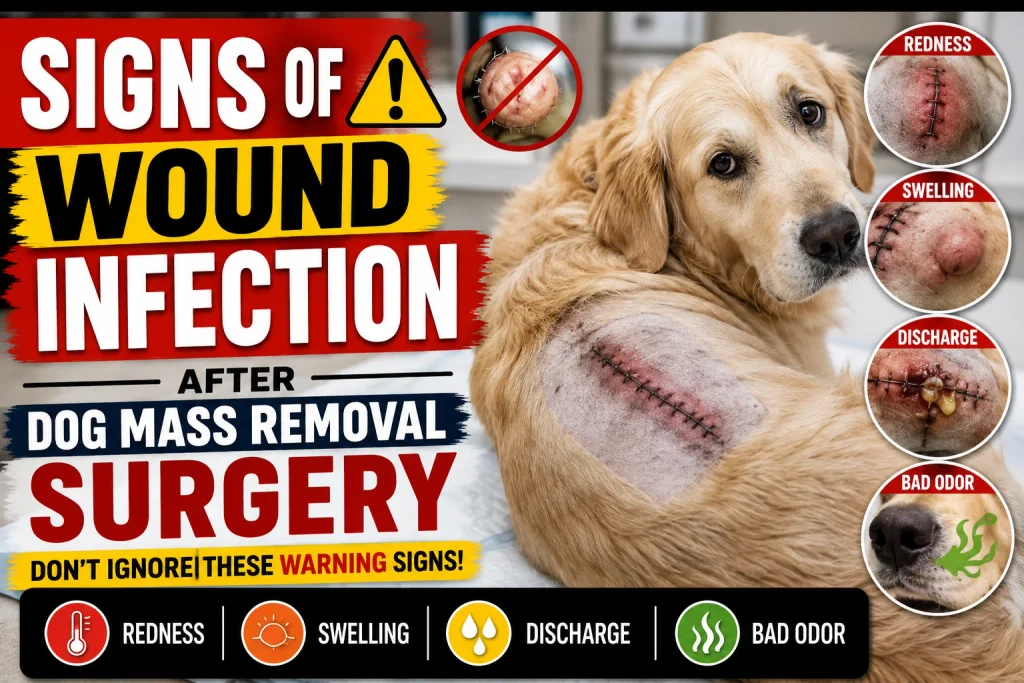
You will feel some peace of mind when you finally get your dog back home after its mass removal surgery, but there’s an entire aftercare situation underway. A big concern I have for my patients coming home to you is maintaining an infection-free Surgical Site, hereafter referred to as a “SSI,” after the skin tumor removal surgery. Though most surgeries are performed without problem, SSIs can occur and they affect about 9.4% of skin tumors in dogs, while 12.9% of all SSIs are associated with mast cell tumor removals.
The best way that you will be able to care for the wound you are home with is if you know when an infection has truly set in and when an abnormality should send you rushing to the nearest ER. A 2025 report indicated that the addition of perioperative antibiotics did not seem to show an improvement for protecting your patient against any SSIs and it could definitely lead to a case for close owner vigilance.
The Golden Rule: “Better Safe Than Sorry”
A classic surgical mantra rings quite true for your pets as well: The surgeon’s work is only half complete when the last stitch is put in. – the aftercare of a patient’s surgical wounds is just as important. Anything other than smooth normal healing should serve as a yellow flag. An incisional SSIs, according to CDC’s guidelines, is one confined to the skin and subcutaneous tissue only that occurs within 30 days of the operation and demonstrates the following clinical signs.
Also Check: How to Stop a Dog from Licking His Incision After Neuter Surgery 2026
The 5 Cardinal Signs of an Infected Wound
I find the best way to remember all the indicators is to learn my 5 signs of infection which can quickly be checked off during our daily “wound check.”
1. Changes in Discharge (Exudate)
Some clear, or lightly tinged fluid called serosanguinous fluid, for the first 48 hours is perfectly normal. Signs of problems occur when you notice one of the following:
- Purulent Drainage: This is the most obvious indication of infection! Any time you notice pusa thick fluid that is generally white, yellow, or greenish then your dog’s wound is infected.
- Continuous “Weeping”: If a tiny hole or pinpoint opening forms in the incision line weeks after surgery and constantly keeps leaking fluid then your dog most likely has an infection that goes deep under the surface, or there is an underlying seroma or abscess that is not healing.
2. Local Inflammation: The “T-Rex” Trio
It is characterized, at the wound site. These would typically include:
- Rubor (Redness): A normal amount of redness is present immediately after surgery but should decrease over time. Increasing redness and extending away from incision are key signs.
- Tumescence (Swelling): Surgery will causes moderate swelling around the wound, however this should generally improve. A tense, puffy appearance to the wound with an “area” feeling tight and like a water balloon or hard mass (implying infection forming into an abscess).
- Calor (Heat): Infected would feel warm to the touch and will feel significantly warmer than uninfected skin as blood rushes to fight infection.
3. Pain and Discomfort
Some soreness would be anticipated. But we consider soreness to be different than pain.
- Pain localized/tenderness to palpation: If your dog whimpers/cries/tries to bite with the smallest pressure when you gently feel around the incision site, infection is quite likely.
- Behavioural changes: Dogs in pain may become restless/lethargic/bitter. They will likely attempt to obsessively lick or bite at the wound site creating a much better bacterial environment.
4. Odor
A wound that is healing healthy will have little to no odor or only a faint “surgical” smell. An infected wound may have a disgusting, putrid, or rancid smell as the bacteria break down the tissue and flourish.
5. Wound Breakdown (Dehiscence)
In severe situations, the wound may even “pop open”. When your incision opens up, and the skin along the cut falls open, this is known as dehiscence. This often happens when bacteria and infection have compromised the integrity of the tissue and the stitches have pulled through. Even if not bleeding badly, an open incision will need a trip to the vet.
Systemic Signs of Severe Infection (Sepsis Risk)
Sometimes the infection doesn’t stay local; it spreads throughout the body. This is a life-threatening condition called sepsis. If you see any of the following signs, your dog is a veterinary emergency :
- Fever or Hypothermia: A high fever (over 103°F) or, conversely, an abnormally low temperature.
- Lethargy and Weakness: Your dog becomes extremely tired, refuses to get up, or seems depressed.
- Loss of Appetite: Refusing food or water.
- Vomiting or Diarrhea.
- Rapid Heart Rate and Breathing.
- Pale or Blue-Tinged Gums: This is a sign of poor circulation and oxygen deprivation .
What To Do If You Suspect an Infection
- No Home Remedies: Do not put over-the-counter creams or even a human medication for it (like Neosporin) unless your veterinarian prescribed or recommended something. These topical creams usually just prevent healing of a wound and can trap bacteria into the infection making the condition worse.
- Leave The Cone On!: Use the Elizabethan (e-collar) on your dog. If your dog is licking at the would then he will be infecting the bacteria into the would and causing more damage. Your dog may be miserable at having it on, but DO NOT take it off!
- Contact Your veterinarian: Depending on what your vet diagnosed the wound as, you will may or may not be prescribed oral antibiotics for your dog. The culture may or may not be taken depending on the diagnosis of the cause of the infection, but in deep pocket (or in our cases an abscess), minor surgery might be needed by which the wound would be lanced, cleaned, and “debrided” (which means to clean out dead skin tissue). Home treatment of a deep infection is not only impractical but ineffectiveness.
Frequently Asked Questions (FAQs)
What is the most common sign of infection I can see at home?
The most telling sign is “purulent drainage” either a copious amount or a thick, white, yellow or green discharge from the wound.
Is it normal for my dog’s incision to be red a few days after surgery?
A little redness the first day or two is normal. If, however, the redness continues, or darkens or expands significantly away from the stitches 48 hours post-op, it could be a sign of infection.
My dog’s incision is weeping clear fluid, is that an infection?
Clear or light pink fluid in the first 48 hours is normal. But if a constant trickle of a clear substance persists for weeks from what appears to be “pinholes,” then there might be a deeper problem, like a dead space under the skin or inflammation due to foreign material that will need a vet visit to resolve .
My dog has a lump under the stitches, is this an infection?
That could indicate anything from a normal reaction to the stitches (foreign body reaction), fluid build up (seroma), or pus formation (abscess). If the lump is hot, firm, and painful, an infection is likely .
How quickly can an infection develop after mass removal?
Infections typically begin to appear between 3 and 5 days after the procedure, but some infections may develop much later, even as long as 30 days after the surgery.
Do all infected wounds require antibiotics?
Not necessarily. Some mild superficial infections may improve simply by keeping the wound clean with topical applications. Most SSI however need oral antibiotics.
My dog seems fine (eating and playing) but the wound looks bad. Is it still infected?
Yes, absolutely. Dogs can remain clinically healthy while suffering from an infection localized to a surgical wound. They have enough circulation in and around the area that they don’t yet feel sick, but their tissue is dying, and a pool of pus can still form underneath perfectly healthy-looking skin!
Why did my vet say we didn’t need antibiotics if infection is a risk?
The incidence of incisional SSI from clean tumor excisions has been found to be low and not significantly impacted by prophylactic antibiotics, increasing risk of antibiotic resistance . Surgical technique and thorough home care is believed to be the most effective measures for prevention.
Can my dog get sepsis from a wound infection?
Yes. If a local SSI is not treated and the bacteria spread into the bloodstream they will form a condition called septicemia, where the body reacts violently to the toxins produced by the bacteria and the fever, lethargy, vomiting and often extremely pale mucus membranes will indicate a medical emergency.
Conclusion
When your dog goes in for surgery to remove a mass, post-operative care and the care required by owners extends much further than making sure your dog is comfortable. Keeping a close eye on how your dog’s wounds is critical to spotting complications. There are signs of infections; redness, inflammation, pain, swelling, a foul odor, and changing discharge. Remember that recent 2025 research demonstrated that around 10% of dogs with surgical wounds become infected, so vigilance is really important.
If the wound isn’t looking as healthy today as it did yesterday; trust your instincts, call your vet and let them assess the wound. To sum it up, “Take out the tumor but care for the dog”.




3 Comments