Symptoms Of Dental Disease In Young Cats
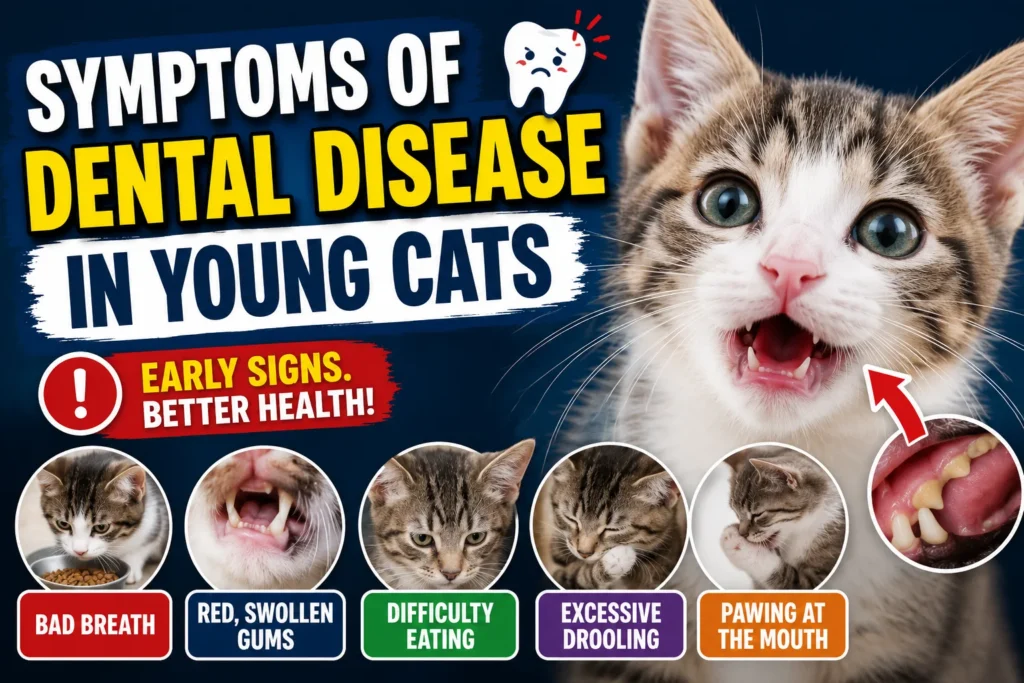
Symptoms Of Dental Disease In Young Cats.When we think of dental disease, the image of a grizzled, 15-year-old senior cat often comes to mind. However as a practicing veterinarian, I am seeing a dramatic rise in juvenile periodontal disease and tooth resorption in cats as young as 1 to 3 years old.
Many owners dismiss bad breath in a kitten as cute but in reality, it is often the first clinical sign of a pathological mouth. Dental disease in young cats is not just about tooth loss it is a systemic issue. Bacteria from the oral cavity can seed into the kidneys, heart and liver.
Symptoms Of Dental Disease In Young Cats: Step by Step Guide
1. The “Red Ring” of Gingivitis (Bleeding Margin)
The earliest objective sign of dental disease is inflammation at the gingival margin.
- Signs to look out for: Open up your cat’s mouth and inspect its gums. Normal gums are light pink in color and firm. In case of disease, a sharp red line is visible where the tooth meets the gum.
- Sensitivity: In young cats gingivitis causes sensitivity in the cheeks.
2. Halitosis (The “Fish Breath” Myth)
Cats have fish-based diets, so mild “fishy” breath is normal. Rotting breath is not.
- The smell test: If your young cat’s breath smells like sulfur, metal or decaying tissue, it indicates active anaerobic bacteria.
- Why it matters: In young cats persistent bad breath usually rules out simple “tartar” and points toward juvenile lymphocytic plasmacytic gingivitis which is aggressive and painful.
3. Pawing at the Mouth (The “False Hairball”)
Cats hide pain masterfully. However, oral pain triggers a specific reflex.
- The motion: Watch your cat eating then stopping to shake their head or swipe a paw across their mouth.
- The aftermath: You may see them drool stringy saliva after the pawing. Unlike a hairball cough, mouth pawing is a jerky localized action to dislodge a perceived tooth spike.
Also Check: Why Does My Dog Sleep By My Feet All The Time?
4. “Chattering” While Chewing
Young cats rarely chew with their mouths open wide. If you hear a clicking or grinding noise while they eat, do not ignore it.
- The mechanism: This is often a sign of tooth resorption , a common disease in cats as young as 2 years old. The body literally dissolves the tooth root exposing nerve endings.
- The visual: The cat chatters to try and close the jaw without the painful tooth touching anything.
5. The “Taste and Spit” Eating Pattern
A young cat wants to eat but is afraid of the pain. This creates a specific eating disorder.
- The behavior: The cat approaches the bowl, picks up a piece of food, tilts their head back to swallow whole drops it and walks away.
- The result: Unexplained weight loss despite a good appetite. Alternatively, they may prefer soft food but cry when eating it which is paradoxical unless the gums are swollen.
6. Dropping Kibble (Unilateral Chewing)
Cats have a dominant side for chewing. If dental disease is on the right side, they will chew exclusively on the left.
- The symptom: Food falls out of the mouth on the unused side.
- The asymmetry: You may find dry kibble pieces scattered around the bowl like confetti. Over time, this leads to excessive tartar on the good side and muscle wasting on the painful side.
7. Subdued Grooming (The Matted Coat)
A depressed cat stops grooming because grooming requires scraping the incisors through fur.
- The specific sign: Look at the flank and tail base. These areas are hard to groom with a healthy mouth. If your young cat has matted fur specifically on the lower back but is still playful otherwise assume dental pain until proven otherwise.
Why “Waiting it Out” is Dangerous for Young Cats
Unlike humans, cats do not get cavities frequently. Instead, they get resorptive lesions. Once you have noticed that the cat has stopped eating, the bacteria have probably made their way into the mandible. In case of young cats, chronic inflammation may result in poor weight gain and improper urination due to systemic inflammation.
The Vet’s Gold Standard: Do not rely on “dental treats” to cure stage 2 disease. A visual exam under anesthesia by a DVM with dental radiographs is the only way to save your young cat’s teeth.
Frequently Asked Questions (FAQs)
Can a 1 year old cat really have dental disease?
Absolutely. While less common than in seniors, juvenile hyperplastic gingivitis can appear as early as 6 months post eruption of permanent teeth. Purebreds like Abyssinians and Persians are genetically predisposed.
Is it normal for my kitten’s gums to bleed when losing baby teeth?
Slight pinkness when a tooth erupts is normal. Active bleeding or pus is not. If the gums bleed when you touch them that is gingivitis not teething.
My young cat has bad breath but eats fine. Should I worry?
Yes. Cats are masters of stoicism. Eating “fine” does not mean eating pain-free. Halitosis indicates bacterial overload. By the time a cat refuses food, they are in severe crisis.
Why does my cat only drool when sleeping?
Drooling that is constant or occurs only during relaxation is often related to a failure to swallow due to a painful mouth. Healthy cats have a tight lip seal.
Are “dental diets” like Hill’s t/d enough for a young cat with symptoms?
No. Dental diets help prevent tartar via mechanical abrasion. Once active gingivitis or loose teeth exist, a hard kibble is painful. Medical treatment is required first.
What is Feline Juvenile Gingivitis?
It is an exaggerated immune response to plaque. Unlike normal gingivitis, it does not respond well to brushing alone. It often requires steroids or CO2 laser therapy and these cats need a dental vet check every 6 months.
How do I brush a young cat’s teeth if they resist?
Start with “finger brushing” using only tuna water on a gauze pad. Never force a toothbrush into a painful mouth. If the cat resists touching the mouth at all, assume pain exists.
Does anesthesia for a dental cleaning at age 2 shorten their lifespan?
No. Modern protocols are very safe. Conversely, leaving dental disease to fester definitely shortens lifespan by stressing the kidneys and heart.
Can tooth resorption kill a young cat?
Indirectly, yes. The pain causes anorexia. Starvation or hepatic lipidosis is a secondary killer. FORLs require extraction of the affected tooth there is no filling.
My cat has one red gum. Is that an emergency?
It is urgent, not necessarily an emergency. A single red spot could be a resorptive lesion or a fractured tooth. Schedule a vet visit within 2 weeks. If the face swells go to ER immediately.