How to Treat a Cats Scratched Eye at Home?
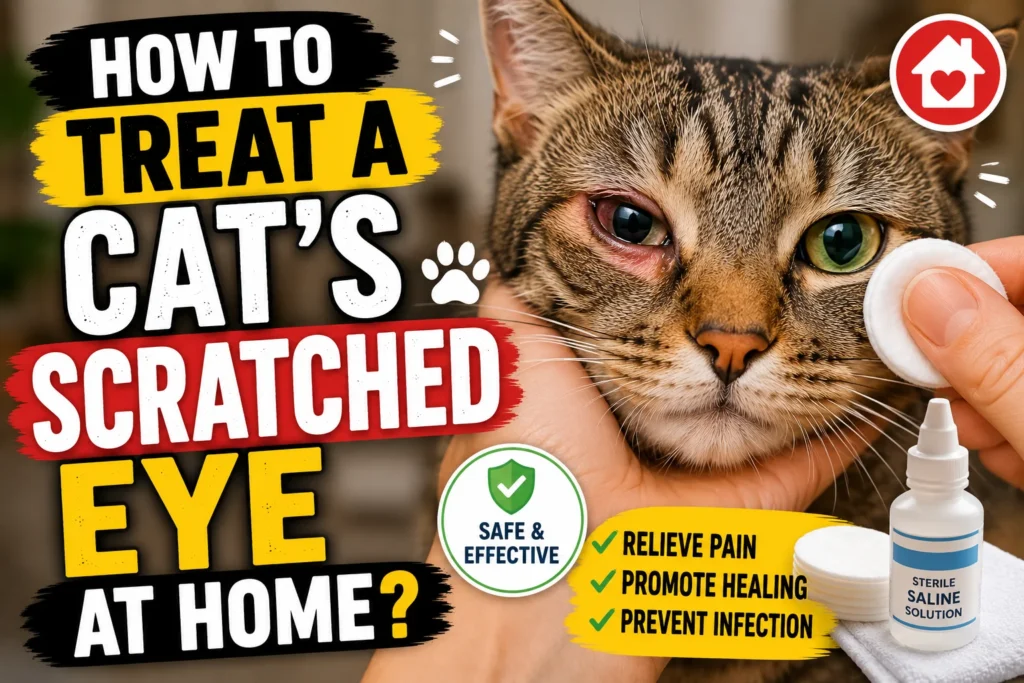
How to Treat a Cats Scratched Eye at Home? When your cat suddenly starts squinting, pawing at their face, or producing a waterfall of tears, panic can set in. As a cat owner, your first instinct is to help immediately. A scratched eye (medically known as a corneal abrasion) is painful, but can you treat it safely without rushing to the emergency vet? The short answer is: Yes but only for superficial scratches and only if you follow a strict safety protocol.
However, here is the hard truth every owner needs to hear: The cornea (the clear front surface of the eye) heals quickly, but it also ruptures easily if infected. This guide will teach you how to distinguish a mild scratch from an emergency, and how to provide immediate at-home first aid while supporting natural healing.
Understanding the Cat’s Corneal Scratch
Cats scratch their corneas by fighting with other animals, running through bushes, or even by accident during play with a toy. Unlike a human scratch on skin, the eye has no blood vessels to fight infection. A small scratch can become a melting ulcer in 24 hours.
Signs your cat has a scratched eye:
- Squinting or keeping the eye completely closed
- Rubbing the face on the floor or furniture
- Redness and swelling of the conjunctiva
- Cloudy appearance to the eye (This is a RED FLAG skip home care)
- Clear or yellow-green discharge
Also Check: Why Is My Cats Stomach Bloated and Hard?
Step 1: The Immediate Safety Assessment (Do This First)
Before attempting any home treatment, check for these Emergency Vet signs. Do NOT treat at home if:
- The eye looks cloudy or blue/grey.
- There is a visible flap of tissue or a dent in the eye.
- Your cat is screaming or hiding due to pain.
- The eyeball looks larger than the other eye.
If none of the above are present, you may proceed with first aid for a mild scratch (likely superficial).
Step 2: Safe At-Home First Aid for How to Treat a Cats Scratched Eye at Home?
1. Restrain your cat safely (The “Purrito” Method)
Wrap your cat in a thick towel with only their head out. This prevents clawing and biting. Never hold a cat’s head still by the scruff if they are struggling this increases intraocular pressure.
2. Flush the eye (Sterile saline only)
- Use ONLY sterile, preservative-free saline solution (like the kind used for human contact lenses or wound wash).
- NEVER use tap water, Visine, Clear Eyes, or any redness-relief drop. These are toxic to cats.
- How to flush: Hold the bottle 1 inch from the eye. Gently squeeze 3–4 drops directly onto the eyeball to wash out the foreign body (dirt, claw fragment).
3. Apply a lubricant (Not medicated)
- Safe: Artificial tears gel (preservative-free, single-use vials) brands like Systane or GenTeal Gel.
- Apply 1 drop every 4-6 hours. This reduces friction when they blink, allowing the scratch to heal.
- Avoid: Any drop with “Redness relief,” “Visine,” “Polysporin for eyes,” or steroids (prednisolone).
4. The E-Collar (Elizabethan Collar) is non-negotiable
You cannot treat a scratched eye without a cone. Cats will paw at the eye, turning a micro-scratch into a deep ulcer overnight. Use a soft cone or plastic cone day and night for at least 72 hours.
Step 3: What Medications Are Safe to Use at Home?
Zero human eye drops are safe for cats without a vet’s approval. However, these two are generally regarded as safe for temporary relief while waiting for a vet or for superficial scratches:
| Medication | Safe? | Use |
|---|---|---|
| Sterile Saline | Yes | Rinsing debris |
| Artificial Tears (Gel) | Yes | Lubrication/protection |
| Terramycin (Ophthalmic Ointment) | Vet Guidance | Antibiotic for mild infection (requires diagnosis) |
| Neomycin/Hydrocortisone | Never | Steroid slows healing and worsens herpes |
Do not use leftover antibiotic ointments from previous vet visits unless explicitly told to do so. Many cat eye ulcers are viral (herpes), and antibiotics won’t help.
Step 4: Natural Support for Healing at Home
While the eye repairs itself (usually 3–5 days for mild scratches), support the immune system:
- L-Lysine supplement: 250mg once daily (if cat is prone to herpes flare-ups, which often look like scratches).
- Reduce light: Close curtains. Photophobia is real with corneal scratches.
- Reduce stress: Use Feliway diffusers or calming treats. Stress suppresses corneal healing.
Step 5: The 48-Hour Rule – Improvement or Vet Visit?
You must see significant improvement within 48 hours.
- Good signs (Keep treating): Squinting is 50% better; eye is clear; no discharge; cat eats normally.
- Bad signs (Go to vet immediately): Eye looks worse; new cloudiness; green/yellow pus; cat stops eating.
Pro Tip: Vets use a special green dye (fluorescein) to see the scratch. If the scratch is deep or infected, they may prescribe antibiotic eye drops (like Tobramycin) or pain medication. A simple vet visit for a fluorescein stain costs $50–$100 and can save your cat’s sight.
When Home Treatment Must Stop
Do not use the “wait and see” approach for more than two days. Corneal sequestrum (a dead black spot on the eye) or a ruptured globe are devastating and require surgery. If your cat’s third eyelid is permanently covering half the eye, home care has failed.
Final Verdict: Should you treat at home?
Yes for a blink spasm or mild irritation.
No for a true laceration or ulcer.
Use saline and a cone immediately. If the eye isn’t bright and open in 24 hours, see your vet. Cat eyes heal very fast, but that speed also means infections spread fast.
Frequently Asked Questions (FAQs)
Can a cat’s scratched eye heal on its own?
Yes, a very superficial scratch (like a dust particle abrasion) can heal in 2–3 days. However, a scratch from a claw usually penetrates deeper and requires antibiotics to prevent infection.
What home remedy can I use for my cat’s eye?
The only safe “home remedy” is sterile saline rinse and a clean, warm compress over the closed eyelid for 2 minutes. Never use tea bags, boric acid, or colloidal silver.
How can I tell if my cat’s eye scratch is serious?
Check for cloudiness, squinting even in the dark, and pawing at the face despite wearing a cone. Those three signs mean emergency vet.
Is there an over-the-counter antibiotic for cat eye infections?
No. Terramycin is available online without a prescription, but it is a broad-spectrum antibiotic. Using it without a vet’s diagnosis can mask a viral ulcer or a fungal infection.
How long does a cat eye scratch take to heal?
With proper treatment (cone + drops): 3 to 7 days. Without a cone: Never, because they will reinjure it.
Can I use human artificial tears for my cat?
Yes but only preservative-free single-use vials. Preservatives like benzalkonium chloride (BAK) are toxic to cat corneas and worsen the scratch.
Why is my cat’s eye watering and squinting but no redness?
This is often a corneal scratch or a foreign body (like a grass seed under the third eyelid). Redness comes later with infection. Do not delay treatment.
What does a vet do for a scratched cat eye?
They apply fluorescein dye to see the scratch under a blue light, scrape any dead tissue, and prescribe antibiotic drops (like ciprofloxacin) plus atropine for pain.
Is a scratched eye painful for cats?
Extremely. A corneal scratch has the same nerve density as a dental cavity. Think of it as sandpaper rubbing your eyeball with every blink. Pain relief is essential.
How do I apply eye drops to a difficult cat?
Sit behind the cat (so they can’t back up). Rest your wrist on top of their head. Use your pinky to pull down the lower lid, and drop the medicine into the “pocket” of the lower lid, not directly onto the eyeball.