My Cat Twitching Her Back and Running Around?
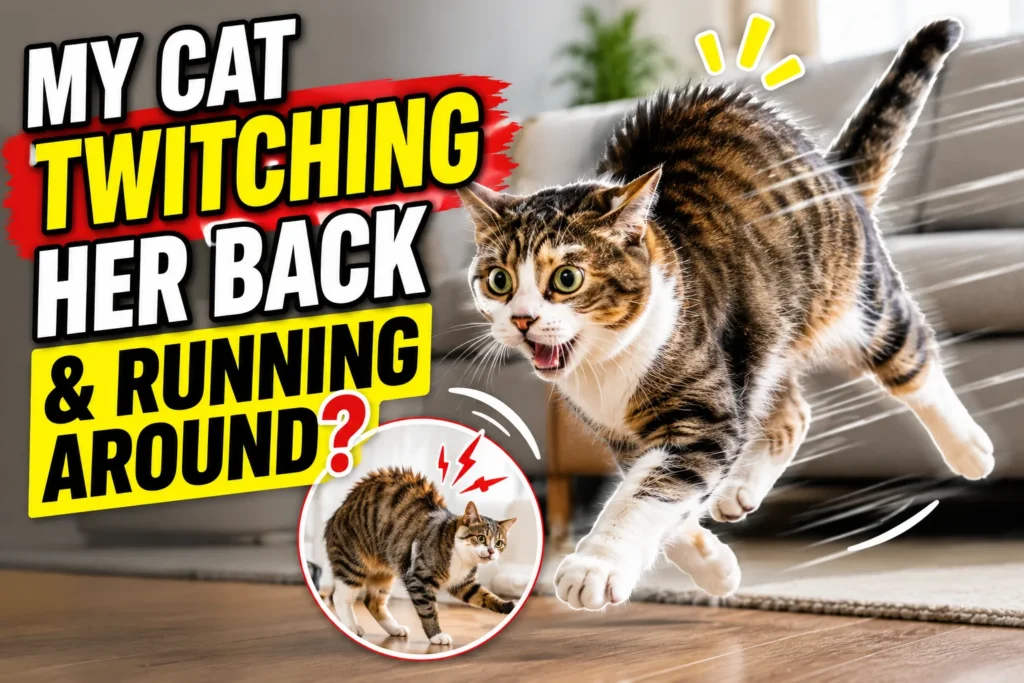
Why Is My Cat Twitching Her Back and Running Around? This is something that all cat owners can relate to: one moment your cat is calm, the next it starts quivering its back, having wide eyes and dashing around the entire house as if there were spirits chasing it. The abrupt quiver and running about by the cat may appear scary, but they are triggered by a specific cause which is easy to manage.
Why is My Cat Twitching Her Back and Running Around?
The main reason of Feline Hyperesthesia Syndrome (FHS), which is sometimes called “twitchy cat syndrome” or “rolling skin disease,” is a twitching back combined with sudden frantic running around. It is characterized by extreme sensitivity in the skin, typically along the back, especially near the tail . When this sensitive area is triggered or even for no obvious reason it can cause a dramatic reaction .
During an episode of FHS, you may observe :
- Skin twitching where the skin moves and quivers on the back area.
- Pupils dilating in size Unexpected episodes of activity, such as suddenly jumping and moving about as if alarmed.
- Tail chasing Obsessive licking, chewing, and scratching on their back, tail, or rear end.
- Vocalization such as meowing or howling.
- Aggression if touched during an episode .
What is Causing This Bizarre Behavior?
These episodes are usually brief, often lasting only 20 to 30 seconds . Even though FHS is identified as the leading cause of back twitches, it is important to keep in mind that back twitches may have different origins. This disorder is not well understood by veterinarians, but they assume that it is associated with neurological, psychological, or dermatological problems . Moreover, it should be mentioned that certain cat breeds, such as Siamese, Burmese, and Abyssinian cats, are prone to developing this syndrome genetically.
Also Check: Signs Your Cat Has A Hairball Stuck In Their Stomach
Other Possible Causes for Twitching
Before diagnosing FHS, a vet must rule out other conditions that can cause similar symptoms . Your cat’s behavior could be due to:
- Pain or Injury: Back pain, from an injury or conditions like arthritis, can cause muscle twitching and a reaction to being touched .
- Skin Irritation (Fleas, Allergies): Itchy skin is a primary reason for twitching and scratching. Fleas, mites, and allergies are common culprits . A severe flea allergy can cause a cat to become hypersensitive at the base of the tail .
- Poisoning: The intake of toxic chemicals may have an adverse effect on the nervous system and result in muscle trembling.
- Nutritional Deficiency: Lack of particular nutrients such as vitamin B1 or calcium may induce involuntary muscle shaking.
- Neurological Disorder: Various neurological disorders such as epilepsy may be the causes of muscle trembling and other strange activities.
What to Do When It Happens
Should your cat be having one of these episodes, the main thing you should do is remain calm and don’t attempt to touch or contain her, as doing this will only overexcite her and you might end up being bitten or scratched. Just let it run its course, while watching your cat closely enough to be able to explain it to your veterinarian.
When to Call the Vet
In case you find yourself experiencing this type of twitching in your kitty, then I would advise you to visit the vet. That’s because:
- There is an increased occurrence of twitching or running around.
- She is hurting herself by excessive scratching or biting.
- She exhibits other signs of illness, including being listless and not eating.
- There are suspicions that she has been poisoned.
Your vet will conduct a full examination to exclude other possible reasons. This can include testing for fleas, testing for allergic reactions on her skin, and running blood tests to determine any possible problems, such as kidney or diabetic issues. Since FHS is a “diagnosis of exclusion,” these steps are critical to confirm it .
How FHS is Managed?
If FHS is diagnosed, it’s often a chronic condition that is managed rather than cured . Treatment is tailored to your cat’s specific needs and may include :
- Treating the Underlying Cause: If an allergy or flea infestation is found, treating that directly will likely resolve the symptoms.
- Medication: Drugs like gabapentin can help manage nerve pain and seizure-like activity . For cases linked to compulsive behavior, anti-anxiety or anti-depressant medications like fluoxetine might be prescribed .
- Dietary Changes: Ensuring a high-quality, balanced diet is essential. For some cats, a hydrolyzed protein diet can help if a food allergy is a trigger. Adding Omega-3 fatty acid supplements can also help reduce inflammation .
- Stress Reduction: Since stress can trigger episodes, maintaining a calm, predictable routine is beneficial. Providing environmental enrichment, such as toys, scratching posts, and quiet spaces, can help keep your cat mentally stimulated and relaxed .
Conclusion
Seeing your kitty cat doing all sorts of crazy things like arching her back and running all over the place may worry you, but in many instances, this is because she is suffering from a known disease called feline hyperesthesia syndrome. Even though it is a lifelong illness, it can be controlled by going to the veterinarian for advice on the treatment plan and enable your kitty cat to live happily.
Frequently Asked Questions (FAQs)
What causes the skin of my cat to ripple whenever I stroke her?
The answer to this question is Feline Hyperesthesia Syndrome (FHS). In this condition, the cat’s skin becomes hyper-sensitive such that any slight pressure could induce uncontrolled muscle spasms or rippling, particularly around the lower back region of the body.
Is feline hyperesthesia painful for my cat?
While the exact sensation is unknown, it is believed to be uncomfortable, possibly causing a tingly or painful “pins and needles” feeling. Many cats react as if they are in pain or distress, and the condition is associated with “maladaptive pain” where nerves remain sensitized .
Should I just ignore my cat’s twitching and running if she seems fine after?
No. Even if your cat quickly returns to normal, the behavior is a sign of an underlying issue that needs to be investigated by a vet to rule out serious conditions like skin problems, neurological disorders, or pain .
Can stress and anxiety cause my cat to twitch and run around?
Yes, stress and anxiety are considered a major trigger for FHS and similar behaviors. Stressful events like moving house, a new pet, or changes in routine can cause episodes of compulsive behavior, overgrooming, and frantic running .
My cat is twitching and seems to be hallucinating. What’s wrong?
During an episode of FHS, a cat’s pupils often dilate, and they may appear to be chasing things that aren’t there. This “hallucinatory behavior” is one of the recognized clinical signs of a hyperesthesia episode .
Could fleas be the only reason my cat is twitching?
Fleas and flea allergies are a very common cause of skin irritation and the resulting twitching and scratching, especially near the tail . However, if the twitching is accompanied by frantic running and an overreaction to touch, it points more strongly to FHS .
Is it a seizure in cats?
No, it is not; however, it may be classified as a seizure disorder. Some specialists state that it is a focus-based seizure or associated with epilepsy. Cats can even suffer from a grand mal seizure after having hyperesthesia.
How does my veterinarian make a diagnosis for the twitching?
The vet will conduct a thorough physical examination and perform such diagnostic tests as complete blood test, urinalysis, and skin scraping to identify the cause of the condition and to rule out such disorders as allergies, parasites, kidney diseases, and diabetes. It should be noted that FHS is a diagnosis of exclusion, and the tests are conducted to exclude other disorders .
Can I use a specific diet for my twitchy cat?
It is possible. If food allergy causes FHS, your veterinarian may prescribe you the limited ingredient diet or a hydrolyzed protein diet that will relieve the symptoms of the disorder. Even in case if the cause of the twitching is not known, it is still recommended to feed the animal with high quality fresh food.
What medication should I use for twitchy cat syndrome?
It really depends on the patient’s condition, so there is no such thing as a “best” medication. Some frequently used medications include gabapentin for controlling the nerve pains and seizures and fluoxetine for behavioral issues.