
How to calm down a reactive dog on a tight leash walk?
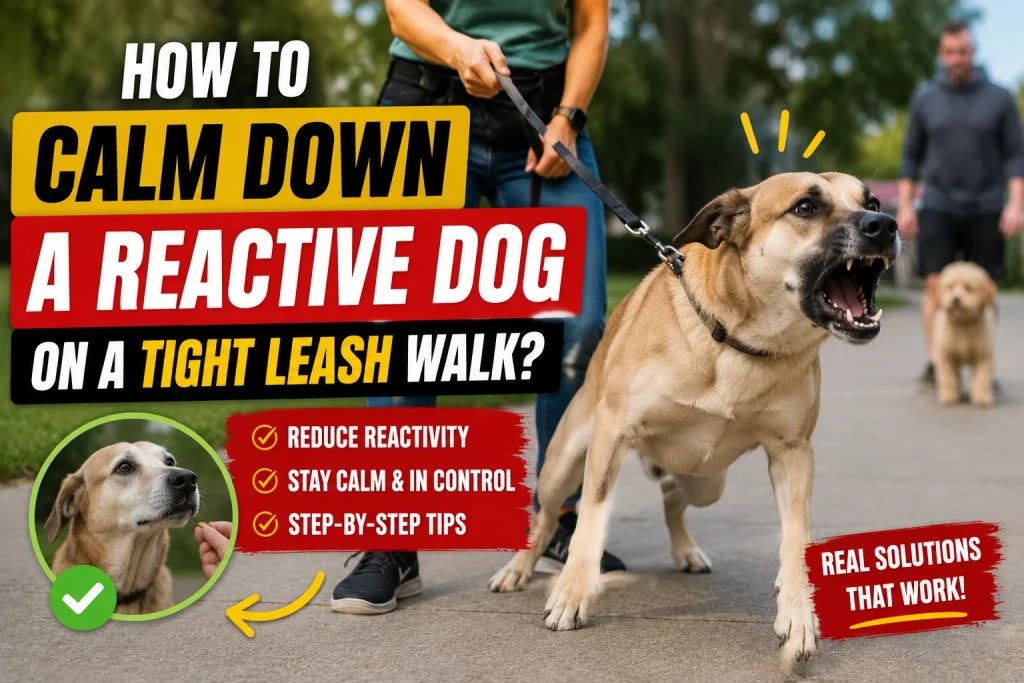
The picture described is all too real for countless dog owners. Here you are on a relaxing dog walk when you spot it-the trigger. Your dog is halfway to frenzy before you even have a moment to react and find yourself wrestling with a leaping, snarling, and barking ball of energy, tightening your grip on the leash and transmitting your own stress along to your dog and then back to them with more stress amplified. Leashes and walk-times morph into a state of nervous anticipation.
For me, a veterinary professional and dog behavior expert, this level of dog owner frustration and subsequent humiliation is something that is deeply understood. However, the important first step to recognizing is that you and your dog are not ‘bad’; reactivity can be a manageable issue and not a personal failing-it comes out of deep-rooted fear, anxiety, or immense frustration.
Understanding the Root Cause: Why “Tightening Up” Backfires
But first, we must understand the source of reactivity. At its heart, all reactivity stems from a “fight or flight” drive. When a dog is unleashed, it has an escape route to consider.
The leash however, robs the dog of that option.
It is left feeling “backed against the wall,” and forced into an option of either to flight which has been denied or fight by barking, lunging or other, to make the scary thing disappear. Unfortunately, the technique many humans will accidentally use to assist them with their reactivity problem:When handlers see trouble on the horizon, it is their natural instinct to grip the leash tighter and take up slack, pulling down, not allowing the dog to lunge as much as they feel the dog wants to. However, to the dog, pulling down on a leashes sends powerful, unmistakable distress signals. Pressure on the leash confirms to the dog their instinctual knowledge that the approaching subject is a danger.
It has learned: if the leash tightens, a ‘fight’ is required.
The purpose and goal of all training solutions for reactive dogs, including, but not limited to the below, will not be ‘perfect heel work,’ but instead, to change the dog’s fear into a feeling of calm and confidence by using.
The “Calm Walk” Protocol: A Step-by-Step Plan
Here is a practical, step-by-step protocol to help you calm your reactive dog on walks.
1: Gear Up for Success
Some supplies can have a dramatic impact.
- Standard 4-6 ft: Leash (no retractable leashes!): This is a great danger in terms of a reactive dog, since they apply consistent pressure, which is one of the things the dog would react to, and can’t be put into a controlled state for emergency control. Your leash must be a solid, fixed length.
- Soft, comfortable, front-clip harness: A properly-fitted harness is much kinder, and safer than a collar for any dog that is prone to lunging, as collars can actually apply extreme pressure to a dog’s trachea. A front-clip harness, meaning your leash attaches in front of the dog’s body, can help control a dog, and their body will pull you back to you when the dog pulls forward.
- Extremely high value treats: These are going to be your most useful tool in training. You need super small, super stinky, yummy treats that only a dog gets when the leash comes out. Ideas range from boiled bits of cheese, cooked chicken, or a good quality dog hot dog or commercial training treat.
2: Master the “Leash Dip” and Loose Leash Walking
This is THE most important thing you will ever teach him. It literally changes the way you and him communicate on leash.
- How this works: Leash should always be loose. In other words when your dog hits the end of their leash and creates tension, don’t pull them back-rather take the leash and “dip” it towards the ground by just letting your hand go toward your hip.
- This slackens it temporarily: The point is when the leash gets tight a dog that knows this technique learns to look back at you. When he does this, just click (if your using one) or say yes! And feed him a treat from your hand. You’re turning a stressful cue into a positive cue. Do this a lot in a non-stressful setting like your house or backyard before you even think about walking on a city street.
3: Identify the “Buffer Zone”
Your dog has a “threshold” distance the point at which they can see a trigger but are still calm and able to take treats . Your job is to find this buffer zone and train there.
You must be a “defensive driver” on your walks. This means scanning the environment constantly to spot triggers before your dog does . When you see one, change direction, cross the street, or put a car or a bush between your dog and the trigger to maintain that safe distance. If you cannot maintain the buffer zone, it is better to turn around and walk the other way.
Step 4: The “Engage-Disengage” Game
Once you are in your dog’s buffer zone, you can play this powerful game to change how they feel about their triggers. This is known as counter-conditioning and desensitization .
- Engage: As soon as your dog notices the trigger, say your marker word (“yes!”) or click.
- Disengage: Immediately put a treat in front of their nose and lure them to turn their head away from the trigger, looking back at you. Reward them with the treat .
- Repeat: Be prepared for your dog to whip their head back to look at the trigger. The moment they do, you mark (“yes!”) and treat again. You are building the association that seeing a trigger predicts an amazing treat.
- Progression: Over many sessions, and only when your dog is successful, you can very gradually decrease the distance to the trigger. If your dog shows signs of stress (won’t take a treat, stares fixedly, tenses up), you are too close. Back up to a distance where they are comfortable. This is not a race; progress must be measured in days and weeks, not minutes .
5: Manage Your Own Energy
The most underestimated (but most important) piece of the puzzle. Your own anxiety can communicate itself to your dog and “trigger” your dog to act out. The keys here is taking slow, long, deep breaths.
Shoulders relaxed. Keep your leash hand relaxed- imagine you’re holding coffee.not gripping. You need to be in the leadership role, a calm and confident presence when these moments arise.
Also Check: The Ultimate Guide to Your Sleeping Cat’s Breathing?
Frequently Asked Questions (FAQs)
Is my dog aggressive, or is this just reactivity?
Reactivity is not the same as aggression, though it can look very similar and could escalate into aggression if not addressed. Reactivity is typically an overreaction caused by fear, anxiety, or frustration that is amplified by the restriction of the leash. An aggressive dog is often trying to cause harm, while a reactive dog is often trying to make the scary thing go away or is frustrated they can’t get to something they want . If you have any safety concerns, especially for other people or animals, contact a qualified behaviour professional immediately.
Why is my dog so calm off-leash but reactive on it?
The leash is the key. Off-leash, your dog has a full range of options to cope with a stressful situation. They can use natural calming signals like turning their body, sniffing the ground, or walking away. The leash removes their ability to “escape,” which is their primary means of managing fear, leaving them feeling trapped and resorting to a “fight” response . This is why we should never force on-leash greetings between unfamiliar dogs, as it forces a high-stress, unnatural encounter.
What shouldn’t I do when my dog reacts?
Never correct, jerk, or yell at your dog during a reaction. Adding punishment to an already fearful and highly aroused state only increases their anxiety and can reinforce the idea that the trigger is a source of bad things. It can also suppress their warning signals (like growling), which could lead to them biting “without warning” in the future . The goal is to change the emotion, not suppress the behaviour.
What’s the best way to hold the leash for a reactive dog?
The goal is to maintain control without creating constant tension. A recommended method is to hold the leash with a relaxed grip, with the leash coming over your palm and between your index and middle fingers, then looped around your index finger. The rest of the slack is gathered loosely in your palm. This allows you to use gentle, subtle cues rather than a constant, stressful pull.
Can I let my reactive dog meet other dogs on leash?
No. It is highly advised to avoid all on-leash greetings. These encounters are unnatural, stressful, and can quickly go wrong. It is not a “socialization” opportunity for a dog that is already anxious. Your goal is to teach your dog to remain calm and focused on you in the presence of their triggers, not to interact with them.
What are signs of stress I should look for before my dog reacts?
Dogs give subtle signals long before they bark or lunge. Look for a stiff body, a “hard” stare, a closed mouth, ears pinned back, lip licking, yawning (when not tired), and panting (when not hot). If you see these signs, you are too close to the trigger. Give your dog more space immediately.
What is the “Yellow Dog Project”?
The Yellow Dog Project is a global movement where owners of dogs who need space (for any reason) tie a yellow ribbon to their leash. It’s a visual cue to other dog owners to keep their dogs away and not approach. This is a fantastic tool for creating a safe space for your dog.
My dog is too distracted to take treats on a walk. What do I do?
If your dog won’t take a treat, they are “over threshold” and too stressed to learn. You need to start in an environment with fewer distractions or work at a much greater distance from triggers. Sometimes, this means not taking them for a “walk” at all and instead providing exercise through other means (fetch in a yard, playing with a flirt pole, indoor enrichment). Short, successful training sessions are far more valuable than long, stressful walks.
Can I just use obedience commands like “heel” or “look” to control my dog?
While useful, relying solely on obedience can be a trap. Telling a fearful dog to “sit” while they are panicking does nothing to address the underlying fear. It can suppress the outward signs but not the internal distress. Your goal is rehabilitation and changing the emotion, which comes from techniques like counter-conditioning and managing the environment, not just enforcing a position.
Will I ever be able to walk my dog normally again?
Yes, with patience, consistency, and a good training plan, you can make tremendous progress. However, it’s important to have realistic expectations. Your dog may never be a dog who enjoys a bustling city street, and that’s okay. The goal is to create calm, manageable walks for you both. Celebrate the small victories the first time they look at you when they see a dog, or the first time you walk past without a reaction. Progress is a journey, not a race.





One Comment