Signs Your Indoor Cat is Bored and Depressed
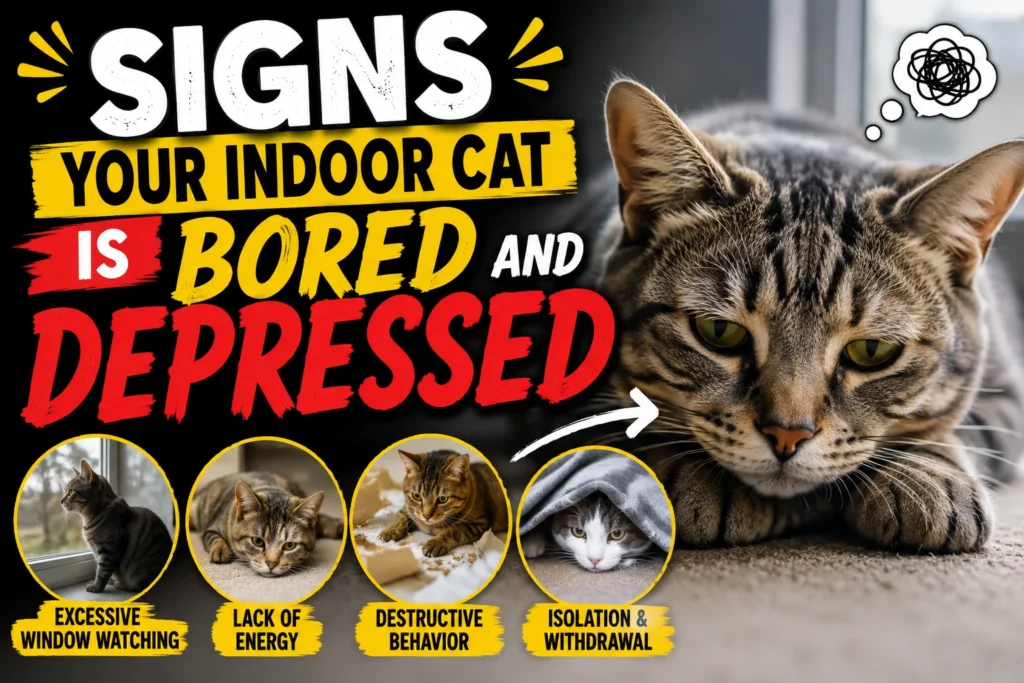
Signs Your Indoor Cat is Bored and Depressed. As a veterinarian, one of the questions I get asked most frequently is what a pet parent should do because their indoor cat’s behavior has changed. You’d think having a house and everything your cat needs in it would lead to total contentment. But I see pets on a regular basis whose health physical and mental is not all that great simply because they are lacking sufficient stimulation. You’d think being safe in the house would be wonderful, but it often turns into a kind of boring “gilded cage”.
Your cat is built for hunting, exploring, and puzzle solving. If your cat’s indoor environment lacks outlets for these instincts, he or she could easily sink into a depression which would be displayed by several behavioral or even physical problems.
Signs Your Indoor Cat is Bored and Depressed
The Crucial First Step: Ruling Out Medical Issues
First and foremost, before you conclude that your kitty’s altered behavior is a result of boredom or depression, you must visit your veterinarian! There are several cat symptoms we mistake as indicators of a down cat (such as decreased appetite, sleepiness, house-training mishaps, excessive licking) which are, in fact, an indication of medical illness, including:
Dental illness, hyperthyroidism, kidney disease or arthritis! After your vet gives your feline a clear health bill, you can then start to help him with the environmental and emotional side.
Key Signs of Boredom and Depression in Indoor Cats
A cat doesn’t simply transform from ‘bored’ to ‘depressed’ overnight. As we’ll discuss below (based on evidence from behavioral and veterinary science), these are a handful of crucial differences you can monitor to know when a “chill” cat needs some special attention:
1. Changes in Activity and Energy Levels
Increased Sleeping and Laziness: cats can sleep between 12 to 18 hours of the day; however, excessive sleeping as well as the cat losing interest to play is a prevalent symptom of depression . A depressed cat tends to feel lethargic and has lost interest for daily activities, spending more time alone and being at ease . Other signs of a cat with depression can also include losing the desire to do everything they typically do for them .
2. Destructive and Disruptive Behaviors
Excessive Scratching and Destruction While your cat has an innate need to scratch, when it gets bored, it will destroy furniture, carpets, curtains, and pretty much anything else to pass the time, relieve boredom and take out the tension. The Attention-Hungry Kitty knocks Things Off Countertops Another typical feline behaviour, this likely happens when your feline friend gets an attention deficit disorder. It’s just bored and wants some attention or just needs to spice up its routine.
3. Changes in Social Interaction and Vocalization
Over Meowing or Vocalizing Whether it’s through constant meowing, yowing, or crying at you at the wee hours of the night, if your cat acts like this most of the day, they may be trying to tell you that they are lonely and bored . Withdrawal – A depressed cat often becomes a withdrawal cat who isolates and hides from its humans and the rest of the pets. They may also hide in plain sight and stay isolated, seeking less attention. Withdrawal also refers to hiding under a bed or inside a cupboard .
However, sometimes depression can manifest as the opposite; clinginess A cat experiencing depression may follow you around your home and seek out comfort. Clinginess can also be a manifestation of a lack of self confidence or insecurity . Increased Aggression Boredom and frustration can often translate to an ill tempered or aggressive feline . This typically results in a cat that hisses, swat, or even bites their owners or other pets. Some depressed cats have been observed ambushing peoples feet and hands as if hunting. This is more often than not a misplaced hunting endeavor from an under stimulated cat .
4. Altered Grooming and Appetite
Excessive grooming: The typical stress signal for cats is to groom more often and to more intensely. If a cat gets bored and doesn’t have much else to do, he might lick his skin excessively, nibble or bite himself till he has patches or his skin becomes irritated and infected – basically he is coping through self-stimulation. Weight changes.
A cat who is dealing with emotional trauma or distress might increase or decrease his appetite to a remarkable degree.
Some cats may eat twice as much due to the stress, whereas other may not eat a single bite, potentially becoming dangerously underweight over time.
5. Litter Box Issues
When depressed and bored, a cat may even urinate inappropriately. If you’re finding that your cat has peed or defecated out of the litterbox, it might be because he’s being under stimulated and bored, or that he’s emotionally upset or depressed. You still need to be sure that a medical problem isn’t being hidden.
Also Check: How Often Should A 10 Year Old Dog Go To The Vet For Checkups?
How to Re-engage Your Bored or Depressed Cat?
Once medical issues have been cleared, you can start enriching your cat’s world to break up the boredom and raise their mood. You want to provide your cat with the “thrill of the hunt” as well as plenty of stimulation for their brain and body. Here are several easy, cheap and creative ideas to enrich your cat’s indoor world.
Play the Hunt for Food: You may be putting your cat’s food into the same bowl day after day.
Some people have their cats play a puzzle game or even scatter treats or kibble for the cats to discover. You might not be surprised to learn that it’s possible to build your own puzzle feeder, with a couple of treats shoved into a plastic water bottle that’s had holes cut out of the side, for instance. If your cat seems uninspired, use an interactive toy such as a feather wand; dart back and forth, dart and then stalk the toy, pounce… it really makes them engage with you and the toy.
Provide your cat with their own cat climbing tree, shelf, or simply a bookcase which provides a vantage point.
Consider a perch on the window sill, with their bed set up near a window where they can observe the great outdoors, possibly supplemented with a bird feeder or bird bath which can be visible from the window. Try not to let your cat play with the same toy each and every day; switch toys every week or so, just presenting a couple of toys to them at a time.
Frequently Asked Questions (FAQs)
Can an indoor cat be depressed?
Although they may not suffer from the human equivalent of clinical depression, most veterinarians and behaviorists agree that cats can indeed become depressed. This typically presents itself as a visible shift in attitude, conduct, and movement, commonly induced by an absence of enrichment within their environment or significant shifts in their life .
What’s the difference between a ‘lazy’ cat and a depressed cat?
A “lazy” cat will at least maintain interest in things it finds enjoyable, such as a favourite snack, a special toy, or interaction with you. In contrast, a depressed cat will demonstrate a general lack of interest in all things, including its preferred activities, and may also show additional signs such as a loss of appetite or a change in its grooming habits .
Does my cat always sleeping all the time mean anything?
Cats are naturally crepuscular (active mainly during dawn and dusk) and can typically sleep 12-18 hours in a day. However, a cat who is sleeping much longer than usual and acts lethargic when they are awake warrants concern.
Why all of a sudden, is my cat going crazy shredding everything in sight?
Scratching is a completely normal behavior for cats. When it becomes excessive and destructive, it is very indicative that your cat is bored and needs to let out some of the pent-up stress and frustration. A variety of secure and varied scratching post structures would be a great help to redirect this behavior .
Will a second cat help relieve my cat’s boredom?
This seems like a sensible thing to do, but there is some risk involved. On the one hand, this might end with cats falling madly in love and becoming great friends; on the other hand, the introduction of another feline might prove very stressful for both cats and could even trigger conflict.
What is the best toy for a bored cat?
Rather, the best approach is to rotate various kinds of toys, especially when considering the kinds which require activity or engagement.
Interactive toys, such as feather wands, provide bonding opportunities and a sense of play, while interactive toys that provide food help keep your feline thinking and motivated.
Is my cat over grooming itself?
Cats are obviously clean creatures. In reality, when your cat is over grooming itself to the point that it licks one specific spot in particular to the point where it becomes bare of hair, or develops skin problems, your feline is most probably experiencing significant stress
My cat has started vocalizing more than it has ever in its life before. Why?
A significant increase in mewing or vocalizations may signify boredom, loneliness or the cat wanting some form of attention . In older cats, this might signify that something such as hyperthyroidism or hypertension is occurring, and for this reason it is always recommended to consult a veterinarian as there is medication available to assist with this problem.
Will providing a stimulated environment help to bring my cat out of a depression?
Of course, as this is the very purpose of stimulating the environment. Your feline may just be lacking the stimulation in his or her environment and may also feel depressed because he or she does not have anything to play with or anything to stimulate them mentally or emotionally, such as more playing, toys and other forms of environmental engagement.
When should I consider a veterinary visit?
As with all behavioral changes – especially if accompanied by loss of appetite or any house-training issues, such as changes to litter-box habits – any change in your cat’s routine and behaviour could be a sign of illness or pain.