
The Ultimate Guide to Common Health Problems in Golden Retriever Puppies
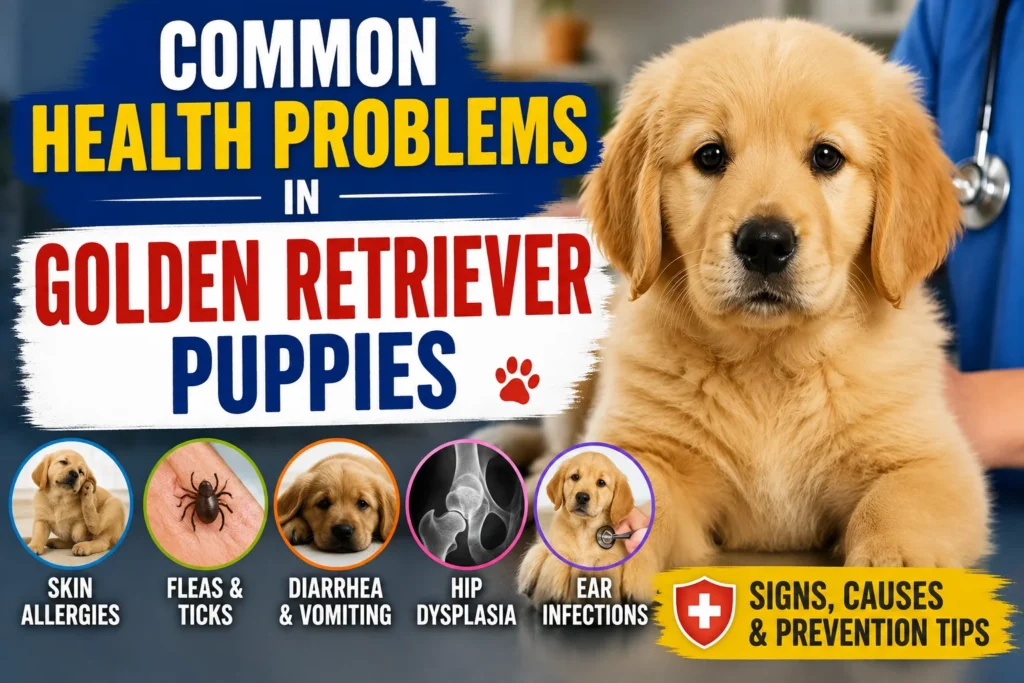
The Ultimate Guide to Common Health Problems in Golden Retriever Puppies.
You are welcome to bring a fluffy bundle of golden love home. When the dog’s little feet start to patter around your ankles, he will be sure to win your heart through his puppy-dog eyes and always happy wagging tale. The dog will remain faithful and a good friend to you forever, but during his initial year the dog grows fast and has the tendency to a few health problems given the popularity and typical development rate.
As a veterinarian and champion of your pet owner’s rights, join me as I outline some of the health challenges you’ll want to be watching for in your Golden’s first 12 months of life.
Be empowered with information, as well as the fact that successful outcomes often rely on early identification and treatment.
The Orthopedic Challenges: Growing Pains vs. Real Problems
Large breed dogs that mature fast at their fast pace growth is called a “growth spurt.” Growth spurts are typically know for developing health concerns. Know the difference between the characteristics a normal clumsly Golden Retriever exhibits to clinical lameness.
Hip and Elbow Dysplasia
Perhaps the one Golden health problem we all recognize. Here’s how hip dysplasia impacts dogs like my 200-pound, Golden goofball, Max: Hip is the ball and socket that have the unfortunate issue of not seating together snugly resulting in rubbing that eventually progresses to arthritis. Elbow dysplasia is like hip dysplasia but it impacts the front.
Signs to watch for in puppies:
- Reluctance to run, jump, or climb stairs.
- A “bunny-hopping” gait when running (moving both back legs together).
- Stiffness or lameness after exercise.
- Difficulty rising from a resting position.
What you can do: The single most important thing is nutrition. You must feed a large breed puppy food to limit your puppy’s growth rate and to get the proper calcium to phosphorus ratio; do not over supplement with calcium. Keep your puppy in lean condition; the extra weight puts tremendous stress on immature joints. While there’s a genetic predisposition, the responsible breeder who screens for hip problems with practices such as OFA or PennHIP screening is a must.
Panosteitis (Pano)
Often called “growing pains,” Panosteitis is a painful inflammation of the long bones in the legs. It comes and goes, often shifting from one leg to another .
Signs: The dog may be suddenly and inexplicably lame and it appears to stop after a day or two, but lameness develops in another limb. Commonly seen in puppies between 5 and 18 months.
What to do: It’s usually a temporary self-resolving condition as puppy grows, but can be extremely painful and requires veterinary intervention with pain medication (anti-inflammatories).
Also Check: The Dachshund Owner’s Guide to Preventing Back Pain and IVDD 2026
Skin, Coat and Ear Troubles
This rich, dense double-coat on a Golden can be both a blessing and a curse. It’s wonderfully insulating but can also maintain an environment ideal for yeast and bacteria.
Skin Allergies (Atopic Dermatitis)
Many Golden Retrievers suffer from environmental allergies that manifest as skin problems. The hallmark sign of allergies in dogs is itchiness .
Signs to watch for:
- Obsessive licking of paws.
- Chewing at the base of the tail or flanks.
- Red, inflamed skin, especially on the belly and ears.
- Recurrent skin infections.
Ichthyosis
This is a genetic skin condition, more common in Golden Retrievers, where the skin appears scaly and flaky (like fish scales) . It isn’t typically itchy but can make the skin susceptible to secondary infections. Responsible breeders are now testing for this.
Ear Infections (Otitis Externa)
Those adorable floppy ears are basically “earwax factories” that trap moisture and debris, making them a prime location for bacterial and yeast overgrowth .
Signs to watch for:
- Vigorous head shaking.
- Scratching at the ears.
- A foul odor coming from the ears.
- Redness or dark discharge inside the ear canal.
What you can do: Clean your puppy’s ears weekly with a vet-approved ear cleaner. Keep the ears dry, especially after swimming or baths.
Eye and Vision Concerns
A portion of eye conditions can be passed genetically through golden retrievers. The disorders commonly encountered are those that are usually encountered more often in an elderly animal but in general its still just good to have a good eye check for and out from the puppy days forard of and around eye is a simple precaution.
Cherry Eye (Prolapsed Nictitans Gland)
This condition is noticeable when the tear gland in the third eyelid prolapses, appearing as a red, fleshy mass in the corner of the eye .
Signs: A red, cherry-like lump at the inner corner of the eye. It’s usually not painful but requires veterinary correction.
Veterinary Note: If surgical correction is needed, advocate for a “tacking” procedure (replacement) rather than removal of the gland. That gland produces a significant portion of your dog’s tears; removing it predisposes them to “dry eye” (Keratoconjunctivitis sicca) later in life .
Juvenile Cataracts
Most dogs develop cataracts as they grow older, but these juvenile cataracts can affect puppies and tend to run in bloodlines.
Symptoms: Whitening of the pupil, which can also alter the color of the eye. Clumsiness (bumping into objects) can also be a symptom of cataracts. Diagnosis and prompt treatment (such as surgery) are essential if these symptoms are detected.
Digestive and Systemic Issues
Puppies explore the world with their mouths, making gastrointestinal issues very common.
Dietary Indiscretion and Parasites
It’s normal for puppies to eat things they shouldn’t. However, persistent vomiting or diarrhea is a red flag .
Parasites: The possibility of intestinal parasites (including worms and coccidia) can be high among all Golden Retriever puppies. Take a fecal sample to have your vet check for this and to initiate appropriate treatment as necessary.
The symptoms: Scooting, a dull coat, loose or diarrehic stools and lethargy. What you should do about it:Follow a rigorous deworming regimen prescribed by your vet.
Congenital Myasthenic Syndrome (CMS)
A fairly rare and inherited neuromuscular disease of young Golden Retriever puppies.
Clinical signs: Diffuse exercise-induced generalised weakness. You may observe exercise intolerance, “pacing,” or exercise collapse in a younger Golden puppy. Check your veterinarian if your puppy demonstrates unusual exercise intolerance.
“Puppy Strangles” (Juvenile Cellulitis)
This usually appears on an otherwise healthy young puppy (between 3 weeks and 4 months) and the puppy develops a rather drastic swelling of his or her muzzle, face, chin, eyes, and even ears. Pups may develop pus-filled scabs, or ” pimples”, on their chin or face, and have painful, swollen lymph nodes, perhaps feel quite feverish, and lethargic. If untreated, it typically progresses to sloughing off of skin around the muzzle and face.
What to do: The is is a true medical emergency and warrants immediate, aggressive therapy with corticosteroids; fortunately, although this may look as if death is about to occur the, majority of pups survive with rapid treatment.
FAQs
My Golden Retriever pup has soft poop and is a very skinny. Could my pup be sick?
It is most likely intestinal parasites or some sort of intolerence to its food. Take a stool sample (fresh as possible) to your vet to have it checked and do not use dog wormer unless directed by your vet.
My puppy gets ear infections very often; what is wrong?
Golden retrievers have floppy hair to their ears, which does not allow ventilation and they can get infections. If your Golden is prone to infections, it can be brought on by allergies. Make sure that your Golden’s ears have had sufficient drying time if it plays in water, as well as use a cleaner recommended by your vet.
What’s the best food and feeding amounts to prevent my puppy from having health problems later in life?
Feed your Golden Retriever a puppy-food called ‘large breed puppy formula. Use a meal that will have 3-4 feedings per day until 4 months and feed 2-3 per day by 6 months. Stick to the food guide and watch weight – when your Golden’s ribs are visible and not palpable and a defined waist is present, it is the correct food ratio per day. Do not feed free-choice with this breed.
My puppy wakes up in the early morning and has a loud goose honk sort of a cough. Is that Kennel Cough?
Yes, this sounds to be Kennel Cough (Canine Infectious Respiratory Disease). Kennel cough often only needs rest, in the case of being dry and your Golden has clear breathing, eating, and playing and only wheezes when the coughing fits arrive. Use a harness rather than a leash/collar to take the pressure off the trachea and consult your vet if the coughing worsens or your Golden becomes lethargic.
My puppy ate a piece of chocolate or a sugar free gum; help me?
This is a very urgent and life-threatening situation. Chocolate contains thiobromine, and sugar-free gums and candies contain an ingredient called Xylitol which does damage to their low blood glucose level which only takes minutes for the symptoms to set in (death is even more imminent). Immediately get your pup to your vet or contact Pet Poison Center . DO NOT wait for symptoms to appear!
My puppy’s face is swollen and covered with bumps is there anything that my puppy might have?
This could be Canine Juvenile Cellulitis; usually called” Puppy Strangles”. This requires intensive high-dose steroid treatment and antibiotics immediately from your veterinarian.
My puppy has an intermittent, sometimes mild, limp. Is it something to worry about?
Panosteitis, also known as growing pains, can often have a slight shifting-leg lameness. It can also be a pre-cursor to or a sign of early Canine Hip/Elbow Dysplasia. Rest, though it might take away from his energy, has been reported to decrease inflammation of the bones and you need your vet to diagnose this and administer any pain management.
I noticed a red colored lump in the corner of my puppy’s eye. What can that be?
That is a Cherry Eye and although it looks frightful, it is generally not painful unless your pup begins to paw at it. A Cherry Eye is a prolapse of the third eyelid gland. This will need to be removed surgically or “tacked” back so it will not cause dryness and prevent the need of subsequent medications.
What’s the best way to figure out whether my pup’s allergies are from the food or from something in the environment?
Dogs who are allergic to their food typically have severe GI distress along with an itch. The vast majority of young dogs’ allergies are from the environment, which would likely cause them to scratch themselves into oblivion as well as other symptoms not as prevalent with a food allergy. Diet trials administered by your vet will be the ultimate key to determine if the allergies are related to food or the environment.
My puppy seems very lethargic and has to stop and collapse after exercise. Is there anything else that could be wrong with him other than being a lazy puppy?
Lack of tolerance for exercise is never normal in a pup; in many cases, this means that something is wrong with their heart, i.e. Aortic Stenosis. Muscular or neurological conditions, such as Congenital Myasthenic syndrome is another likely culprit that needs a vet’s visit.






One Comment