Is an Essential Oil Diffuser Safe Around Pet Birds?
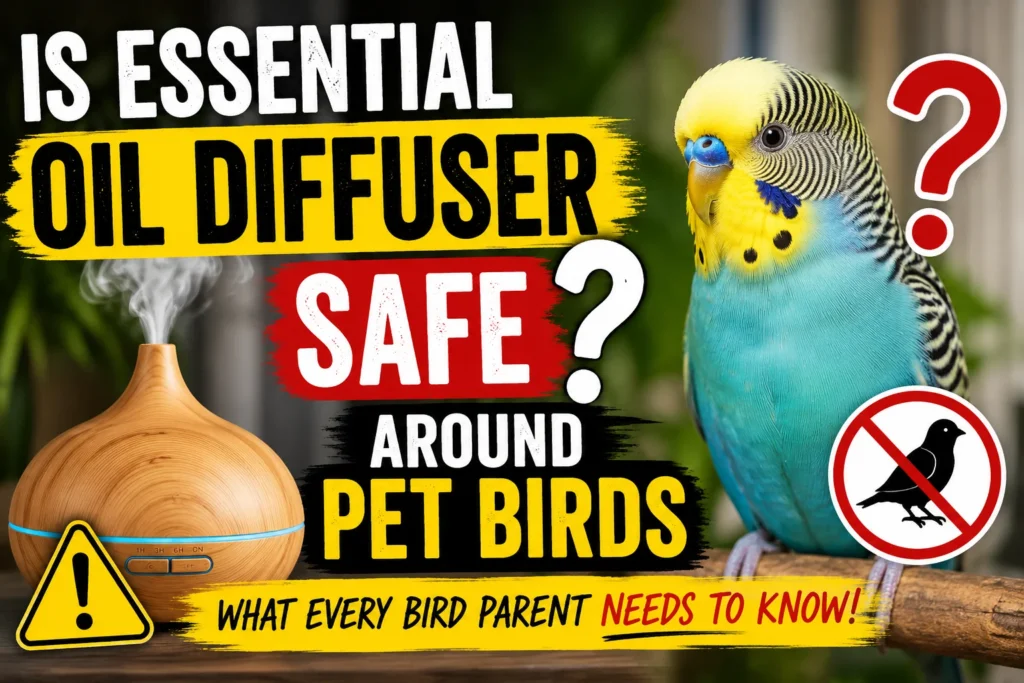
Is an Essential Oil Diffuser Safe Around Pet Birds?. A gentle hum emanates from the living room. From the essential oil diffuser an amber light shines as the diffuser sends tiny lavender vapor tendrils up towards the ceiling. You inhale deeply and release your tensions as your shoulders relax. You lift your gaze over toward the living room cage, toward Sunny.
Could this peace be a time bomb in the making?
As an avian veterinary clinician, I have encountered confusion from pet owners, and I am writing this article to provide a straightforward, science-backed answer on whether you should run that diffuser near your feathered friend.
So the answer?
No. A general rule of thumb in veterinary medicine dictates that if your practice sees avian patients, it will also probably caution against essential oil diffusion near pet birds.
The Avian Respiratory System: Why Birds Are Different
If your bird is vulnerable, it’s helpful to know about the anatomy. Humans operate with a “two way” breathing process, the air comes in and goes out via the same tubes. Birds however, breathe with a “one way” air flow where air enters one set of tubes and exits by another.
This system allows birds to experience: amazing “oxygen efficient” process-Birds oxygenate both their inhaled and exhaled air which causes their bodies to be very sensitive to air quality and air pollutants.
No diaphragm: Birds do not have the ability to cough or “clear their lungs” like a human does rapid absorption anything that is a VOC (Volatile Organic Compound), like essential oil molecule particles can very rapidly enter the blood system of a bird.
What is in your air, smells relaxing like “eucalyptus,” is really a terpene/phenol party going on in their tiny air sacs.
The “Diffuser Mist” vs The Bird
Many owners believe, “I’m not burning a candle. I’m just misting water with a little bit of oil.
That’s natural, right?”But unfortunately, it is not.
When using ultrasonic and nebulizing diffusers, essential oils are broken down into tiny particles. They do not combine with water; they remain airborne as tiny oil particles.
When these particles are inhaled by birds: Irritation. Birds have an incredibly sensitive airway, which may become inflamed from the oils covering their air sacs and trachea.
Hyper-responsiveness/Allergy.
They can have an acute allergic response which is essentially the onset of a respiratory emergency. Organ toxicity. Some oils are neurotoxic and/or hepatotoxic.
Also Check: Signs of Heartworms in Dogs Even on Prevention
Is an Essential Oil Diffuser Safe Around Pet Birds
Emergency Signs:
Turn off the diffuser, open the room, and go see an avian vet right away if you see signs like the following after using a diffuser in the vicinity:
- tail bobbing
- open-mouth breathing
- sneezing or nasal discharge
- lethargy
- clicking sounds or wheezing
- loss of balance or seizures
Which Oils Are the Most Dangerous?
In clinical avian medicine, there is no “safe” essential oil, but some are lethal even in minuscule amounts.
The Red Zone
- Tea Tree are Causes ataxia and liver failure.
- Eucalyptus Severe respiratory irritant.
- Peppermint Can cause rapid neurological depression.
- Cinnamon Burns mucous membranes.
- Clove Extremely toxic to the liver.
- Pine, Fir, or Spruce Direct pulmonary irritants.
- Oregano, Thyme Highly concentrated phenols.
The “Less Dangerous”
- Lavender
- Chamomile
Vet’s Note: I have treated budgies who died after 10 minutes of exposure to a tea tree diffuser in a closed bathroom.The risk is not theoretical.
The “But It’s Natural” Fallacy
Cyanide is natural. Hemlock is natural. “Natural” does not equal “safe.” Essential oils are highly concentrated plant extracts. One drop of peppermint oil is equivalent to 28 cups of peppermint tea. You are exposing your bird to a pharmaceutical-grade concentration of plant chemicals. Their 2-ounce body cannot process that.
Safer Alternatives for a Fragrant Home
Your house doesn’t have to stink. All you have to do is bird-safe.
For air freshening: Simmer pots ( boil on the stovetop with safe fruit peels, cinnamon sticks and cloves), Baked baking soda ( put a bowl of baking soda in a room for absorption). Ventilation
For bird’s environment: Dry herbs ( put lavender buds or chamomile flowers near the cage, not inside, and they will create an odor free, mild scent). Activated charcoal filter( use an air purifierwith a charcoal filter to prevent odors and dander without chemicals) So, what if I put my diffuser in another room?
What If I Use the Diffuser in a Different Room?
This is the simplest option for most people, but it still is not totally safe.
The most common rule: if the oil smells in your bird’s room, the bird is getting the oil in his lungs. HVAC systems, ceiling fans and air pressure all move around small particles.
If you absolutely must use a diffuser for your own health , follow these Iron-Clad Rules:
- Place the diffuser in a room that is sealed off.
- Run an HEPA air purifier in the bird’s room.
- Use the diffuser for 15 minutes maximum.
- Wait 2 hours with windows open before allowing the bird back into that room.
- Never use it in a car, small office, or bathroom with the bird.
Frequently Asked Questions (FAQs)
Can I use a water-only diffuser near my bird?
Yes, but make sure it is thoroughly washed clean of any oils. A cool-mist water humidifier is actually quite good for birds, especially during a molt or during winter’s dry spells, it will help your bird’s skin and respiratory tract.
Are electric wax warmers safer than oil diffusers?
No, melts contain both artificial scents and VOCs, which are just as harmful to your bird’s lungs.
What about “bird-safe” essential oils sold online?
There is no such thing. Any company marketing “bird-safe” essential oils is lying. Birds have no biological mechanism to safely metabolize terpenes. Do not trust this marketing.
My bird has been near a diffuser for a month and seems fine. Is that luck?
Yes. A bird is prey animal and is designed to hide illness until they are critically ill. You’re not seeing any symptoms until the bird is literally dying. Do not wait for symptoms.
Can I put a single drop on a cotton ball instead of a diffuser?
No, even worse as the potency is more concentrated and is placed directly where the bird might come into contact. You wouldn’t want the bird to chew it or inhale it.
Are incense sticks or candles safe for birds?
Absolutely not. Incense and burning candles release particulate matter, carbon monoxide, and soot. 100% beeswax, unscented candles can be burned only in another room with ventilation.
What if my bird is in a cage with a cover?
3 Never cover a bird’s cage in an attempt to protect from airborne irritants. I have a large aviary outdoors.
Is it OK to use a diffuser indoors, but nearby?
If the aviary is outdoors and the diffuser is inside with the doors closed and the windows shut tight, then the risk is relatively low. Do not use any diffuser near the aviary whether it’s on the patio or porch; the breeze will carry the particles into the aviary.
What natural scents are actually safe to use as room spray?
Nothing can be sprayed as an aerosol. If you really want to scent your house, try placing some washed organic orange peels in a bowl of water by a sunny window; they will naturally evaporate in the room, but do not spray the room. My veterinarian has prescribed a nebulizer for her medication.
Is it the same as a diffuser?
No, the medical device used by a veterinarian to deliver water-soluble medication or sterile saline to the lungs of the bird is not the same as a diffuser and should never be confused with it.
The Final Verdict
Essential oil diffusers: modern day luxury for humans, modern day hazard for your parrot and avian pets. Your pet parrot, cockatiel, finch or budgie counts on you to navigate this planet with their delicate lungs, so while that relaxing spa scent might be bringing down your cortisol, it might also bring down their risk for sudden, unexplained death. Bird or diffuser. Make your choice.