The Best Way to Clean Dog Teeth Without Brushing
The Best Way to Clean Dog Teeth Without Brushing. A dog presenting with a stinky mouth so bad you could smell the dog in the room at least 10 feet away. His gums were so inflamed you could see how much pain he was in.
“Do you brush your dog’s teeth?”
I asked the worried owner.
“Oh I try, but they hate it.” The more I hear this response, the more I realize this is the problem… We’ve bought into the idea that if our dog dislikes something, we shouldn’t do it to them, even when that something could save his smile. Luckily for you, and your poor dog’s sensitive mouth, you don’t have to engage in a wrestling match just to clean your dog’s teeth. In this guide, I will teach you the most vet-approved and safest non-brushing teeth cleaning alternatives you can do to maintain your dog’s dental health.
Why Is Brushing So Hard And Is It Really Necessary?
Before we begin, let’s clarify what exactly is causing the problem. Plaque begins when food particles mix with your dog’s saliva and forms a sticky, colorless layer. Within 48 hours, the plaque hardens into tartar and can only be removed by a professional with a veterinary dental tool.
However, if you use the right mechanical and chemical alternatives daily, you can prevent plaque from ever turning into that rock-hard tartar.
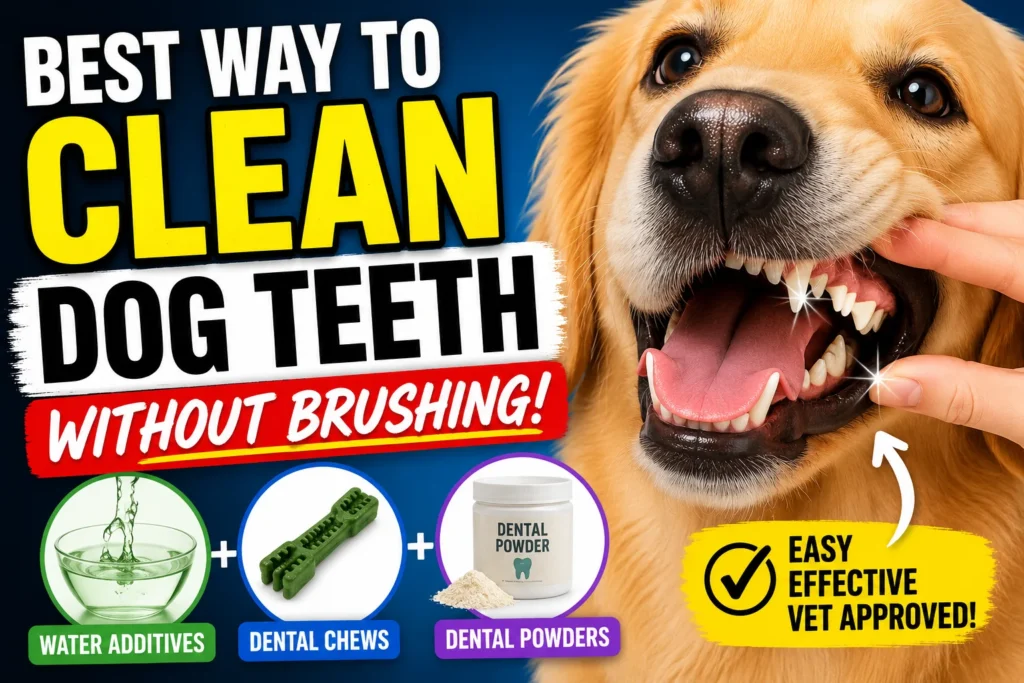
The Best Way to Clean Dog Teeth Without Brushing
Here is the hierarchy of what actually works, ranked from most effective to supportive care.
1. Enzymatic Dental Sprays & Gels
That’s the closest you’ll come to brushing minus the physical scrubbing. Enzymes in oral sprays chemically destroy the walls of the bacteria in the plaque.
How to use them: Don’t simply spritz the contents around the dog’s lips. Pull the lip up and spritz directly onto the gum line and the surface of the tooth. With gels, simply dispense a thin bead down the back upper molars. Your dog’s tongue does the work spreading it around and activating it.
Best for: Busy owners. Best for dogs that require a 30-second solution.
Expectations: Improves breath within 2 weeks; prevents further plaque buildup.
2. Veterinary Oral Hygiene Chews
Bypass the bleached bones and raw hides. Go for something with the VOHC seal ( Veterinary Oral Health Council).
A good chew will have a porous, fibrous surface, essentially a loofa for the tooth.
Top choices:
- Celestial Teeth Cleaning Chews: Contain natural abrasives and chlorophyll.
- Whimzees: Shaped with ridges to scrape the buccal surface of teeth.
- Greenies (Regular size): Proven to reduce tartar buildup by 60% when given once daily.
The rule: The chew must be slightly larger than the dog’s mouth so they have to chew with the molars. If they swallow it in three bites, it won’t clean anything.
3. Dental Wipes
If your dog evades the toothbrush yet does not mind you stroking its face, your transitional tooth cleaner of choice are the dental wipes. Dental wipes are premoistened cloths which consist of antibacterials like baking soda and also chlorhexidine, you rub these antibacterial wipes over the teeth which will certainly remove a film of food debris as well as kill bacteria. How-to Wipe The wipe around your index finger.
Rub your pet’s exterior tooth in a upward to the bottom instructions on the back side of your pet’s leading teeth, just touching where the gum issue and tooth meet. All you’re really attempting to achieve is cleaning off the surface of the gum issue and teeth. It will only take regarding 10 seconds on either side.
Pro-tip: Use this for positive reinforcement with the banana flavored dental wipe so your dog learns to associate the treat with brushing time!
4. Natural Chews & Raw Bones
As a vet, I have pulled too many splintered bones from dog esophagi. However, safe natural chews do exist.
Safe options
- Bully sticks: The braiding creates texture.
- Beef cheek rolls: Softer than rawhide but long-lasting.
- Deer antlers: Only for aggressive chewers avoid for senior dogs with weak teeth.
Dangerous options to avoid
- Cooked bones
- Hard nylon chews
5. Water Additives
Water additives are the most convenient but least mechanically effective. They work via chlorine dioxide or zinc chloride to alter the bacterial environment in the mouth.
How to use them for success:
Use them as a supplement, not a standalone solution. Change the water bowl daily. They are excellent for controlling halitosis (bad breath) but will not scrape existing tartar off.
The 3-Step “No-Brush” Daily Protocol
For a dog who truly refuses brushing, here is your daily routine:
- Morning: Add VOHC-approved water additive to fresh bowl.
- Afternoon/Evening: Give 1 enzymatic dental chew for mechanical scraping.
- Night: Spray enzymatic spray onto gum line.
Result: You are attacking plaque chemically and mechanically. Without brushing, this routine reduces dental disease risk by roughly 70%.
What Absolutely Does NOT Work
- All Coconut oil alone: While coconut oil has some antibiotic capabilities, its oily residue actually serves to lock food debris against your pet’s teeth.
- Strawberries or baking soda paste: In terms of fruit-based dental hygiene approaches, not just can the acids from the berries degrade enamel but baking soda, once swallowed by your pet, will affect gut flora and can result in gastrointestinal issues.
- “No-brush” rubber finger brushes: They might not have bristles but a finger-shaped brush with rubber nodules is still brushing. If your dog rejects bristles, it will absolutely reject this.
Also Check: Why Does My Dog Sleep By My Feet All The Time?
When You MUST See a Vet
No alternative method removes existing tartar. If you see:
- Yellow/brown buildup covering 1/3 of the tooth.
- Red, bleeding, or receding gums.
- Lumps under the eye tooth root abscess.
- Difficulty eating or dropping food.
- Your dog needs a professional dental cleaning under anesthesia. After the vet scales the teeth, then you start the “no-brush” methods to prevent it from coming back.
Frequently Asked Questions (FAQs)
What’s the best single alternative to brushing for cleaning your dog’s teeth?
The most effective single alternative to brushing your dog’s teeth are enzymatic dental sprays used directly on your pet’s gum line daily, as they physically disintegrate the plaque biofilm through chemical reaction without friction.
Can I brush my dog’s teeth with baking soda?
Never. Baking soda is alkaline and in high levels will disturb your dog’s electrolyte balance and stomach.
Will carrots clean your dog’s teeth?
Partially. Raw carrots are a good source of a mild abrasive, but they too are brittle and not good for cleaning your dog’s molars, so they do not compare to dog dental chews.
How long does it take for enzymatic spray to work?
5-7 days. For visible plaque reduction allow 4 to 6 weeks of daily use.
Are greenies actually safe for small dogs?
Yes, if you buy the specific “Teenie” or “Petite” size. Never give a large dog chew to a small dog the hard texture can break a Chihuahua’s jaw or cause choking.
What if my dog has already has heavy tartar?
Non-brushing methods will not remove hard tartar. You need a veterinary dental cleaning. Once teeth are clean, initiate the non-brushing protocol to maintain oral cleanliness.
Do water additives cause diarrhea?
Some do. Steer clear of those with xylitol or significant essential oils.
Stick to VOHC-accepted brands like Healthy Mouth or Tropiclean, beginning with half dosage for the first week. Can I use a piece of gauze instead of a toothbrush? Absolutely, wrap damp gauze around a finger.
Can I use a piece of gauze instead of a toothbrush?
Absolutely. Wrap damp gauze around your finger. It works better than a cloth because the weave texture scrapes plaque. This is the 1 vet-recommended alternative for aggressive dogs who bite brushes.
How often should I do the “no-brush” cleaning?
A 10-second spray once daily is far superior to a weekly 5-minute scrub.
You cannot clean their teeth “once a week” and expect results. A 10-second spray daily is better than a 5-minute scrub weekly.
What is the 1 sign the non-brushing method is working?
The elimination of a “fishy” or “metallic” odor to your dog’s breath.
Once her breath stays clean for 24 hours after the administration of a spray or chew, the bacterial population is under control. If the breath returns to normal within 6 hours, the method is failing your dog.
Final Verdict
If you absolutely cannot brush your dog’s teeth, enzymatic spray + a daily VOHC chew is the best way to clean dog teeth without brushing. Stop feeling guilty. Perfect is the enemy of good. Doing something daily even a quick spray will add years to your dog’s life. Dental disease doesn’t just hurt the mouth it damages the heart, kidneys, and liver.