
How to Help an Overweight Cat Lose Weight Safely Without Liver Damage?
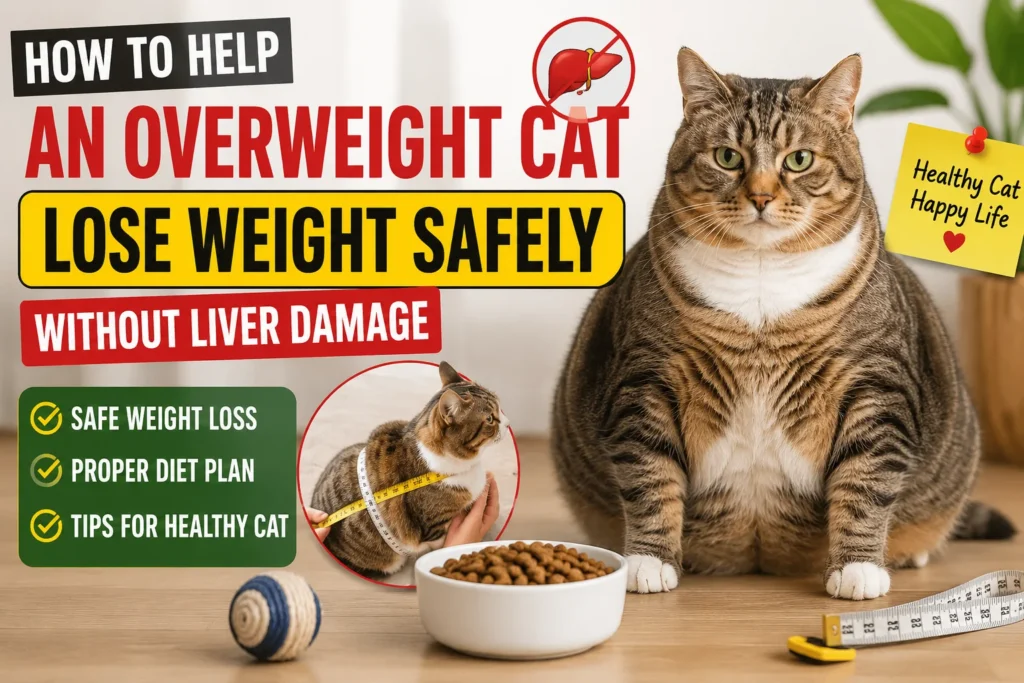
How to Help an Overweight Cat Lose Weight Safely Without Liver Damage?.Being a vet, few things affect the feline pet owners as universally as an overweight cat. Trust me, you’re not alone: in a 2022 survey by the Association for Pet Obesity Prevention, 61 percent of all cats were deemed overweight or obese . Among all of the potentially devastating – and frankly very sad – health conditions you can prevent your cat from experiencing, this is definitely one of the most rewarding that you CAN prevent.
But whereas for us, an overweight animal can go on a “crash diet”, in a cat, these severe diet restrictions can be very dangerous. This causes hepatic lipidosis or fatty liver disease in the liver that the body simply cannot process.
Step-By-Step Guide How to Help an Overweight Cat Lose Weight Safely Without Liver Damage?
1: Confirm the Diagnosis with the Body Condition Score (BCS)
First things first, we need a base line. As you can imagine, the vet doesn’t only use the scale to judge your dog, they use something called a BCS or Body Condition Score. It is often scaled from one to nine, with a score of five being the average.
There’s a quick ‘hands on’ test you can do at home:
- Feel the Ribs: With your hands on your cat’s sides, you should be able to feel the ribs beneath their body as if they were knuckles on the back of your hand. It’s easy to over-fat cats, so make sure you’re pressing more firmly than that if your cat’s ribs aren’t very apparent.
- Look from Above: Stand over your cat. There should be a visible waistline that curves inward behind the ribs. If the outline looks straight or bulges outward, that indicates excess fat .
- Look from the Side: There should be a slight abdominal tuck. A hanging “belly” or a large fat pad swinging beneath the abdomen indicates obesity .
A cat is generally considered obese when it is 20% or more above its ideal body weight .
2: Address the Immediate Danger of Hepatic Lipidosis
This is the most critical section of this guide. Cats must never be fasted or put on a starvation diet.
Why It Happens
In an overweight cat, you can pack large reserves of fat in. When a cat with huge reserves becomes anorexic (refuses to eat) for 24-48 hours or you cut too many calories too fast then the body freaks out. It releases large volumes of fat to utilize to provide energy which floods the liver with it. To help the body utilize these stores of fat, the liver needs certain proteins and amino acids which are in limited supply during starvation, so the fat gets caught in the liver cells and cell damage occurs.
The mechanics of safe weight loss focus on preventing this by ensuring the cat continues to eat a balanced diet rich in protein to support liver function throughout the process. Any weight loss plan must be approached with the primary goal of keeping the liver safe.
Also check: Can You Add Unflavoured Gelatin to Homemade Cat Food for Joint Health 2026?
3: The Safe Weight Loss Strategy
Cat weight loss success story, the mantra in cat weight loss for your cat is slow and steady . We suggest 0.5% to 2% of body weight loss per day(1%/month loss for three to four months is around 3% per month). Racing this process is a ticket to your closest veterinary ER.
Here is the formula for a safe plan:
1. Consult Your Veterinarian First
Talk to your Vet Now, don’t even buy the diet food until your cat has seen the vet. Many health conditions, such as diabetes, hyperthyroidism or osteoarthritis can cause a cat to gain weight. Your vet will ensure your cat doesn’t have health problems, a formula for calculating her ideal daily calorie count and a goal weight to reach.
2. Choose the Right Food: High Protein, Low Carb
When feeding an overweight cat, an overfeeding of protein and a deficit of carbohydrates is optimal to utilize stored body fat more efficiently.
- Preservation of lean muscle mass: Increasing the protein levels in an overweight cat’s diet (>40%ME) is critical in order to reduce the amount of lean muscle that is lost during the period when the cat’s metabolic energy requirement is less than its previous intake. Muscle tissue is the major calorie burning tissue. Its metabolizable protein and readily available amino acids assist the liver in safely metabolizing fat to prevent lipidosis.
- Canned Food is Preferred: Dry foods are often high in carbohydrates and calories. Canned foods typically have a lower carbohydrate profile, higher protein, and a higher water content, which helps your cat feel full while eating fewer calories . A typical low-carb canned food ranges from 165-190 kcal per 5.5 oz can, making portion control easier .
Important: Look for veterinary therapeutic diets (like Royal Canin Satiety Support or Hill’s Prescription Diet Metabolic). These are specifically formulated with high fiber to reduce begging and high protein to maintain muscle. For example, Royal Canin’s Satiety formula boasts 34% crude protein and high fiber levels to help 97% of cats lose weight within 3 months while maintaining muscle mass .
3. Master Portion Control
The most common cause of weight loss failure is inconsistent portioning.
- Determine Caloric Intake: The veterinarian will calculate the amount in calories each day to feed your cat (this can be as low as 130-150 kcal per day for a large cat) considering his ideal weight.
- Measure the food: Do not use a scoop; you must weight it in grams and to do that, the more practical the is the cheapest kitchen digital weighing scale, you can easily double or halving the meal if you estimate, as to it can easily result in feeding your cat twice or half the amount he actually needs.
- Stop Free-Feeding: Pick up the food bowl. You must switch to meal feeding. Divide the daily ration into at least 2-3 meals per day. This not only controls calories but also prevents the boredom and begging behavior associated with continuous grazing . Use a timer feeder if you are away during the day.
4. Control Begging with Satiety
They will insist on you feeding them. Fight this by switching to a diet high in fiber. Royal Canin Veterinary Diet Satiety Weight Management diets consist of high levels of natural fiber (around 14.6% crude fiber) to ensure cats feel full up in the time between meals, and clinical data shows that it reduces the begging behaviour of as many as 82% of cats as part of their weight loss plan.
5. Incorporate Exercise and Enrichment
I guess nutrition does 90% of the work, but working is pretty necessary for building muscle and revving up your metabolism.
- Interactive Play: Aim for two 10-15 minute play sessions daily. Use wand toys, laser pointers (but end the session on a toy they can “catch”), or motorized toys to stimulate their hunting instinct .
- Puzzle Feeders: Use puzzle feeders for their meals. This forces them to “work” for their food, burning a few extra calories and keeping them mentally stimulated .
- Environmental Enrichment: Install climbing trees or cat shelves to encourage jumping and climbing.
6. Monitor Progress Religiously
- Weekly weigh ins: Weigh your cat 1x a week on a baby scale or on the one used at your vet, on the same scale of course. Aim for 1% loss of body weight 1x per week. If the loss >2%, 10% calories more. Not losing -5 to-10%.
- Adjust Monthly: You must adjust the food amount as the cat loses weight. Smaller cats require fewer calories to continue losing. Check back with your vet monthly for adjustments.
FAQs
How can I tell if my cat is overweight or just “fluffy”?
Feel the ribs. If you cannot easily feel the ribs with a thin layer of fat over them, your cat is overweight. Stand above your cat; if they lack a waistline and look like a rectangle or have a bulging abdomen, they are likely carrying excess weight.
What is Hepatic Lipidosis and why is it a risk?
Hepatic Lipidosis (fatty liver disease) is a life-threatening condition where excess fat is mobilized into the liver faster than it can be processed. This happens when an overweight cat stops eating or loses weight too rapidly. It is a leading cause of liver failure in cats.
How fast is a safe speed for a cat to lose weight?
A safe and healthy rate is 0.5% to 1% of body weight per week (roughly 3-4% per month). For an average cat, this might look like just a few ounces a week. If they are losing weight faster than this, you risk triggering hepatic lipidosis.
What kind of food is best for helping an obese cat lose weight?
Canned food is generally preferred due to its high moisture content and low carbohydrate levels. Look for a high-protein, low-carbohydrate formula. The protein should be >40% of the metabolizable energy to preserve muscle mass, which is vital for a healthy metabolism.
Is dry kibble okay for weight loss?
It is generally not recommended for easy weight loss. Dry foods are calorie-dense and high in carbohydrates. While some prescription dry foods are high in fiber and protein, canned food is easier to portion control and has lower caloric density, allowing cats to eat a larger volume of food for fewer calories.
How do I stop my cat from begging all the time?
Switch to a high-fiber veterinary diet, which promotes a feeling of fullness. Divide the daily food portion into multiple small meals throughout the day (using a timed feeder if needed) to prevent long gaps where begging occurs.
My cat doesn’t like canned food. What should I do?
Transition slowly. Mix a tiny amount of the new canned food with the old food. Gradually increase the proportion over 7-10 days. You can also try different textures (pate vs. chunks in gravy) or warming the food slightly to enhance the aroma.
How many calories should a cat eat to lose weight?
This depends on the cat’s size and ideal weight. An average obese cat might need as little as 130-150 calories per day to start losing weight. Your veterinarian will calculate the precise number based on your cat’s Body Condition Score.
Should I increase exercise even if my cat is obese?
Yes, but carefully. Focus on short, gentle play sessions. Avoid activities that cause joint strain (like high jumps) initially. Wand toys and laser pointers are great for encouraging movement while allowing the cat to control the exertion.
Can my cat ever go back to free-feeding after reaching their goal?
Typically, no. Overweight cats often have a lower energy requirement than cats that have never been obese. Once the goal weight is reached, you must transition to a “maintenance” ration, which is usually about 30-40% more than the weight-loss ration, but still measured and portioned into meals to prevent weight regain.




One Comment