
Chronic Vomiting in Cats: Could it Be a Vitamin B12 Deficiency 2026?
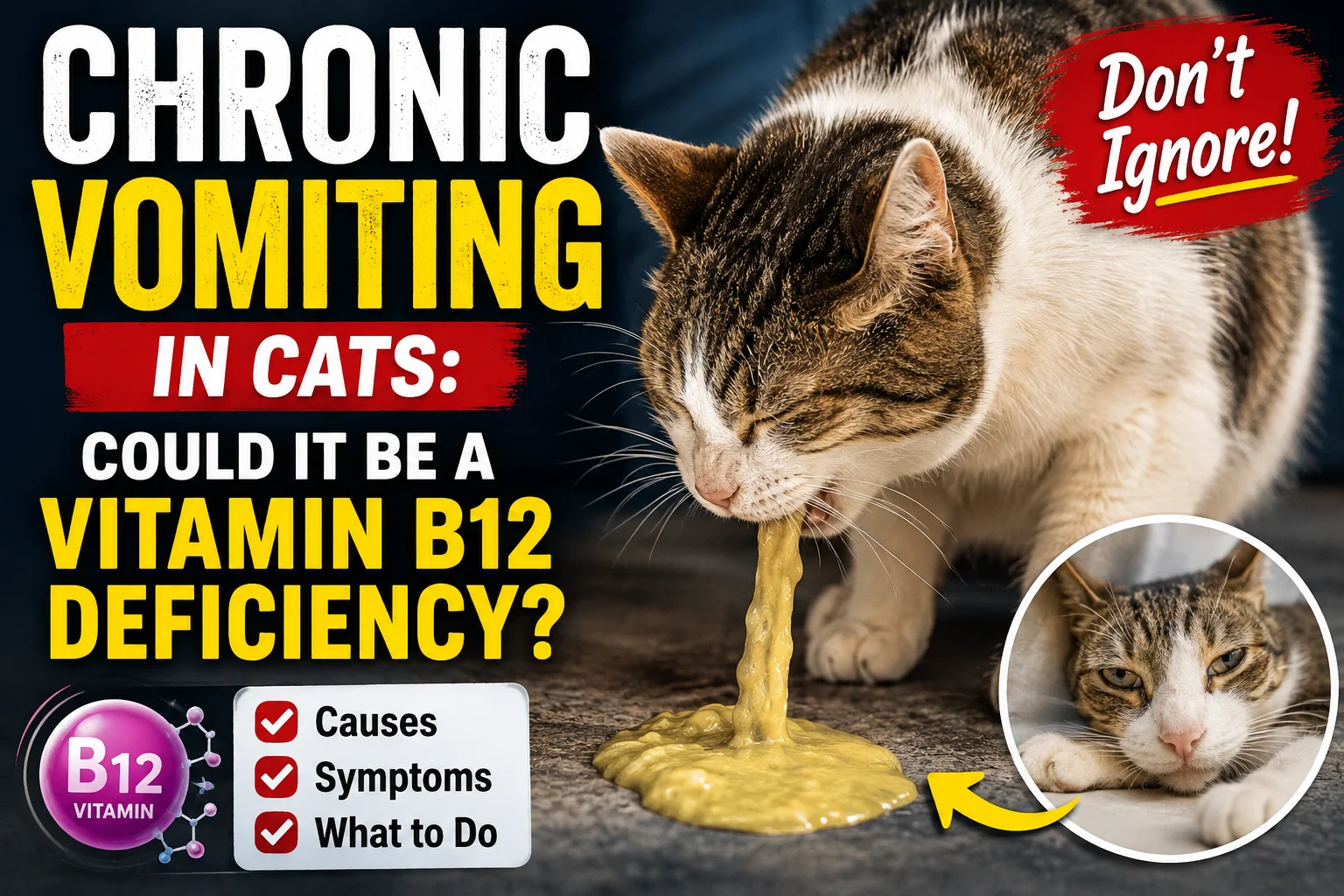
Chronic Vomiting in Cats: Could it Be a Vitamin B12 Deficiency?. In my line of work, perhaps the single most frequent and maddening presenting complaint that walk through the door is the vomiting cat. While the hairball once in a while could be of concern, the habitually vomiting cat-that is, vomiting more than a couple of times a month-is usually secondary to something else that can and will be treated.
A common but often missed consequence of chronic GI disease is cobalamin or Vitamin B12 deficiency. This deficiency can often become the driving factor behind declining health
The Prevalence Problem: How Common is B12 Deficiency?
When a cat has chronic vomiting, the odds are high that their B12 levels are depleted. A major 2025 study involving 216 cats referred to a veterinary hospital found that 35% of the cats assessed had hypocobalaminaemia (low B12) .
More importantly, when looking specifically at cats with chronic GI issues, the numbers are even more stark. A 2025 study found that chronic vomiting was present in 47% of cats diagnosed with low B12 . Another study found a 28.2% prevalence of B12 deficiency in cats with gastrointestinal signs . This is a significant portion of the patient population, meaning if your cat vomits frequently, there is a high chance that a B12 deficiency is either contributing to or resulting from the problem.
Why are Vomiting Cats at Risk?
Let’s consider the digestion as a means of trying to determine the relationship. Vitamin B12 is a large, intricate molecule; therefore, in order for it to be assimilated, it needs to combine with a specific protein called Intrinsic Factor. This is a substance that is secreted by the pancreas. The combination of vitamin B12 and Intrinsic Factor then gets absorbed in the distal end (lower) of the small intestine
If a cat suffers from chronic enteropathy (CE) a broad term for chronic intestinal inflammation or Exocrine Pancreatic Insufficiency (EPI) , several things happen:
- Malabsorption: The inflamed gut lining fails to absorb the B12 complex properly .
- Pancreatic Issues: If the pancreas isn’t producing enough Intrinsic Factor, B12 can’t bind effectively to be absorbed.
- Rapid Depletion: Cats have a relatively short half-life for B12, and they cannot store large amounts of it. In a healthy cat, serum B12 has a half-life of roughly 12-14 days, and in cats with GI disease, this is shortened to as little as 5 days . This means deficiency can develop very quickly.
Signs of Chronic Vomiting in Cats: Could it Be a Vitamin B12 Deficiency?
Because signs of deficiency are somewhat nebulous, overlapping often with signs and symptoms of underlying GI disease, the problem might be easily overlooked. They fall into three major categories:
1. Gastrointestinal Signs (The Cycle of Discomfort)
This is where the condition often begins and feeds back into itself.
- Chronic Vomiting: Persistent, often intermittent, vomiting of food or bile .
- Chronic Diarrhea: While less common than vomiting in low-B12 cats, it can still occur .
- Hyporexia (Loss of Appetite): A decreased interest in food, sometimes leading to anorexia .
2. Systemic Signs (Wasting and Weakness)
Over time the absence of B12 has had widespread effects on the cat.
- Loss of weight: This will be apparent despite in sometimes cases, a maintained appetite. It is the inability of the body to process and use nutrients that is at hand.
- Extreme lethargy and weakness: Cats become listless, spending far too much time asleep and unwilling to perform anything so strenuous as to get up to play. It’s more common for cats to also show reluctance to jump in to, or on, items.
- Failure to thrive: Particularly seen in kittens, where weight, general health and development are failing.
3. Neurological and Other Signs
Nervous system B12 is extremely important for normal function.
- Neurological problems: The neurological problems are much more prevalent in dogs and cats have weakness, uncoordination and behavioural changes.
- Anemia: There is a unique non regenerative anemia seen in the bone marrow because it cannot produce new red cells.
Also Check: How to Change a Wet Paw Bandage on a Dog Safely at Home 2026
The Underlying Causes: What’s Driving the Vomiting and Deficiency?
So once you learn that your cat is deficient in B12, it’s important to find out what is causing it. These deficiences are more often than not secondary and have an underlying cause, so what are the underlying cause. The study from 2025 states that these underlying causes most often are:
| Primary Diagnosis | Percentage of Low-B12 Cats |
|---|---|
| Chronic Enteropathy (CE) | 51% |
| High-Grade Lymphoma | 18% |
| Exocrine Pancreatic Insufficiency (EPI) | (Commonly co-occurring) |
- Chronic Enteropathy(CE): Most common cause of malabsorption . Intestine is inflammed throughout its wall, causing food not to be absorbed.
- Lymphoma: An intestinal tumor causing damage to the intestinal wall and loss of food absorption.
- Exocrine Pancreatic Insufficiency (EPI): Lack of production of enzymes by the pancreas and Intrinsic Factor for proper digestion and absorption of food.
Why It Matters: The Prognosis Factor
In an act of criminal negligence, the vomiting cat should not be treated for a B12 deficiency. That same 2025 paper to mention B12 deficiency, also mentioned one very startling fact. In the cats with hypocobalaminaemia, the median life was 274 days while the median life for B12 normal cats was 711 days, showing that “hypocobalaminaemia is a factor related to poorer survival time”. This is why early detection of B12 deficiency is critical.
How is B12 Deficiency Diagnosed and Treated?
Diagnosis
Your vet will probably run a blood panel to measure serum cobalamin when you seek treatment for chronic vomiting. Serum levels below 290 ng/l generally indicate an B12 deficiency. Your vet might also measure serum methylmalonic acid (MMA) since elevated levels of this metabolite are a good indicator of a functional B12 deficiency.
Treatment
The good news is that B12 deficiency is highly treatable. Recent studies have confirmed what we have long suspected: supplementation is highly effective.
Two main options exist:
- Injectable B12 (Cyanocobalamin or Hydroxocobalamin): The Traditional Answer. Typical protocol is a once weekly 250 g injection (subcutaneous or IM) X6 weeks and then every 30 d as a maintenance injection. Cats with enteropathy are quick to deplete cobalamin, therefore these injections may be needed long term and at different frequencies.
- Oral B12 (Cyanocobalamin): Though traditionally felt to be inferior, recent findings have caused this belief to be revised. A recent 2024 prospective study found a 250 g once daily oral administration was 100% effective in correcting serum B12 in patients with GC disease or EPI alongside other medical and dietary therapies.
Frequently Asked Questions (FAQs)
My cat vomits hairballs once a week. Should I worry about B12 deficiency?
A hairball once or twice a month is often normal. However, if your cat is vomiting more than twice a month, has hairballs that are accompanied by food or bile, or is showing weight loss or appetite changes, you should consult your vet. The data shows that “chronic vomiting” is a key sign.
What is the specific blood test for B12 deficiency in cats?
The test is called a serum cobalamin assay. It measures the amount of B12 in your cat’s blood. A value below 290 ng/L is generally considered deficient.
What is the best way to give a cat B12: pills or injections?
Both are effective. A 2024 study found that oral (250 µg once daily) and subcutaneous (250 µg weekly) supplementation were both 100% effective at normalizing B12 levels . The best choice depends on your cat’s temperament and your vet’s recommendation.
How long does it take to see improvement after B12 supplementation?
You may see improvement in clinical signs within a few weeks. Studies show that after 4 weeks of supplementation, cats show significant improvement in biochemical markers (like MMA) and an average body weight gain of 8.2%.
Can a cat get too much B12?
B12 is a water-soluble vitamin. Excess amounts are typically excreted in the urine and are not considered toxic. Treatment protocols often aim for supranormal serum concentrations to ensure enough is available for the body’s needs.
Why can’t my cat just store B12 like other nutrients?
Cats lack specific binding proteins (transcobalamin-1) that allow other species to store significant amounts of B12 for long periods. Their serum half-life is only about 11-14 days, which is why they become deficient so quickly when absorption is compromised.
My cat has been diagnosed with IBD. Is B12 deficiency inevitable?
Not inevitable, but very common. In one study, 51% of cats with chronic enteropathy (like IBD) had low B12 . This is why B12 testing is a standard part of diagnosing and managing IBD.
Is B12 deficiency a sign of cancer in cats?
It can be. While Chronic Enteropathy is the most common cause, 18% of cats with low B12 in a 2025 study were diagnosed with high-grade lymphoma . A B12 deficiency warrants a thorough diagnostic workup to rule out cancer.
What is the link between B12 deficiency and Exocrine Pancreatic Insufficiency (EPI)?
The pancreas produces the “Intrinsic Factor” that B12 needs to bind to for absorption. In EPI, the pancreas fails, leading to a lack of digestive enzymes and Intrinsic Factor, resulting in B12 deficiency.
What happens if a cat’s B12 deficiency is left untreated?
Untreated B12 deficiency can lead to worsening GI symptoms, continued weight loss, lethargy, and chronic anemia. More importantly, research shows it’s a negative prognostic factor associated with a significantly shorter survival time.


One Comment